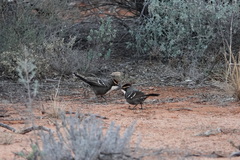
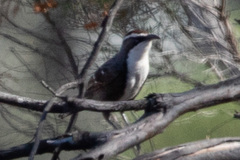

Chestnut-crowned Babbler

Chestnut-crowned Babbler

Pomatostomus ruficeps

Silhouette: Sheatherius · PhyloPic

LCLeast ConcernNTVUENCR Endemic
Daily sighting probability ~10% · With luck
at Hattah-Kulkyne National Park

In 3 days ~40% in a week ~70%

187 Verified sightings at Hattah-Kulkyne National Park From 2019 to 2026
187 In 1 park
September Best month
☀️ Diurnal When it's spotted

About the Chestnut-crowned Babbler

The chestnut-crowned babbler (Pomatostomus ruficeps) is a medium-sized bird that is endemic to arid and semi-arid areas of south-eastern Australia. It is a member of the family Pomatostomidae, which comprises five species of Australo-Papuan babblers. All are boisterous and highly social, living in groups of up to 23 individuals that forage and breed communally. Other names include red-capped babbler, rufous-crowned babbler and chatterer.

Chestnut-crowned babblers are dark, brown-grey birds with a white throat and breast, white-tipped tail and a long, black, down-curved bill. Wings are short and rounded and the tail is long with a rounded tip. Diagnostic features include two white wing bars and a rich, chestnut crown highlighted by long, white eyebrows. The birds have dark brown eyes and grey legs, while the wings, back and flanks are brown-grey to mottled dusky on the mantle. The white of the throat and breast is well-defined and narrower than that of the similar, white-browed babbler (Pomatostomus superciliosus). Combined, these characteristics give the chestnut-crowned babbler a rather unusual appearance.

At 21–23 cm and approximately 50 g in weight, the chestnut... Wikipedia →

Sounds

Call0:46

Australia · 2023

© Peter Boesman · XC860230 · CC BY-NC-ND 4.0

Alarm call0:20

Australia · 2016

© Marc Anderson · XC334911 · CC BY-NC-ND 4.0

Song?0:12

Australia · 2009

© Mark Harper · XC40763 · CC BY-NC-ND 2.5

Global Distribution

Parks Where Found

# Park Country Daily sighting probability
1 Hattah-Kulkyne National Park 🇦🇺 Australia
~10%

More parks will be added in future updates.

Before you go

What are the chances of seeing a Chestnut-crowned Babbler in Hattah-Kulkyne National Park?

With luck

About 10% of wildlife watchers report a Chestnut-crowned Babbler sighting in Hattah-Kulkyne National Park on a given day, based on 187 verified sightings from GBIF citizen-science data from 2019 to 2026. It is the 72nd most-seen of the 170 birds we can rate there. Over three days the chance rises to about 40%, and over a week to about 70%, if each day is a fresh chance.

When is the best time to see a Chestnut-crowned Babbler in Hattah-Kulkyne National Park?

February, July–September and November

In those months about 20% of wildlife watchers report a Chestnut-crowned Babbler in Hattah-Kulkyne National Park on a given day, against under 5% in May, the lowest month.

What time of day is best to see a Chestnut-crowned Babbler?

Between 9 am and noon

Across all the parks we cover, that three-hour window holds the most Chestnut-crowned Babbler sightings with a recorded time, and about 9 in 10 of them come between 6 am and 6 pm: it is a daytime animal.

Where else can you see a Chestnut-crowned Babbler?

Only Hattah-Kulkyne National Park, in our data

Hattah-Kulkyne National Park is the only park on Wallace's Line with enough records to rate Chestnut-crowned Babbler sightings: about 10% of wildlife watchers there report one on a given day.

Where does the Chestnut-crowned Babbler sighting chance come from?

GBIF citizen-science records

It is estimated from how often the Chestnut-crowned Babbler is recorded against all the birds logged in Hattah-Kulkyne National Park (187 verified sightings from 2019 to 2026), calibrated against known sighting rates. Figures are rounded to the nearest 10% because citizen-science data supports honest approximations, not decimals, and months with records from fewer than five people show "—". How it works.

← Back to Hattah-Kulkyne National Park