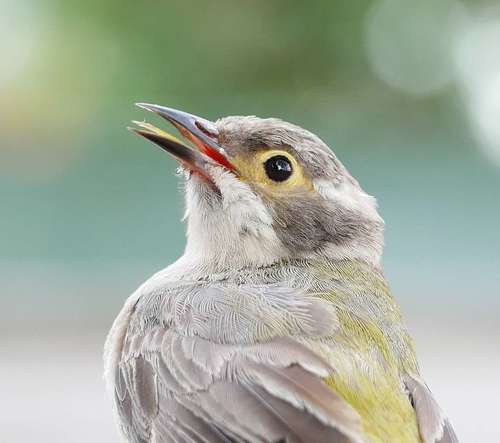
Yellow-plumed Honeyeater

Yellow-plumed Honeyeater

Ptilotula ornata

Silhouette: PhyloPic

LCLeast ConcernNTVUENCR Endemic
Daily sighting probability ~70% · Very likely
at Hattah-Kulkyne National Park

In 3 days >90%

1,384 Verified sightings at Hattah-Kulkyne National Park From 2019 to 2026
1,424 In all 2 parks
August Best month
☀️ Diurnal When it's spotted

About the Yellow-plumed Honeyeater

The yellow-plumed honeyeater (Ptilotula ornata) is a species of bird in the family Meliphagidae. It is endemic to Australia, where it inhabits temperate forests and Mediterranean-type shrubby vegetation. The yellow-plumed honeyeater was previously placed in the genus Lichenostomus, but was moved to Ptilotula after a molecular phylogenetic analysis, published in 2011, showed that the original genus was polyphyletic.

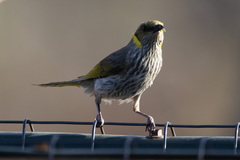
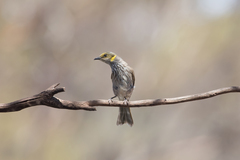
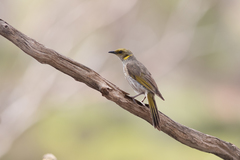
The yellow-plumed honeyeater is a medium-sized honeyeater with a relatively long, down-curved black bill, a dark face and a distinctive, upswept yellow neck plume. It has an olive-green head, with a faint yellow line under the dark eye, grey-green upperparts, and heavily streaked grey-brown underparts. Young birds have a yellow bill base and eye-ring.

Similar species include purple-gaped honeyeater, grey-fronted honeyeater and fuscous honeyeater. The song is a loud, clear, three-note chier wit chier, often performed before dawn, and by males during display flight. The yellow-plumed honeyeater is endemic to southern mainland Australia, from western New South Wales and Victoria, through South Australia to south-west Western Australia... Wikipedia →

Sounds

Dawn song0:41

Australia · 2024

© Khristos Nizamis · XC864745 · CC BY-NC-ND 4.0

Call0:14

Australia · 2023

© Peter Boesman · XC860140 · CC BY-NC-ND 4.0

Song0:41

Australia · 2019

© Christopher Watson · XC642680 · CC BY-NC-SA 4.0

Global Distribution

Parks Where Found

# Park Country Daily sighting probability
1 Hattah-Kulkyne National Park 🇦🇺 Australia
~70%
2 Flinders Ranges National Park 🇦🇺 Australia
~10%

Before you go

What are the chances of seeing a Yellow-plumed Honeyeater in Hattah-Kulkyne National Park?

Very likely

About 70% of wildlife watchers report a Yellow-plumed Honeyeater sighting in Hattah-Kulkyne National Park on a given day, based on 1,384 verified sightings from GBIF citizen-science data from 2019 to 2026. It is the 2nd most-seen of the 170 birds we can rate there. Over three days the chance rises to over 90%, if each day is a fresh chance.

When is the best time to see a Yellow-plumed Honeyeater in Hattah-Kulkyne National Park?

January and July–September

In those months about 80% of wildlife watchers report a Yellow-plumed Honeyeater in Hattah-Kulkyne National Park on a given day, against about 60% in March and June, the lowest months.

What time of day is best to see a Yellow-plumed Honeyeater?

Between 8 and 11 am

Across all the parks we cover, that three-hour window holds the most Yellow-plumed Honeyeater sightings with a recorded time, and about 9 in 10 of them come between 6 am and 6 pm: it is a daytime animal.

Is Hattah-Kulkyne National Park the best place to see a Yellow-plumed Honeyeater?

Yes

Of the 2 parks where we can rate Yellow-plumed Honeyeater sightings, Hattah-Kulkyne National Park has the highest daily chance: about 70%. Next come Flinders Ranges National Park (Australia, about 10%).

Where does the Yellow-plumed Honeyeater sighting chance come from?

GBIF citizen-science records

It is estimated from how often the Yellow-plumed Honeyeater is recorded against all the birds logged in Hattah-Kulkyne National Park (1,384 verified sightings from 2019 to 2026), calibrated against known sighting rates. Figures are rounded to the nearest 10% because citizen-science data supports honest approximations, not decimals, and months with records from fewer than five people show "—". How it works.

← Back to Hattah-Kulkyne National Park