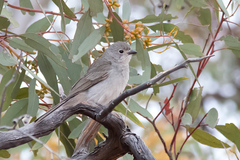
Gilbert's Whistler

Gilbert's Whistler

Pachycephala inornata

Silhouette: Sheatherius · PhyloPic

LCLeast ConcernNTVUENCR Endemic
Daily sighting probability ~10% · With luck
at Hattah-Kulkyne National Park

In 3 days ~30% in a week ~60%

165 Verified sightings at Hattah-Kulkyne National Park From 2019 to 2026
165 In 1 park
November Best month
☀️ Diurnal When it's spotted

About the Gilbert's Whistler

Gilbert's whistler (Pachycephala inornata) is a monotypic species of bird endemic to Australia, scattered in semi-arid zones of southern Australia. The family Pachycephalidae originated within the Australo-Papuan region. Together with the red-lored whistler and the olive whistler, Gilbert's whistler is basal to the genus Pachycephala – the typical whistlers. This old monotypic lineage represents a relictual form that was once more widespread.

John Gould, who first described this species in 1841, named it after Mr Gilbert who discovered the bird in Western Australia and collected specimens that he handed over to Gould. As for its scientific name – Pachycephala inornata – in Ancient Greek pachys and kephale respectively mean 'thick' and 'head'; several of the members of the genus Pachycephala are indeed called 'thickheads', and other common names for Gilbert's whistler include black-lored Gilbert thickhead, red-throated thickhead, Gilbert's thickhead, or simply thickhead. With inornatus meaning 'plain' in Latin, the second part of its binominal name is attributed to Gilbert's whistler's plumage, which is often described in the literature as being plain.

There are several... Wikipedia →

Sounds

Song0:28

Australia · 2021

© Marc Anderson · XC1002179 · CC BY-NC-ND 4.0

Call0:28

Australia · 2024

© Khristos Nizamis · XC932106 · CC BY-NC-ND 4.0

Song0:50

Australia · 2015

© Frank Lambert · XC407766 · CC BY-NC-ND 4.0

Global Distribution

Parks Where Found

# Park Country Daily sighting probability
1 Hattah-Kulkyne National Park 🇦🇺 Australia
~10%

More parks will be added in future updates.

Before you go

What are the chances of seeing a Gilbert's Whistler in Hattah-Kulkyne National Park?

With luck

About 10% of wildlife watchers report a Gilbert's Whistler sighting in Hattah-Kulkyne National Park on a given day, based on 165 verified sightings from GBIF citizen-science data from 2019 to 2026. It is the 78th most-seen of the 170 birds we can rate there. Over three days the chance rises to about 30%, and over a week to about 60%, if each day is a fresh chance.

When is the best time to see a Gilbert's Whistler in Hattah-Kulkyne National Park?

July and October–November

In those months about 20% of wildlife watchers report a Gilbert's Whistler in Hattah-Kulkyne National Park on a given day, against under 5% in June, the lowest month.

What time of day is best to see a Gilbert's Whistler?

Between 9 am and noon

Across all the parks we cover, that three-hour window holds the most Gilbert's Whistler sightings with a recorded time, and about 9 in 10 of them come between 6 am and 6 pm: it is a daytime animal.

Where else can you see a Gilbert's Whistler?

Only Hattah-Kulkyne National Park, in our data

Hattah-Kulkyne National Park is the only park on Wallace's Line with enough records to rate Gilbert's Whistler sightings: about 10% of wildlife watchers there report one on a given day.

Where does the Gilbert's Whistler sighting chance come from?

GBIF citizen-science records

It is estimated from how often the Gilbert's Whistler is recorded against all the birds logged in Hattah-Kulkyne National Park (165 verified sightings from 2019 to 2026), calibrated against known sighting rates. Figures are rounded to the nearest 10% because citizen-science data supports honest approximations, not decimals, and months with records from fewer than five people show "—". How it works.

← Back to Hattah-Kulkyne National Park