Tibetan Partridge

Tibetan Partridge

Perdix hodgsoniae

Silhouette: PhyloPic

LCLeast ConcernNTVUENCR
Daily sighting probability ~30% · Possible
at Hemis National Park

In 3 days ~60% in a week ~90%

40 Verified sightings at Hemis National Park From 2019 to 2026
40 In 1 park
March Best month
☀️ Diurnal When it's spotted

About the Tibetan Partridge

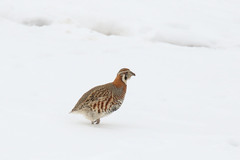
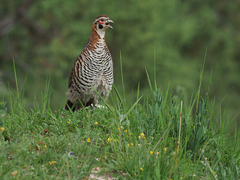
The Tibetan partridge (Perdix hodgsoniae) is a gamebird in the pheasant family Phasianidae of the order Galliformes. They are found widely across the Tibetan Plateau and have some variations in plumage across populations. They forage on the ground in the sparsely vegetated high altitude regions, moving in pairs during the summer and in larger groups during the non-breeding season. Neither males nor females have spurs on their legs.

Somewhat different in appearance from the other Perdix species such as the grey and Daurian partridges this 28–31 cm long partridge has the brown back, blackish belly patch and chestnut flanks of its relatives, but has a striking black and white face pattern, which contrasts with the rufous collar.

The forehead, broad supercilium, face and throat are white. A broad black stripe runs down the face from below the eyes and it has a broad chestnut hind neck collar. The upper parts are buff, barred with rufous and black. The other tail-feathers are chestnut, tipped with white. The lower plumage is pale buff closely barred with black, with broad chestnut bars on the flanks. The male has a black belly patch which is barred in the female. The female... Wikipedia →

Sounds

Uncertain0:16

Bhutan · 2021

© Truly Bhutan · XC683989 · CC BY-NC-SA 4.0

Song0:14

China · 2019

© Peter Boesman · XC491366 · CC BY-NC-ND 4.0

Call0:49

China · 2010

© Zeidler Roland · XC399543 · CC BY-NC-SA 4.0

Global Distribution

Parks Where Found

# Park Country Daily sighting probability
1 Hemis National Park 🇮🇳 India
~30%

More parks will be added in future updates.

Before you go

What are the chances of seeing a Tibetan Partridge in Hemis National Park?

Possible

About 30% of wildlife watchers report a Tibetan Partridge sighting in Hemis National Park on a given day, based on 40 verified sightings from GBIF citizen-science data from 2019 to 2026. It is the 17th most-seen of the 52 birds we can rate there. Over three days the chance rises to about 60%, and over a week to about 90%, if each day is a fresh chance.

When is the best time to see a Tibetan Partridge in Hemis National Park?

March

In that month about 60% of wildlife watchers report a Tibetan Partridge in Hemis National Park on a given day, against about 10% in May, July and December, the lowest months. January has too few records to rate.

What time of day is best to see a Tibetan Partridge?

Between 9 am and noon

Across all the parks we cover, that three-hour window holds the most Tibetan Partridge sightings with a recorded time, and about 8 in 10 of them come between 6 am and 6 pm: it is a daytime animal.

Where else can you see a Tibetan Partridge?

Only Hemis National Park, in our data

Hemis National Park is the only park on Wallace's Line with enough records to rate Tibetan Partridge sightings: about 30% of wildlife watchers there report one on a given day.

Which relatives of the Tibetan Partridge live in Hemis National Park?

Same family: Phasianidae

The closest relatives of the Tibetan Partridge that you can see in Hemis National Park (family Phasianidae, Pheasants, Grouse, and Allies) are Chukar (about 70%) and Himalayan Snowcock (about 30%), with each one's daily chance of a sighting.

Where does the Tibetan Partridge sighting chance come from?

GBIF citizen-science records

It is estimated from how often the Tibetan Partridge is recorded against all the birds logged in Hemis National Park (40 verified sightings from 2019 to 2026), calibrated against known sighting rates. Figures are rounded to the nearest 10% because citizen-science data supports honest approximations, not decimals, and months with records from fewer than five people show "—". How it works.

← Back to Hemis National Park