Lesson's Seedeater

Lesson's Seedeater

Sporophila bouvronides

Silhouette: Sheatherius · PhyloPic

LCLeast ConcernNTVUENCR
Daily sighting probability <5% · Rare
at Henri Pittier National Park

In 3 days <5% in a week ~10%

7 Verified sightings at Henri Pittier National Park From 2019 to 2026
13 In all 2 parks
June Best month
☀️ Diurnal When it's spotted

About the Lesson's Seedeater

Lesson's seedeater (Sporophila bouvronides) is a bird species in the family Thraupidae (formerly in Emberizidae). It is found in Bolivia, Brazil, Colombia, Ecuador, French Guiana, Guyana, Panama, Peru, Suriname, Trinidad and Tobago, and Venezuela. There is also a report in 2021 of Lesson's seedeater from Quebec. Its natural habitats are subtropical or tropical moist shrubland and heavily degraded former forest.

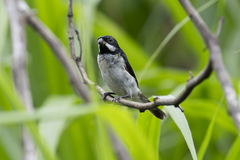
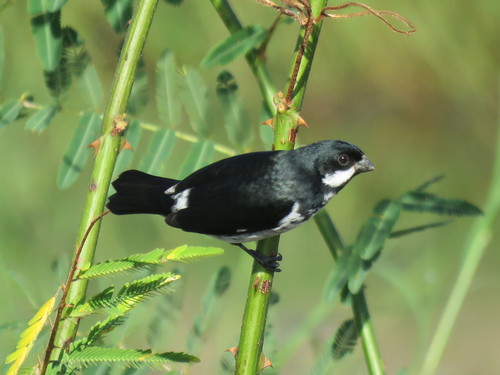
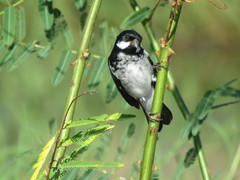
The Lesson's seedeater is a small, sparrow-like bird around 10.5–11 cm (4.1–4.3 in). Males have a mostly black head with large white whisker mark; females have an olive-brown back and pale yellowish belly with a dull yellow bill.

Most of Lesson's seedeaters are found in open marshlands and disturbed habitats with long grass, especially near water and are at times seen in flocks, feeding on grass seeds. Their natural habitats are subtropical or tropical moist shrubland and heavily degraded former forest. Most are similar to lined seedeaters, but male Lesson's lacks a white stripe on its crown while females of the two species are identical and not safely identified unless accompanied by males. Females are best told from other seedeaters... Wikipedia →
Sounds

Song0:06

Brazil · 2024

© JAYRSON ARAUJO DE OLIVEIRA · XC939914 · CC BY-NC-SA 4.0

Aberrant1:03

Venezuela · 2020

© Francisco contreras · XC581868 · CC BY-NC-SA 4.0

Recording0:42

Colombia · 1996

© Mauricio Álvarez-Rebolledo (Colección de Sonidos Ambientales - Instituto Humboldt) · XC524079 · CC BY-NC-SA 4.0

Global Distribution

Parks Where Found

# Park Country Daily sighting probability
1 Henri Pittier National Park 🇻🇪 Venezuela
<5%
2 Amacayacu National Natural Park 🇨🇴 Colombia
<5%

Cities Where Found

# City Country Daily sighting probability
1 Valencia 🇻🇪 Venezuela
<5%
2 Caracas 🇻🇪 Venezuela
<5%

Before you go

What are the chances of seeing a Lesson's Seedeater in Henri Pittier National Park?

Rare

Under 5% of wildlife watchers report a Lesson's Seedeater sighting in Henri Pittier National Park on a given day, based on 7 verified sightings from GBIF citizen-science data from 2019 to 2026. It is the 345th most-seen of the 358 birds we can rate there. Over three days the chance rises to under 5%, and over a week to about 10%, if each day is a fresh chance.

When is the best time to see a Lesson's Seedeater in Henri Pittier National Park?

Any time of year

In every month with enough records, under 5% of wildlife watchers report a Lesson's Seedeater in Henri Pittier National Park on a given day, so our monthly data shows no clear season.

What time of day is best to see a Lesson's Seedeater?

Between 6 and 9 am

Across all the parks we cover, that three-hour window holds the most Lesson's Seedeater sightings with a recorded time, and about 8 in 10 of them come between 6 am and 6 pm: it is a daytime animal.

Is Henri Pittier National Park the best place to see a Lesson's Seedeater?

Yes

Of the 2 parks where we can rate Lesson's Seedeater sightings, Henri Pittier National Park has the highest daily chance: under 5%. Next come Amacayacu National Natural Park (Colombia, under 5%).

Which relatives of the Lesson's Seedeater live in Henri Pittier National Park?

Same genus: Sporophila

The closest relatives of the Lesson's Seedeater that you can see in Henri Pittier National Park (genus Sporophila, Typical Seedeaters and Seed-Finches) are Yellow-bellied Seedeater (about 10%) and Gray Seedeater (about 10%), with each one's daily chance of a sighting.

Where does the Lesson's Seedeater sighting chance come from?

GBIF citizen-science records

It is estimated from how often the Lesson's Seedeater is recorded against all the birds logged in Henri Pittier National Park (7 verified sightings from 2019 to 2026), calibrated against known sighting rates. Figures are rounded to the nearest 10% because citizen-science data supports honest approximations, not decimals, and months with records from fewer than five people show "—". How it works.

← Back to Henri Pittier National Park