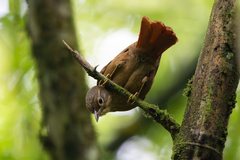
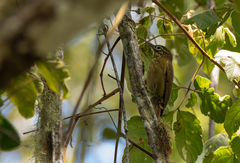

Montane Foliage-gleaner

Montane Foliage-gleaner

Anabacerthia striaticollis

Silhouette: Sheatherius · PhyloPic

LCLeast ConcernNTVUENCR
Daily sighting probability ~20% · Possible
at Henri Pittier National Park

In 3 days ~50% in a week ~80%

102 Verified sightings at Henri Pittier National Park From 2019 to 2026
777 In all 4 parks
April Best month
☀️ Diurnal When it's spotted

About the Montane Foliage-gleaner

The montane foliage-gleaner (Anabacerthia striaticollis) is a species of bird in the Furnariinae subfamily of the ovenbird family Furnariidae. It is found in Bolivia, Colombia, Ecuador, Peru, and Venezuela. The montane foliage-gleaner has these six subspecies:

Some authors in the early twentieth century treated the montane foliage-gleaner and the scaly-throated foliage-gleaner (A. variegaticeps) as conspecific. Later they were considered to form a superspecies but by the early 2000s it was determined that they are not even sister species.

The montane foliage-gleaner is 16 to 17 cm (6.3 to 6.7 in) long and weighs 22 to 28 g (0.78 to 0.99 oz). It is a medium-sized furnariid with a wedge-shaped bill. The sexes have the same plumage. Adults of the nominate subspecies A. s. striaticollis have a mostly dark brown face with some pale flecks and a wide pale tawny-buff eyering that extends as a streak behind the eye. Their crown, nape, and upper... Wikipedia →

Sounds

Dawn song0:23

Ecuador · 2024

© Manuel Sánchez-Nivicela · XC1161980 · CC BY-NC-ND 4.0

Call0:04

Peru · 2016

© Dries Van de Loock · XC682230 · CC BY-NC-SA 4.0

Uncertain0:05

Colombia · 2020

© Jerome Fischer · XC584827 · CC BY-NC-SA 4.0

Global Distribution

Parks Where Found

# Park Country Daily sighting probability
1 Henri Pittier National Park 🇻🇪 Venezuela
~20%
2 Podocarpus National Park 🇪🇨 Ecuador
~10%
3 Los Nevados National Natural Park 🇨🇴 Colombia
~10%
4 Farallones de Cali National Natural Park 🇨🇴 Colombia
<5%

Before you go

What are the chances of seeing a Montane Foliage-gleaner in Henri Pittier National Park?

Possible

About 20% of wildlife watchers report a Montane Foliage-gleaner sighting in Henri Pittier National Park on a given day, based on 102 verified sightings from GBIF citizen-science data from 2019 to 2026. It is the 65th most-seen of the 358 birds we can rate there. Over three days the chance rises to about 50%, and over a week to about 80%, if each day is a fresh chance.

When is the best time to see a Montane Foliage-gleaner in Henri Pittier National Park?

April

In that month about 40% of wildlife watchers report a Montane Foliage-gleaner in Henri Pittier National Park on a given day, against about 10% in January–March, June–July and November, the lowest months.

What time of day is best to see a Montane Foliage-gleaner?

Between 9 am and noon

Across all the parks we cover, that three-hour window holds the most Montane Foliage-gleaner sightings with a recorded time, and about 9 in 10 of them come between 6 am and 6 pm: it is a daytime animal.

Is Henri Pittier National Park the best place to see a Montane Foliage-gleaner?

Yes

Of the 4 parks where we can rate Montane Foliage-gleaner sightings, Henri Pittier National Park has the highest daily chance: about 20%. Next come Podocarpus National Park (Ecuador, about 10%) and Los Nevados National Natural Park (Colombia, about 10%).

Which relatives of the Montane Foliage-gleaner live in Henri Pittier National Park?

Same family: Furnariidae

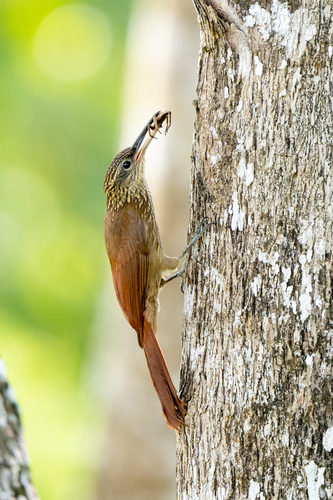
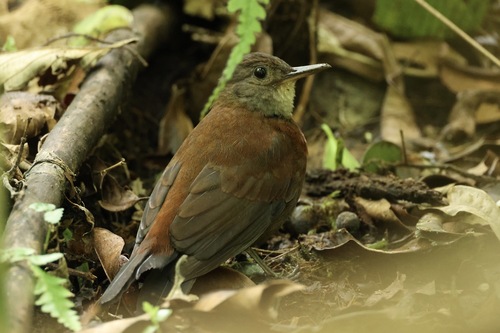
The closest relatives of the Montane Foliage-gleaner that you can see in Henri Pittier National Park (family Furnariidae, Ovenbirds and Woodcreepers) are Cocoa Woodcreeper (about 30%), Plain-brown Woodcreeper (about 20%) and Olivaceous Woodcreeper (about 20%), with each one's daily chance of a sighting.

Where does the Montane Foliage-gleaner sighting chance come from?

GBIF citizen-science records

It is estimated from how often the Montane Foliage-gleaner is recorded against all the birds logged in Henri Pittier National Park (102 verified sightings from 2019 to 2026), calibrated against known sighting rates. Figures are rounded to the nearest 10% because citizen-science data supports honest approximations, not decimals, and months with records from fewer than five people show "—". How it works.

← Back to Henri Pittier National Park