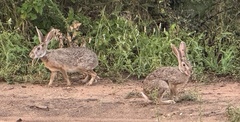
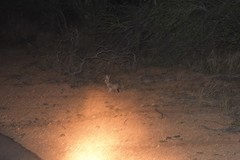
Scrub Hare

Scrub Hare

Lepus saxatilis

Silhouette: Jan A. Venter, Herbert H. T. Prins, David A. Balfour & Rob Slotow (vectorized by T. Michael Keesey) · PhyloPic

LCLeast ConcernNTVUENCR
Daily sighting probability ~10% · With luck
at Hluhluwe-Imfolozi Park

In 3 days ~30% in a week ~50%

6 Verified sightings at Hluhluwe-Imfolozi Park From 2019 to 2026
155 In all 7 parks
January Best month
🌅 Crepuscular When it's spotted

About the Scrub Hare

The Cape scrub hare (Lepus saxatilis) (Afrikaans: ribbokhaas) is a species of hare found in South Africa and Namibia. Although it is listed as a least concern species, the population has been declining and is expected to decline by 20% over the next 100 years, according to a 2004 report.

Frédéric Cuvier wrote the first description of the Cape scrub hare in 1823. It was one of two hares (species in the genus Lepus) known at the time to inhabit South Africa, with the other being the Cape hare (L. capensis). Its taxonomy has since been confused, especially in the region south of the Cunene and Zambezi rivers. The species referred to as the Cape scrub hare is considered to have diverged from the African savanna hare (L. victoriae) fairly recently, but further clarifications on the species' taxonomy requires study of other African hare populations. Populations of Cape hare found in Sardinia and coastal North Africa were found to be more closely related to the Cape scrub hare and the European hare (L. europaeus) than they were to other Cape hares in southern Africa based on phylogenetic analysis. These related hares have been considered part of the Mediterranean hare species... Wikipedia →

Global Distribution

Parks Where Found

# Park Country Daily sighting probability
1 De Hoop Nature Reserve 🇿🇦 South Africa
~30%
2 Addo Elephant National Park 🇿🇦 South Africa
~20%
3 uMkhuze Game Reserve 🇿🇦 South Africa
~20%
4 Kruger National Park 🇿🇦 South Africa
~10%
5 Pilanesberg National Park 🇿🇦 South Africa
~10%
6 Hluhluwe-Imfolozi Park 🇿🇦 South Africa
~10%
7 Etosha National Park 🇳🇦 Namibia
~10%

Cities Where Found

# City Country Daily sighting probability
1 Pretoria 🇿🇦 South Africa
~10%
2 Johannesburg 🇿🇦 South Africa
~10%

Before you go

What are the chances of seeing a Scrub Hare in Hluhluwe-Imfolozi Park?

With luck

About 10% of wildlife watchers report a Scrub Hare sighting in Hluhluwe-Imfolozi Park on a given day, based on 6 verified sightings from GBIF citizen-science data from 2019 to 2026. It is the 25th most-seen of the 29 mammals we can rate there. Over three days the chance rises to about 30%, and over a week to about 50%, if each day is a fresh chance.

When is the best time to see a Scrub Hare in Hluhluwe-Imfolozi Park?

January–February and October

In those months about 20% of wildlife watchers report a Scrub Hare in Hluhluwe-Imfolozi Park on a given day, against under 5% in April–September and November–December, the lowest months. Those are among Hluhluwe-Imfolozi Park's wettest months, with about 110 mm of rain a month against 15 mm in June.

What time of day is best to see a Scrub Hare?

Between 5 and 8 pm

Across all the parks we cover, that three-hour window holds the most Scrub Hare sightings with a recorded time, and about half of them come between 6 pm and 6 am: it is most active around dawn and dusk.

Is Hluhluwe-Imfolozi Park the best place to see a Scrub Hare?

6th of 7

Of the 7 parks where we can rate Scrub Hare sightings, Hluhluwe-Imfolozi Park ranks 6th at about 10%. The best odds are in De Hoop Nature Reserve (South Africa, about 30%), Addo Elephant National Park (South Africa, about 20%) and uMkhuze Game Reserve (South Africa, about 20%).

Where does the Scrub Hare sighting chance come from?

GBIF citizen-science records

It is estimated from how often the Scrub Hare is recorded against all the mammals logged in Hluhluwe-Imfolozi Park (6 verified sightings from 2019 to 2026), calibrated against known sighting rates. Figures are rounded to the nearest 10% because citizen-science data supports honest approximations, not decimals, and months with records from fewer than five people show "—". How it works.

← Back to Hluhluwe-Imfolozi Park