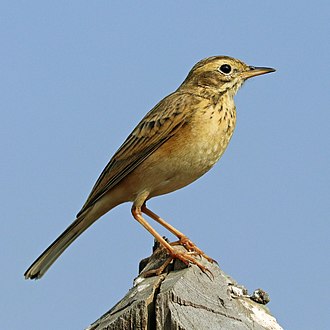
Orange-billed Babbler

Orange-billed Babbler

Turdoides rufescens

Silhouette: Jiekun He · PhyloPic

Daily sighting probability ~10% · With luck
at Horton Plains National Park

In 3 days ~40% in a week ~60%

66 Verified sightings at Horton Plains National Park From 2019 to 2026
1,387 In all 2 parks
July Best month
🌅 Crepuscular When it's spotted

About the Orange-billed Babbler

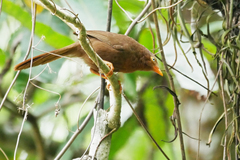
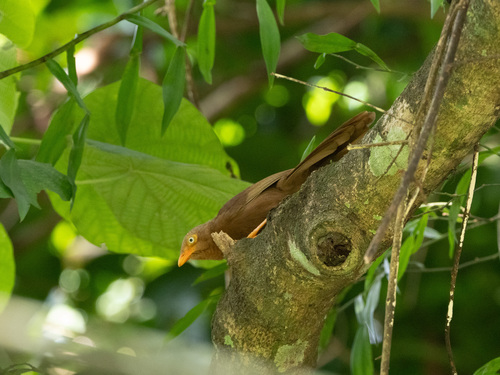
The orange-billed babbler (Argya rufescens), also known as Ceylon rufous babbler or Sri Lankan rufous babbler, is a member of the family Leiothrichidae. The orange-billed babbler is a resident breeding bird endemic to Sri Lanka. In the past, it was considered to be a race of jungle babbler, Argya striata.

Its habitat is rainforest, and it is rarely seen away from deep jungle. This species, like most babblers, is not migratory, and has short rounded wings and a weak flight. Although its habitat is under threat, it occurs in all the forests of the wet zone, and is quite common at prime sites like Kitulgala and Sinharaja. It builds its nest in a tree, concealed in dense masses of foliage. The normal clutch is two or three deep greenish blue eggs.

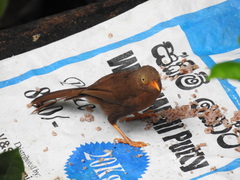
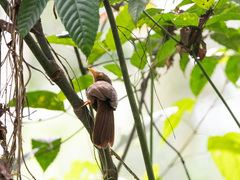
These birds are plain orange brown below, and have a slightly darker shade above. The crown and nape are grey, and the bill is orange. The orange-billed babbler lives in flocks of seven to ten or more. It is a noisy bird, and the presence of a flock may generally be known at some distance by the continual chattering, squeaking and chirping produced by its members. It is usually the first sign that a mixed-species feeding flock, so characteristic of Asian wet forests, is in the vicinity. It feeds mainly on insects, but also eats jungle berries. Wikipedia →
Global Distribution

Parks Where Found

# Park Country Daily sighting probability
1 Sinharaja Forest Reserve 🇱🇰 Sri Lanka
~70%
2 Horton Plains National Park 🇱🇰 Sri Lanka
~10%

Before you go

What are the chances of seeing an Orange-billed Babbler in Horton Plains National Park?

With luck

About 10% of wildlife watchers report an Orange-billed Babbler sighting in Horton Plains National Park on a given day, based on 66 verified sightings from GBIF citizen-science data from 2019 to 2026. It is the 44th most-seen of the 102 birds we can rate there. Over three days the chance rises to about 40%, and over a week to about 60%, if each day is a fresh chance.

When is the best time to see an Orange-billed Babbler in Horton Plains National Park?

July

In that month about 30% of wildlife watchers report an Orange-billed Babbler in Horton Plains National Park on a given day, against under 5% in April, the lowest month.

What time of day is best to see an Orange-billed Babbler?

Between 2 and 5 am

Across all the parks we cover, that three-hour window holds the most Orange-billed Babbler sightings with a recorded time, and about 6 in 10 of them come between 6 am and 6 pm: it is most active around dawn and dusk.

Is Horton Plains National Park the best place to see an Orange-billed Babbler?

2nd of 2

Of the 2 parks where we can rate Orange-billed Babbler sightings, Horton Plains National Park ranks 2nd at about 10%. The best odds are in Sinharaja Forest Reserve (Sri Lanka, about 70%).

Where does the Orange-billed Babbler sighting chance come from?

GBIF citizen-science records

It is estimated from how often the Orange-billed Babbler is recorded against all the birds logged in Horton Plains National Park (66 verified sightings from 2019 to 2026), calibrated against known sighting rates. Figures are rounded to the nearest 10% because citizen-science data supports honest approximations, not decimals, and months with records from fewer than five people show "—". How it works.

← Back to Horton Plains National Park