Cinereous Harrier

Cinereous Harrier

Circus cinereus

Silhouette: Shyamal · PhyloPic

LCLeast ConcernNTVUENCR
Daily sighting probability ~10% · With luck
at Iberá National Park

In 3 days ~20% in a week ~40%

117 Verified sightings at Iberá National Park From 2019 to 2026
888 In all 5 parks
December Best month
☀️ Diurnal When it's spotted

About the Cinereous Harrier

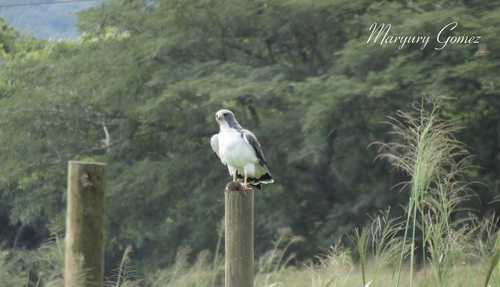
The cinereous harrier (Circus cinereus) is a South American bird of prey of the harrier family. Its breeding range extends from the Tierra del Fuego through Argentina and Chile to Bolivia, Paraguay, Peru and southern Brazil; and across the Andes north to Colombia. The bird's population is declining but due to its large range is not considered vulnerable. The term cinereous, deriving from the Latin word for ashy, describes its colouration.

The male's plumage is dark grey above with black wingtips and a white rump. The underparts are pale grey, with a rufous streaked belly. The female's plumage is brown above, with a white rump, and cream coloured underneath, with a streaked belly similar to the males. The female is larger than the male with an average size of 46 cm (18 in) compared to the male's 40 cm (16 in). The wingspan is 90–115 cm (35–45 in). Since the 44.5 cm (17.5 in) tail comprises about 56% of this raptor's total length, this species ties with the long-tailed hawk as the raptor with the longest tail relative to its body size.

This bird can be found in different open habitats, ranging from lowland marshes to the Andean Altiplano at... Wikipedia →

Sounds

Call0:50

Argentina

© Bernabe Lopez-Lanus · XC48405 · CC BY-NC-SA 3.0

Flight call0:16

Argentina · 2003

© Frank Lambert · XC34965 · CC BY-NC-ND 4.0

Call0:34

Argentina · 2004

© Carlos Ferrari · XC52892 · CC BY-NC-ND 2.5

Global Distribution

Parks Where Found

# Park Country Daily sighting probability
1 Torres del Paine National Park 🇨🇱 Chile
~40%
2 Península Valdés 🇦🇷 Argentina
~10%
3 Iberá National Park 🇦🇷 Argentina
~10%
4 Nahuel Huapi National Park 🇦🇷 Argentina
~10%
5 Tierra del Fuego National Park 🇦🇷 Argentina
<5%

Cities Where Found

# City Country Daily sighting probability
1 Santiago 🇨🇱 Chile
<5%
2 Cordoba 🇦🇷 Argentina
<5%

Before you go

What are the chances of seeing a Cinereous Harrier in Iberá National Park?

With luck

About 10% of wildlife watchers report a Cinereous Harrier sighting in Iberá National Park on a given day, based on 117 verified sightings from GBIF citizen-science data from 2019 to 2026. It is the 172nd most-seen of the 284 birds we can rate there. Over three days the chance rises to about 20%, and over a week to about 40%, if each day is a fresh chance.

When is the best time to see a Cinereous Harrier in Iberá National Park?

February–March, May–June, August and November–December

In those months about 10% of wildlife watchers report a Cinereous Harrier in Iberá National Park on a given day, against under 5% in January, April, July and September–October, the lowest months.

What time of day is best to see a Cinereous Harrier?

Between 4 and 7 pm

Across all the parks we cover, that three-hour window holds the most Cinereous Harrier sightings with a recorded time, and about 8 in 10 of them come between 6 am and 6 pm: it is a daytime animal.

Is Iberá National Park the best place to see a Cinereous Harrier?

3rd of 5

Of the 5 parks where we can rate Cinereous Harrier sightings, Iberá National Park ranks 3rd at about 10%. The best odds are in Torres del Paine National Park (Chile, about 40%) and Península Valdés (Argentina, about 10%).

Where does the Cinereous Harrier sighting chance come from?

GBIF citizen-science records

It is estimated from how often the Cinereous Harrier is recorded against all the birds logged in Iberá National Park (117 verified sightings from 2019 to 2026), calibrated against known sighting rates. Figures are rounded to the nearest 10% because citizen-science data supports honest approximations, not decimals, and months with records from fewer than five people show "—". How it works.

← Back to Iberá National Park