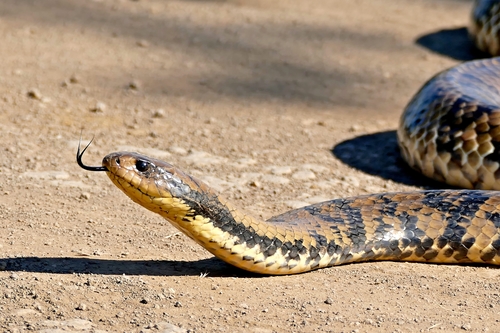
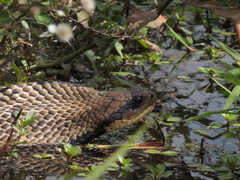
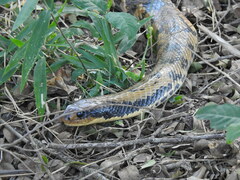
About the False Water Cobra
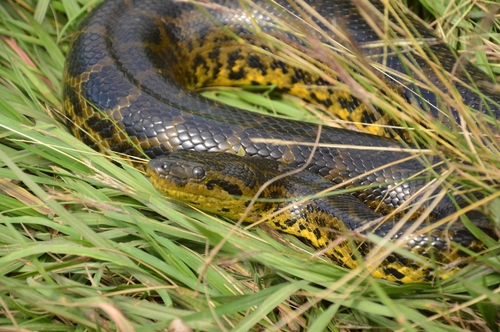
Hydrodynastes gigas is a New World species of large dipsadine snake endemic to South America. Aglyphous snake with enlarged posterior maxillary teeth, not grooved, associated with Duvernoy's gland secretions. endemic to South America. Common names include false cobra, false water cobra, South American water cobra, and Brazilian smooth snake. It is also sometimes referred to as boipevaçu, ñacaniná or yacaniná, from the Guarani ñakanina ('alert head'), mboi-peba, surucucu-do-pantanal, and víbora ladradora ('barking snake').
A mildly venomous species, the false water cobra is so named because when it is threatened, it "hoods" as a true cobra (genus Naja) does. Unlike a true cobra, however, it does not rear up, but instead remains horizontal. No valid subspecies are currently recognized.
H. gigas is a large dipsadine snake that may exceed 3 m (10 ft) in length, with most adult specimens reaching about 2 m (7 ft) in length. The average weight is around 1.6 kg (3.5 lb), but some mature specimens can weigh up to 4.5 kg (9.9 lb). This species exhibits sexual dimorphism, with males being much smaller than females. The common name false water cobra is an allusion to its ability... Wikipedia →