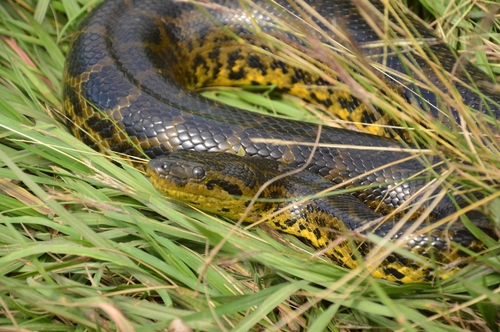
Wagler's Snake

Wagler's Snake

Xenodon merremii

Silhouette: Alex Slavenko · PhyloPic

LCLeast ConcernNTVUENCR
Daily sighting probability ~10% · With luck
at Iberá National Park

In 3 days ~30% in a week ~60%

5 Verified sightings at Iberá National Park From 2019 to 2026
10 In all 2 parks
December Best month
☀️ Diurnal When it's spotted

About the Wagler's Snake

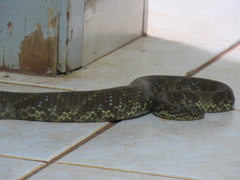
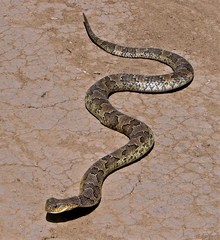
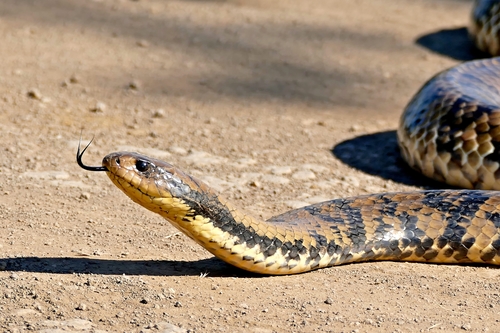
Xenodon merremii, also known commonly as Wagler's snake, is a species of snake in the subfamily Dipsadinae of the family Colubridae. The species is endemic to South America and is widespread in the eastern half of the continent.

Xenodon merremii occurs in Venezuela, Guyana, Suriname, French Guiana, Brazil, Bolivia, Paraguay, Uruguay, and northern Argentina. The preferred natural habitat of Xenodon merremii is open areas of savanna and shrubland, at elevations from sea level to 2,000 m (6,600 ft), but it is also common in disturbed habitats.

The specific name, merremii, is in honor of German herpetologist Blasius Merrem. Adults of Xenodon merremii are usually 1 m (39 in) or less in total length (tail included). Its color pattern is very variable. Some "red phase" specimens are a uniform reddish tan. Other specimens are pale brown dorsally, with broad dark-brown crossbands, which are edged with black, and are narrower or interrupted in the middle. The latter color pattern resembles that of the venomous snake Bothrops alternatus.

Xenodon merremii preys on insects, frogs, toads, lizards, and sometimes snakes... Wikipedia →

Global Distribution

Parks Where Found

# Park Country Daily sighting probability
1 Serra da Canastra National Park 🇧🇷 Brazil
~20%
2 Iberá National Park 🇦🇷 Argentina
~10%

Cities Where Found

# City Country Daily sighting probability
1 Cochabamba 🇧🇴 Bolivia
~20%

Before you go

What are the chances of seeing a Wagler's Snake in Iberá National Park?

With luck

About 10% of wildlife watchers report a Wagler's Snake sighting in Iberá National Park on a given day, based on 5 verified sightings from GBIF citizen-science data from 2019 to 2026. It is the 8th most-seen of the 10 reptiles we can rate there. Over three days the chance rises to about 30%, and over a week to about 60%, if each day is a fresh chance.

When is the best time to see a Wagler's Snake in Iberá National Park?

December

In that month about 30% of wildlife watchers report a Wagler's Snake in Iberá National Park on a given day, against under 5% in January–February, April–August and November, the lowest months.

What time of day is best to see a Wagler's Snake?

Between 1 and 4 pm

Across all the parks we cover, that three-hour window holds the most Wagler's Snake sightings with a recorded time, and about 9 in 10 of them come between 6 am and 6 pm: it is a daytime animal.

Is Iberá National Park the best place to see a Wagler's Snake?

2nd of 2

Of the 2 parks where we can rate Wagler's Snake sightings, Iberá National Park ranks 2nd at about 10%. The best odds are in Serra da Canastra National Park (Brazil, about 20%).

Which relatives of the Wagler's Snake live in Iberá National Park?

Same family: Colubridae

The closest relatives of the Wagler's Snake that you can see in Iberá National Park (family Colubridae, Colubrid Snakes) are False Water Cobra (about 20%) and Jaeger's Ground Snake (about 10%), with each one's daily chance of a sighting.

Where does the Wagler's Snake sighting chance come from?

GBIF citizen-science records

It is estimated from how often the Wagler's Snake is recorded against all the reptiles logged in Iberá National Park (5 verified sightings from 2019 to 2026), calibrated against known sighting rates. Figures are rounded to the nearest 10% because citizen-science data supports honest approximations, not decimals, and months with records from fewer than five people show "—". How it works.

← Back to Iberá National Park