Yellow Cardinal

Yellow Cardinal

Gubernatrix cristata

Silhouette: Sheatherius · PhyloPic

LCNTVUENEndangeredCR
Daily sighting probability ~30% · Possible
at Iberá National Park

In 3 days ~70% in a week ~90%

52 Verified sightings at Iberá National Park From 2019 to 2026
52 In 1 park
September Best month
☀️ Diurnal When it's spotted

About the Yellow Cardinal

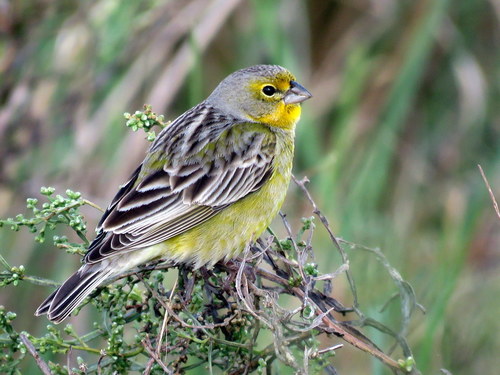
The yellow cardinal (Gubernatrix cristata) is a species of South American bird in the tanager family Thraupidae. It is the only member of its genus, Gubernatrix. The yellow cardinal was formally described in 1817 by the French ornithologist Louis Pierre Vieillot under the binomial name Coccothraustes cristata. The specific epithet is from the Latin cristatus meaning "crested" or "plumed". The species was moved to its own genus Gubernatrix by the French naturalist René Lesson in 1837. The genus name is the Latin word for "governess".

Although traditionally included in the family Emberizidae, a study published in 2011 found that the species was more closely related to the tanager family Thraupidae. A comprehensive study of the tanagers published in 2014 found strong support for a sister relationship between the yellow cardinal and the diuca finch. The two species are known to hybridize. The yellow cardinal is monotypic and no subspecies are recognised.

It is found in Argentina, Brazil, Paraguay, and Uruguay. Its natural habitats are dry savanna, temperate shrubland, subtropical or tropical moist shrubland, and temperate grassland. It is threatened... Wikipedia →

Sounds

Call1:24

Argentina · 2022

© Guilherme Melo Becher · XC770825 · CC BY-NC-SA 4.0

Song0:13

Brazil · 2021

© JAYRSON ARAUJO DE OLIVEIRA · XC686599 · CC BY-NC-SA 4.0

Song0:20

Argentina · 2020

© Guillermo Treboux · XC589790 · CC BY-NC-SA 4.0

Global Distribution

Parks Where Found

# Park Country Daily sighting probability
1 Iberá National Park 🇦🇷 Argentina
~30%

More parks will be added in future updates.

Zoos & Centres Where Found

# Zoo / Centre Country
1 Basel Zoo 🇨🇭 Switzerland In captivity
2 Ostrava Zoo 🇨🇿 Czechia In captivity
3 Gramado Zoo 🇧🇷 Brazil In captivity
4 Attica Zoological Park 🇬🇷 Greece In captivity
5 The Juana's Market 🇦🇷 Argentina In captivity

Before you go

What are the chances of seeing a Yellow Cardinal in Iberá National Park?

Possible

About 30% of wildlife watchers report a Yellow Cardinal sighting in Iberá National Park on a given day, based on 52 verified sightings from GBIF citizen-science data from 2019 to 2026. It is the 60th most-seen of the 284 birds we can rate there. Over three days the chance rises to about 70%, and over a week to about 90%, if each day is a fresh chance.

When is the best time to see a Yellow Cardinal in Iberá National Park?

September

In that month about 50% of wildlife watchers report a Yellow Cardinal in Iberá National Park on a given day, against about 20% in April and December–January, the lowest months.

What time of day is best to see a Yellow Cardinal?

Between 10 am and 1 pm

Across all the parks we cover, that three-hour window holds the most Yellow Cardinal sightings with a recorded time, and about 9 in 10 of them come between 6 am and 6 pm: it is a daytime animal.

Where else can you see a Yellow Cardinal?

Only Iberá National Park, in our data

Iberá National Park is the only park on Wallace's Line with enough records to rate Yellow Cardinal sightings: about 30% of wildlife watchers there report one on a given day.

Which relatives of the Yellow Cardinal live in Iberá National Park?

Same family: Thraupidae

The closest relatives of the Yellow Cardinal that you can see in Iberá National Park (family Thraupidae, Tanagers and Allies) are Brazilian Cardinal (about 70%), Great Pampa-Finch (about 60%) and Sayaca Tanager (about 60%), with each one's daily chance of a sighting.

Where does the Yellow Cardinal sighting chance come from?

GBIF citizen-science records

It is estimated from how often the Yellow Cardinal is recorded against all the birds logged in Iberá National Park (52 verified sightings from 2019 to 2026), calibrated against known sighting rates. Figures are rounded to the nearest 10% because citizen-science data supports honest approximations, not decimals, and months with records from fewer than five people show "—". How it works.

← Back to Iberá National Park