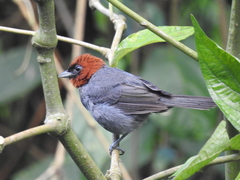
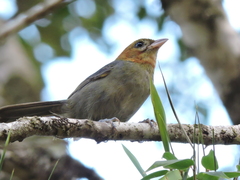

Chestnut-headed Tanager

Chestnut-headed Tanager

Thlypopsis pyrrhocoma

Silhouette: Sheatherius · PhyloPic

LCLeast ConcernNTVUENCR
Daily sighting probability <5% · Rare
at Iguazú National Park

In 3 days ~10% in a week ~20%

141 Verified sightings at Iguazú National Park From 2019 to 2026
257 In all 3 parks
July Best month
☀️ Diurnal When it's spotted

About the Chestnut-headed Tanager

The chestnut-headed tanager (Thlypopsis pyrrhocoma) is a species of bird in the tanager family Thraupidae. It is found in the Atlantic Forest of southeast Brazil, eastern Paraguay, and far northeastern Argentina. It was formerly the only member of the genus Pyrrhocoma but is now placed in Thlypopsis.

The chestnut-headed tanager was formally described in 1844 by the English naturalist Hugh Edwin Strickland under the binomial name Tachyphonus ruficeps. The species was subsequently placed in the monotypic genus Pyrrhocoma by the German ornithologist Jean Cabanis. A molecular phylogenetic study published in 2014 found that the chestnut-headed tanager was embedded in a clade containing members of the genus Thlypopsis. The genera were therefore merged but as Thlypopsis already contained the rust-and-yellow tanager as Thlypopsis ruficeps d'Orbigny & Lafresnaye, 1837, a new specific epithet pyrrhocoma was coined for the chestnut-headed tanager, using the earlier generic name "to communicate past taxonomic connections". The name comes from the Ancient Greek purrhokomēs meaning "red-haired". The species is monotypic: no subspecies are recognised.

The chestnut... Wikipedia →

Sounds

Recording0:33

Paraguay · 2024

© Guillermo Menéndez (gmmv80) · XC950478 · CC BY-NC-SA 4.0

Call0:48

Argentina · 2023

© Luis Seko Pradier · XC897998 · CC BY-NC-SA 4.0

Song0:35

Argentina · 2017

© Aves del NEA · XC380624 · CC BY-NC-SA 4.0

Global Distribution

Parks Where Found

# Park Country Daily sighting probability
1 Iguazú National Park 🇦🇷 Argentina
<5%
2 Serra dos Órgãos National Park 🇧🇷 Brazil
<5%
3 Iguaçu National Park 🇧🇷 Brazil
<5%

Cities Where Found

# City Country Daily sighting probability
1 Curitiba 🇧🇷 Brazil
<5%

Zoos & Centres Where Found

# Zoo / Centre Country
1 Philadelphia Zoo 🇺🇸 United States In captivity

Before you go

What are the chances of seeing a Chestnut-headed Tanager in Iguazú National Park?

Rare

Under 5% of wildlife watchers report a Chestnut-headed Tanager sighting in Iguazú National Park on a given day, based on 141 verified sightings from GBIF citizen-science data from 2019 to 2026. It is the 194th most-seen of the 343 birds we can rate there. Over three days the chance rises to about 10%, and over a week to about 20%, if each day is a fresh chance.

When is the best time to see a Chestnut-headed Tanager in Iguazú National Park?

July and August

In those months about 10% of wildlife watchers report a Chestnut-headed Tanager in Iguazú National Park on a given day, against under 5% in September to June, the lowest months.

What time of day is best to see a Chestnut-headed Tanager?

Between 8 and 11 am

Across all the parks we cover, that three-hour window holds the most Chestnut-headed Tanager sightings with a recorded time, and about 8 in 10 of them come between 6 am and 6 pm: it is a daytime animal.

Is Iguazú National Park the best place to see a Chestnut-headed Tanager?

Yes

Of the 3 parks where we can rate Chestnut-headed Tanager sightings, Iguazú National Park has the highest daily chance: under 5%. Next come Serra dos Órgãos National Park (Brazil, under 5%) and Iguaçu National Park (Brazil, under 5%).

Which relatives of the Chestnut-headed Tanager live in Iguazú National Park?

Same family: Thraupidae

The closest relatives of the Chestnut-headed Tanager that you can see in Iguazú National Park (family Thraupidae, Tanagers and Allies) are Sayaca Tanager (about 40%), Blue Dacnis (about 40%) and Saffron Finch (about 30%), with each one's daily chance of a sighting.

Where does the Chestnut-headed Tanager sighting chance come from?

GBIF citizen-science records

It is estimated from how often the Chestnut-headed Tanager is recorded against all the birds logged in Iguazú National Park (141 verified sightings from 2019 to 2026), calibrated against known sighting rates. Figures are rounded to the nearest 10% because citizen-science data supports honest approximations, not decimals, and months with records from fewer than five people show "—". How it works.

← Back to Iguazú National Park