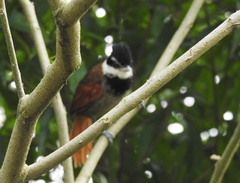
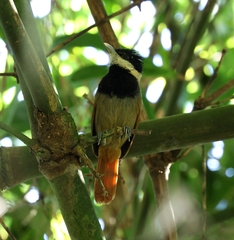
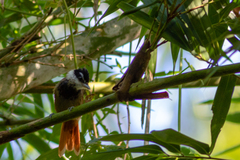

White-bearded Antshrike

White-bearded Antshrike

Biatas nigropectus

Silhouette: Sheatherius · PhyloPic

LCNTVUVulnerableENCR
Daily sighting probability <5% · Rare
at Iguazú National Park

In 3 days <5%

9 Verified sightings at Iguazú National Park From 2019 to 2026
28 In all 2 parks
January Best month
☀️ Diurnal When it's spotted

About the White-bearded Antshrike

The white-bearded antshrike (Biatas nigropectus) is a Vulnerable species of bird in subfamily Thamnophilinae of family Thamnophilidae, the "typical antbirds". It is endemic to Argentina and Brazil. The white-bearded antshrike was described by the French ornithologist Frédéric de Lafresnaye in 1850 and given the binomial name Anabates nigro-pectus. It was later moved to its current genus Biatas that was erected by the German ornithologists Jean Cabanis and Ferdinand Heine in 1860 with the white-bearded antshrike as the type species. The name of the genus is from the Ancient Greek biatas meaning "tyrant". Its specific epithet combines the Latin words niger meaning "black" and pectus meaning "breast".

The white-bearded antshrike is the only member of its genus and has no subspecies. The white-bearded antshrike is 17 to 18 cm (6.7 to 7.1 in) long. This species exhibits some sexual dimorphism, and both sexes have a crest. Adult males have a black forehead, crown, and upper nape. The black of the crown extends down to the lores and eyes except for a faint white line through the eye. Their chin and the rest of their face are white that becomes... Wikipedia →

Sounds

Song0:46

Brazil · 2022

© GABRIEL LEITE · XC733275 · CC BY-NC-SA 4.0

Call0:30

Brazil · 2002

© Jeremy Minns · XC244449 · CC BY-NC-SA 4.0

Song1:25

Brazil · 2021

© Ricardo Gagliardi · XC623212 · CC BY-NC-SA 4.0

Global Distribution

Parks Where Found

# Park Country Daily sighting probability
1 Itatiaia National Park 🇧🇷 Brazil
<5%
2 Iguazú National Park 🇦🇷 Argentina
<5%

Before you go

What are the chances of seeing a White-bearded Antshrike in Iguazú National Park?

Rare

Under 5% of wildlife watchers report a White-bearded Antshrike sighting in Iguazú National Park on a given day, based on 9 verified sightings from GBIF citizen-science data from 2019 to 2026. It is the 325th most-seen of the 343 birds we can rate there. Over three days the chance rises to under 5%, if each day is a fresh chance.

When is the best time to see a White-bearded Antshrike in Iguazú National Park?

Any time of year

In every month with enough records, under 5% of wildlife watchers report a White-bearded Antshrike in Iguazú National Park on a given day, so our monthly data shows no clear season.

What time of day is best to see a White-bearded Antshrike?

Between 8 and 11 am

Across all the parks we cover, that three-hour window holds the most White-bearded Antshrike sightings with a recorded time, and about 9 in 10 of them come between 6 am and 6 pm: it is a daytime animal.

Is Iguazú National Park the best place to see a White-bearded Antshrike?

Among the best

Of the 2 parks where we can rate White-bearded Antshrike sightings, Iguazú National Park ranks 2nd at under 5%, level with the leaders once rounded. The best odds are in Itatiaia National Park (Brazil, under 5%).

Which relatives of the White-bearded Antshrike live in Iguazú National Park?

Same family: Thamnophilidae

The closest relatives of the White-bearded Antshrike that you can see in Iguazú National Park (family Thamnophilidae, Typical Antbirds) are Rufous-margined Antwren (about 40%), Spot-backed Antshrike (about 30%) and Plain Antvireo (about 30%), with each one's daily chance of a sighting.

Where does the White-bearded Antshrike sighting chance come from?

GBIF citizen-science records

It is estimated from how often the White-bearded Antshrike is recorded against all the birds logged in Iguazú National Park (9 verified sightings from 2019 to 2026), calibrated against known sighting rates. Figures are rounded to the nearest 10% because citizen-science data supports honest approximations, not decimals, and months with records from fewer than five people show "—". How it works.

← Back to Iguazú National Park