
Pel's Fishing-Owl

Pel's Fishing-Owl

Scotopelia peli

Silhouette: Ferran Sayol · PhyloPic

LCLeast ConcernNTVUENCR
Daily sighting probability <5% · Rare
at iSimangaliso Wetland Park

In 3 days <5%

6 Verified sightings at iSimangaliso Wetland Park From 2019 to 2026
349 In all 11 parks
December Best month
🌅 Crepuscular When it's spotted

About the Pel's Fishing-Owl

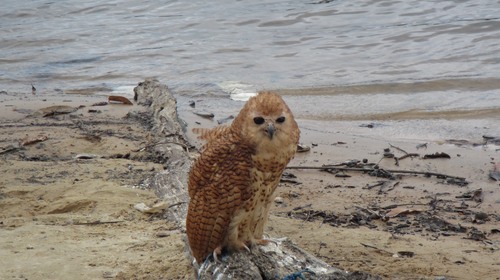
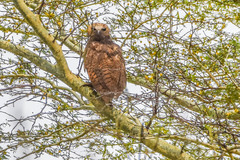
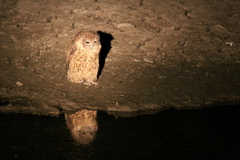
Pel's fishing owl (Scotopelia peli) is a large species of owl in the family Strigidae, found in Africa. It lives near rivers and lakes, and feeds nocturnally on fish and frogs snatched from the surface of lakes and rivers. The species prefers slow-moving rivers with large, overhanging trees to roost in and forage from. It nests in hollows and the forks of large trees. Even though two eggs are laid, often only one chick is raised.

The species' common and specific name honours Hendrik Severinus Pel, who was governor of the Dutch Gold Coast (now Ghana) from 1840 till 1850. Pel's fishing owl is one of the largest owl species in the world. Among the world's owls, it ranks as the fifth-heaviest on average, the seventh-longest in length and measured wing chord, and fourth-longest in mean wingspan, although not all large species have had measured wingspans. It measures 51–63 cm (20–25 in) in length, spans around 153 cm (60 in) across the wings and weighs up to at least 2.35 kg (5.2 lb). One male was found to weigh 1.72 kg (3.8 lb) and four females averaged 2.19 kg (4.8 lb), it may outrival the snowy owl (only around 4% lighter on average in six datasets) as... Wikipedia →

Sounds

Duet0:53

Botswana · 2026

© Francesco Barberini · XC1177930 · CC BY-NC-SA 4.0

Song1:22

Zambia · 2023

© Marc Anderson · XC830775 · CC BY-NC-ND 4.0

Call0:09

Zambia · 2021

© Dries Van de Loock · XC745579 · CC BY-NC-SA 4.0

Global Distribution

Parks Where Found

# Park Country Daily sighting probability
1 Meru National Park 🇰🇪 Kenya
~10%
2 Liwonde National Park 🇲🇼 Malawi
~10%
3 uMkhuze Game Reserve 🇿🇦 South Africa
~10%
4 Niokolo-Koba National Park 🇸🇳 Senegal
~10%
5 Kafue National Park 🇿🇲 Zambia
~10%
6 South Luangwa National Park 🇿🇲 Zambia
~10%
7 Gonarezhou National Park 🇿🇼 Zimbabwe
<5%
8 Moremi Game Reserve 🇧🇼 Botswana
<5%
9 Chobe National Park 🇧🇼 Botswana
<5%
10 iSimangaliso Wetland Park 🇿🇦 South Africa
<5%
11 Kruger National Park 🇿🇦 South Africa
<5%

Zoos & Centres Where Found

# Zoo / Centre Country
1 Prague Zoo 🇨🇿 Czechia In captivity
2 Rákosův pavilon 🇨🇿 Czechia In captivity
3 Velemlokárium 🇨🇿 Czechia In captivity

Before you go

What are the chances of seeing a Pel's Fishing-Owl in iSimangaliso Wetland Park?

Rare

Under 5% of wildlife watchers report a Pel's Fishing-Owl sighting in iSimangaliso Wetland Park on a given day, based on 6 verified sightings from GBIF citizen-science data from 2019 to 2026. It is the 341st most-seen of the 351 birds we can rate there. Over three days the chance rises to under 5%, if each day is a fresh chance.

When is the best time to see a Pel's Fishing-Owl in iSimangaliso Wetland Park?

Any time of year

In every month with enough records, under 5% of wildlife watchers report a Pel's Fishing-Owl in iSimangaliso Wetland Park on a given day, so our monthly data shows no clear season.

What time of day is best to see a Pel's Fishing-Owl?

Between 7 and 10 am

Across all the parks we cover, that three-hour window holds the most Pel's Fishing-Owl sightings with a recorded time, and about 7 in 10 of them come between 6 am and 6 pm: it is most active around dawn and dusk.

Is iSimangaliso Wetland Park the best place to see a Pel's Fishing-Owl?

10th of 11

Of the 11 parks where we can rate Pel's Fishing-Owl sightings, iSimangaliso Wetland Park ranks 10th at under 5%. The best odds are in Meru National Park (Kenya, about 10%), Liwonde National Park (Malawi, about 10%) and uMkhuze Game Reserve (South Africa, about 10%).

Where does the Pel's Fishing-Owl sighting chance come from?

GBIF citizen-science records

It is estimated from how often the Pel's Fishing-Owl is recorded against all the birds logged in iSimangaliso Wetland Park (6 verified sightings from 2019 to 2026), calibrated against known sighting rates. Figures are rounded to the nearest 10% because citizen-science data supports honest approximations, not decimals, and months with records from fewer than five people show "—". How it works.

← Back to iSimangaliso Wetland Park