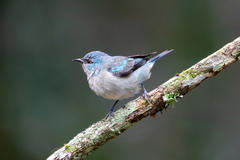
Black-legged Dacnis

Black-legged Dacnis

Dacnis nigripes

Silhouette: Sheatherius · PhyloPic

LCNTNear ThreatenedVUENCR Endemic
Daily sighting probability <5% · Rare
at Itatiaia National Park

In 3 days ~10% in a week ~20%

44 Verified sightings at Itatiaia National Park From 2019 to 2026
44 In 1 park
May Best month
☀️ Diurnal When it's spotted

About the Black-legged Dacnis

The black-legged dacnis (Dacnis nigripes) is a Near Threatened species of bird in the family Thraupidae, the tanagers and allies. It is endemic to Brazil. The black-legged dacnis was formally described in 1856 with its current binomial Dacnis nigripes. The species is monotypic.

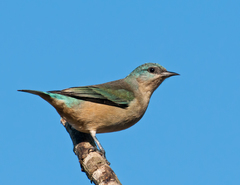
The black-legged dacnis is 11 cm (4.3 in) long and weighs about 14 g (0.49 oz). The species is sexually dimorphic. Adult males have a mostly greenish blue to turquoise head and nape with a small black mask from the lores to behind the eye. Their mantle has a triangular black patch. Their scapulars are turquoise and their back, rump, and uppertail coverts light turquoise to greenish blue. Their wing's coverts and inner flight feathers are black with blue edges and the outer flight feathers are black. Their tail is black with blue edges on the outermost pair of feathers. They have a thin black throat patch and light turquoise underparts. Adult females have a mostly brownish olive head with a greenish to turquoise blue wash on the forecrown and cheeks. Their upperparts are also mostly brownish olive, with a greenish to turquoise blue wash on the scapulars and rump... Wikipedia →

Sounds

Call0:42

Brazil · 2019

© Marco Cruz · XC486223 · CC BY-NC-ND 4.0

Call0:22

Brazil · 2017

© Guilherme Willrich · XC384172 · CC BY-NC-SA 4.0

Call0:09

Brazil · 2011

© Leonardo Pimentel · XC82523 · CC BY-NC-ND 2.5

Global Distribution

Parks Where Found

# Park Country Daily sighting probability
1 Itatiaia National Park 🇧🇷 Brazil
<5%

More parks will be added in future updates.

Before you go

What are the chances of seeing a Black-legged Dacnis in Itatiaia National Park?

Rare

Under 5% of wildlife watchers report a Black-legged Dacnis sighting in Itatiaia National Park on a given day, based on 44 verified sightings from GBIF citizen-science data from 2019 to 2026. It is the 229th most-seen of the 352 birds we can rate there. Over three days the chance rises to about 10%, and over a week to about 20%, if each day is a fresh chance.

When is the best time to see a Black-legged Dacnis in Itatiaia National Park?

May and September

In those months about 10% of wildlife watchers report a Black-legged Dacnis in Itatiaia National Park on a given day, against under 5% in June–August and October–April, the lowest months. Those are among Itatiaia National Park's driest months, with about 90 mm of rain a month against 330 mm in December.

What time of day is best to see a Black-legged Dacnis?

Between 10 am and 1 pm

Across all the parks we cover, that three-hour window holds the most Black-legged Dacnis sightings with a recorded time, and about 8 in 10 of them come between 6 am and 6 pm: it is a daytime animal.

Where else can you see a Black-legged Dacnis?

Only Itatiaia National Park, in our data

Itatiaia National Park is the only park on Wallace's Line with enough records to rate Black-legged Dacnis sightings: under 5% of wildlife watchers there report one on a given day.

Where does the Black-legged Dacnis sighting chance come from?

GBIF citizen-science records

It is estimated from how often the Black-legged Dacnis is recorded against all the birds logged in Itatiaia National Park (44 verified sightings from 2019 to 2026), calibrated against known sighting rates. Figures are rounded to the nearest 10% because citizen-science data supports honest approximations, not decimals, and months with records from fewer than five people show "—". How it works.

← Back to Itatiaia National Park