Pileated Parrot

Pileated Parrot

Pionopsitta pileata

Silhouette: Sheatherius · PhyloPic

LCLeast ConcernNTVUENCR
Daily sighting probability ~10% · With luck
at Itatiaia National Park

In 3 days ~20% in a week ~40%

116 Verified sightings at Itatiaia National Park From 2019 to 2026
127 In all 2 parks
March Best month
☀️ Diurnal When it's spotted

About the Pileated Parrot

The South American pileated parrot (Pionopsitta pileata) is a species of bird in subfamily Arinae of the family Psittacidae, the African and New World parrots. It is found in Argentina, Brazil, and Paraguay. It was formerly known as the red-capped parrot, easily leading to confusion with the Australian Purpureicephalus spurius that bears that English name.

The pileated parrot is the only member of genus Pionopsitta and has no subspecies. However, what are now the seven species in genus Pyrilia were for a long period included in Pionopsitta. A local name for the pileated parrot in Brazilian Portuguese is "cuiú cuiú".

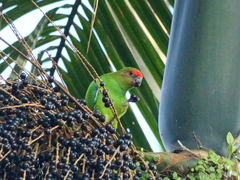
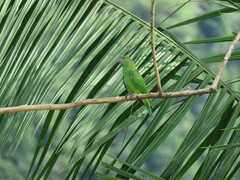
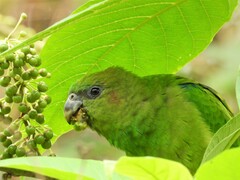
The pileated parrot is 20 to 22 cm (7.9 to 8.7 in) long and weighs 98 to 120 g (3.5 to 4.2 oz). Adults have an essentially all green body, with a yellowish abdomen. Their primaries, primary coverts, and the edges and tips of their tail feathers are dull blue. Males have a red forehead, crown, lores, and upper ear coverts. Females do not have any red but do have a faint blue wash on the forehead and breast. Immature males have less red on the head than adults, and females have less blue on the wings. Wikipedia →

Sounds

Flight call0:54

Brazil · 2025

© JAYRSON ARAUJO DE OLIVEIRA · XC1053016 · CC BY-NC-SA 4.0

Call0:04

Brazil · 2009

© Renan Campos de Oliveira · XC36168 · CC BY-NC-ND 2.5

Recording0:24

Argentina · 2026

© Faustino Hollmann · XC1176796 · CC BY-NC-SA 4.0

Global Distribution

Parks Where Found

# Park Country Daily sighting probability
1 Itatiaia National Park 🇧🇷 Brazil
~10%
2 Serra dos Órgãos National Park 🇧🇷 Brazil
<5%

Cities Where Found

# City Country Daily sighting probability
1 Curitiba 🇧🇷 Brazil
<5%
2 Santos 🇧🇷 Brazil
<5%
3 São Paulo 🇧🇷 Brazil
<5%

Zoos & Centres Where Found

# Zoo / Centre Country
1 Parque das Aves 🇧🇷 Brazil In captivity
2 Bird Paradise 🇸🇬 Singapore In captivity
3 Rainforest Wild Asia 🇸🇬 Singapore In captivity

Before you go

What are the chances of seeing a Pileated Parrot in Itatiaia National Park?

With luck

About 10% of wildlife watchers report a Pileated Parrot sighting in Itatiaia National Park on a given day, based on 116 verified sightings from GBIF citizen-science data from 2019 to 2026. It is the 181st most-seen of the 352 birds we can rate there. Over three days the chance rises to about 20%, and over a week to about 40%, if each day is a fresh chance.

When is the best time to see a Pileated Parrot in Itatiaia National Park?

March–August and December

In those months about 10% of wildlife watchers report a Pileated Parrot in Itatiaia National Park on a given day, against under 5% in January–February and September–November, the lowest months.

What time of day is best to see a Pileated Parrot?

Between 9 am and noon

Across all the parks we cover, that three-hour window holds the most Pileated Parrot sightings with a recorded time, and about 9 in 10 of them come between 6 am and 6 pm: it is a daytime animal.

Is Itatiaia National Park the best place to see a Pileated Parrot?

Yes

Of the 2 parks where we can rate Pileated Parrot sightings, Itatiaia National Park has the highest daily chance: about 10%. Next come Serra dos Órgãos National Park (Brazil, under 5%).

Which relatives of the Pileated Parrot live in Itatiaia National Park?

Same family: Psittacidae

The closest relatives of the Pileated Parrot that you can see in Itatiaia National Park (family Psittacidae, New World and African Parrots) are Maroon-bellied Parakeet (about 60%), White-eyed Parakeet (about 50%) and Scaly-headed Parrot (about 40%), with each one's daily chance of a sighting.

Where does the Pileated Parrot sighting chance come from?

GBIF citizen-science records

It is estimated from how often the Pileated Parrot is recorded against all the birds logged in Itatiaia National Park (116 verified sightings from 2019 to 2026), calibrated against known sighting rates. Figures are rounded to the nearest 10% because citizen-science data supports honest approximations, not decimals, and months with records from fewer than five people show "—". How it works.

← Back to Itatiaia National Park