Dusky-legged Guan

Dusky-legged Guan

Penelope obscura

Silhouette: Sheatherius · PhyloPic

LCLeast ConcernNTVUENCR
Daily sighting probability ~70% · Very likely
at Itatiaia National Park

In 3 days >90%

1,725 Verified sightings at Itatiaia National Park From 2019 to 2026
1,967 In all 4 parks
December Best month
☀️ Diurnal When it's spotted

About the Dusky-legged Guan

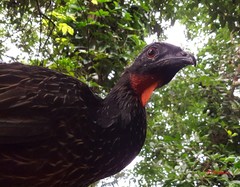
The dusky-legged guan (Penelope obscura) is a species of bird in the family Cracidae, the chachalacas, guans, and curassows. It is found in Uruguay, northeastern Argentina and southernmost areas of Paraguay and Brazil. Its natural habitats are subtropical or tropical moist lowland forest. The bird measures an average of 73 centimeters in length and weighs an average of 1.2 kilograms, being very similar in appearance to its smaller relative, the rusty-margined guan (P. supercilliaris).

It eats fruit, flowers and buds taken from the ground or plucked from tree branches, and acts as a seed disperser for various species of trees and palms, such as the endangered palm Euterpe edulis, or the palms of the genus Syagrus (e.g. queen palm and licuri). Coffee beans digested by the bird are sold for high prices.

Dusky-legged Guan videos on the Internet Bird Collection Stamps (for Argentina) with RangeMap Dusky-legged Guan photo gallery Archived 2019-03-01 at the... Wikipedia →

Sounds

Alarm call1:03

Brazil · 2024

© Robson Silva e Silva · XC1018700 · CC BY-NC-SA 4.0

Song0:22

Brazil · 2022

© João Vitor Oliveira de Souza · XC744792 · CC BY-NC-SA 4.0

Call0:52

Brazil · 2020

© Arthur Gomes · XC586953 · CC BY-NC-SA 4.0

Global Distribution

Parks Where Found

# Park Country Daily sighting probability
1 Itatiaia National Park 🇧🇷 Brazil
~70%
2 Serra dos Órgãos National Park 🇧🇷 Brazil
~20%
3 Serra da Canastra National Park 🇧🇷 Brazil
~20%
4 Tijuca National Park 🇧🇷 Brazil
<5%

Cities Where Found

# City Country Daily sighting probability
1 Curitiba 🇧🇷 Brazil
~20%
2 Campinas 🇧🇷 Brazil
<5%
3 São Paulo 🇧🇷 Brazil
<5%
4 Buenos Aires 🇦🇷 Argentina
<5%
5 Santos 🇧🇷 Brazil
<5%
6 Belo Horizonte 🇧🇷 Brazil
<5%
7 Rio de Janeiro 🇧🇷 Brazil
<5%

Zoos & Centres Where Found

# Zoo / Centre Country
1 Parque das Aves 🇧🇷 Brazil In captivity
2 Curitiba Zoo 🇧🇷 Brazil In captivity
3 Bioparque Municipal Vesty Pakos 🇧🇴 Bolivia In captivity
4 Mangal das Garças 🇧🇷 Brazil In captivity
5 Agroflori Parque de las Aves 🇧🇴 Bolivia In captivity
6 Aqualife 🇦🇷 Argentina In captivity
7 Zoológico Miguél Álvarez del Toro 🇲🇽 Mexico In captivity

Before you go

What are the chances of seeing a Dusky-legged Guan in Itatiaia National Park?

Very likely

About 70% of wildlife watchers report a Dusky-legged Guan sighting in Itatiaia National Park on a given day, based on 1,725 verified sightings from GBIF citizen-science data from 2019 to 2026. It is the 2nd most-seen of the 352 birds we can rate there. Over three days the chance rises to over 90%, if each day is a fresh chance.

When is the best time to see a Dusky-legged Guan in Itatiaia National Park?

September and December

In those months about 90% of wildlife watchers report a Dusky-legged Guan in Itatiaia National Park on a given day, against about 40% in February, the lowest month.

What time of day is best to see a Dusky-legged Guan?

Between 3 and 6 pm

Across all the parks we cover, that three-hour window holds the most Dusky-legged Guan sightings with a recorded time, and about 9 in 10 of them come between 6 am and 6 pm: it is a daytime animal.

Is Itatiaia National Park the best place to see a Dusky-legged Guan?

Yes

Of the 4 parks where we can rate Dusky-legged Guan sightings, Itatiaia National Park has the highest daily chance: about 70%. Next come Serra dos Órgãos National Park (Brazil, about 20%) and Serra da Canastra National Park (Brazil, about 20%).

Where does the Dusky-legged Guan sighting chance come from?

GBIF citizen-science records

It is estimated from how often the Dusky-legged Guan is recorded against all the birds logged in Itatiaia National Park (1,725 verified sightings from 2019 to 2026), calibrated against known sighting rates. Figures are rounded to the nearest 10% because citizen-science data supports honest approximations, not decimals, and months with records from fewer than five people show "—". How it works.

← Back to Itatiaia National Park