Thick-billed Saltator

Thick-billed Saltator

Saltator maxillosus

Silhouette: Sheatherius · PhyloPic

LCLeast ConcernNTVUENCR
Daily sighting probability ~10% · With luck
at Itatiaia National Park

In 3 days ~40% in a week ~60%

250 Verified sightings at Itatiaia National Park From 2019 to 2026
250 In 1 park
November Best month
☀️ Diurnal When it's spotted

About the Thick-billed Saltator

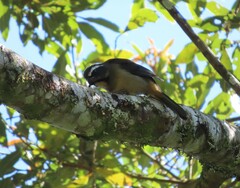
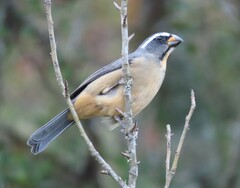
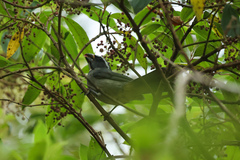
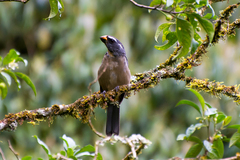
The thick-billed saltator (Saltator maxillosus) is a species of saltator in the family Thraupidae. It is found in highland Atlantic Forest in southeastern Brazil, far northeastern Argentina (only Misiones Province), and perhaps far eastern Paraguay. Unlike most other saltators, it is sexually dichromatic: Females resemble a green-winged saltator, but with a thicker bill, greener face and buff throat. The male thick-billed saltator is unique with its long white eyebrow, grey back, and black and orange beak (amount of orange varies).

Monotypic species ( subspecies are not recognized ). (Clements checklist, 2014). Measures about 19 centimeters. It draws attention by the very thick, tall and yellow beak at the base. Upper parts dark gray. Almost without green, white eyebrow starting at the base of the beak, lower parts rusty; female with green back; the immature with green upper parts and the black beak.

Its vocalization is by stanza of four strong calls, the third loudest, sings from August onwards. Just like its counterpart, the real iron crack (Saltator similis), this species feeds on seeds, leaves, insects and fruits (omnivorous... Wikipedia →

Sounds

Song0:23

Brazil · 2018

© JAYRSON ARAUJO DE OLIVEIRA · XC411808 · CC BY-NC-SA 4.0

Call0:28

Brazil · 2017

© Antonio de Almeida Correia Junior · XC353558 · CC BY-NC-SA 4.0

Call1:00

Brazil · 2016

© Lia Nahomi Kajiki · XC308653 · CC BY-NC-SA 4.0

Global Distribution

Parks Where Found

# Park Country Daily sighting probability
1 Itatiaia National Park 🇧🇷 Brazil
~10%

More parks will be added in future updates.

Cities Where Found

# City Country Daily sighting probability
1 Curitiba 🇧🇷 Brazil
<5%

Before you go

What are the chances of seeing a Thick-billed Saltator in Itatiaia National Park?

With luck

About 10% of wildlife watchers report a Thick-billed Saltator sighting in Itatiaia National Park on a given day, based on 250 verified sightings from GBIF citizen-science data from 2019 to 2026. It is the 141st most-seen of the 352 birds we can rate there. Over three days the chance rises to about 40%, and over a week to about 60%, if each day is a fresh chance.

When is the best time to see a Thick-billed Saltator in Itatiaia National Park?

March–April and November

In those months about 20% of wildlife watchers report a Thick-billed Saltator in Itatiaia National Park on a given day, against under 5% in December to February, the lowest months.

What time of day is best to see a Thick-billed Saltator?

Between 8 and 11 am

Across all the parks we cover, that three-hour window holds the most Thick-billed Saltator sightings with a recorded time, and about 9 in 10 of them come between 6 am and 6 pm: it is a daytime animal.

Where else can you see a Thick-billed Saltator?

Only Itatiaia National Park, in our data

Itatiaia National Park is the only park on Wallace's Line with enough records to rate Thick-billed Saltator sightings: about 10% of wildlife watchers there report one on a given day.

Which relatives of the Thick-billed Saltator live in Itatiaia National Park?

Same genus: Saltator

The closest relatives of the Thick-billed Saltator that you can see in Itatiaia National Park (genus Saltator, Typical Saltators) are Green-winged Saltator (about 60%) and Black-throated Grosbeak (about 10%), with each one's daily chance of a sighting.

Where does the Thick-billed Saltator sighting chance come from?

GBIF citizen-science records

It is estimated from how often the Thick-billed Saltator is recorded against all the birds logged in Itatiaia National Park (250 verified sightings from 2019 to 2026), calibrated against known sighting rates. Figures are rounded to the nearest 10% because citizen-science data supports honest approximations, not decimals, and months with records from fewer than five people show "—". How it works.

← Back to Itatiaia National Park