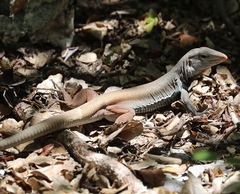

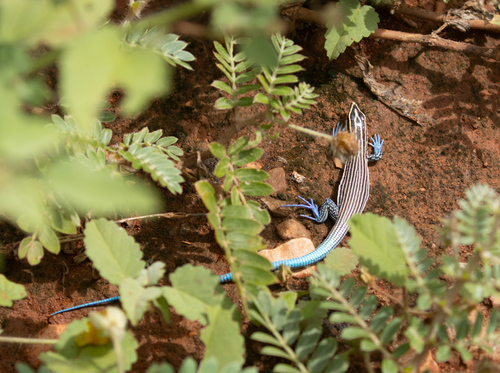
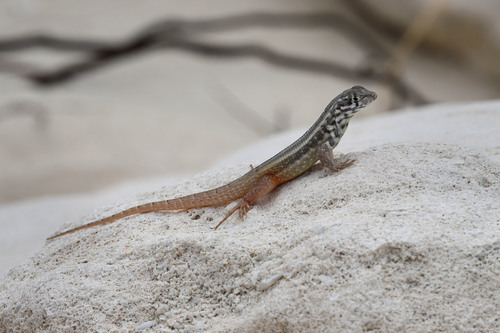
Hispaniola Ameiva

Hispaniola Ameiva

Pholidoscelis chrysolaemus

Silhouette: SeismicShrimp · PhyloPic

LCLeast ConcernNTVUENCR
Daily sighting probability ~50% · Likely
at Jaragua National Park

In 3 days ~90% in a week >90%

15 Verified sightings at Jaragua National Park From 2019 to 2026
15 In 1 park
May Best month
☀️ Diurnal When it's spotted

About the Hispaniola Ameiva

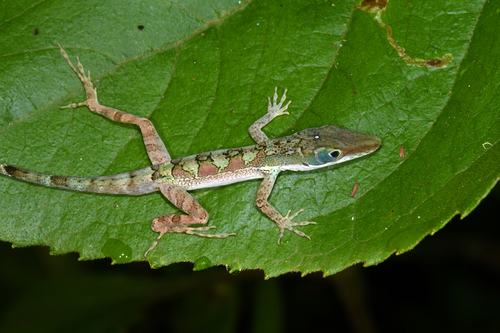
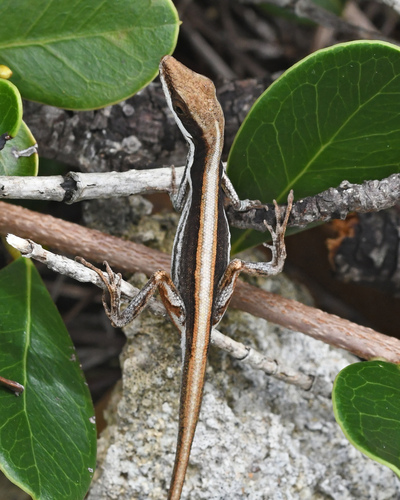
The common ameiva (Pholidoscelis chrysolaemus) is a species of lizard endemic to Hispaniola and a number of smaller associated islands. It is known to engage in homosexual mating among males. The common ameiva was originally described by Edward Drinker Cope in 1868, as Ameiva chrysolaema. The specific epithet likely comes from the Greek chryso, meaning gold, and laimos, meaning neck or throat, for the yellow throat and belly of this species. In 2016, the species was moved to Pholidoscelis based on genetic sequencing and phylogenetic analyses.

There are sixteen accepted subspecies in The Reptile Database. Given the variation among the subspecies, some authors suggest that they probably comprise more than one species. Pholidoscelis chrysolaemus chrysolaemus (Cope 1868)

Pholidoscelis chrysolaemus abbotti (Noble 1923) Pholidoscelis chrysolaemus alacris (Schwartz & Klinikowski 1966) Pholidoscelis chrysolaemus boekeri (Mertens 1939) Pholidoscelis chrysolaemus defensor (Schwartz & Klinikowski 1966)

Pholidoscelis chrysolaemus evulsus (Schwartz 1973) Pholidoscelis chrysolaemus fictus (Schwartz & Klinikowski 1966) Pholidoscelis chrysolaemus jactus (Schwartz &... Wikipedia →

Global Distribution

Parks Where Found

# Park Country Daily sighting probability
1 Jaragua National Park 🇩🇴 Dominican Republic
~50%

More parks will be added in future updates.

Cities Where Found

# City Country Daily sighting probability
1 Santo Domingo 🇩🇴 Dominican Republic
~40%

Zoos & Centres Where Found

# Zoo / Centre Country
1 Schönbrunn Zoo 🇦🇹 Austria In captivity

Before you go

What are the chances of seeing a Hispaniola Ameiva in Jaragua National Park?

Likely

About 50% of wildlife watchers report a Hispaniola Ameiva sighting in Jaragua National Park on a given day, based on 15 verified sightings from GBIF citizen-science data from 2019 to 2026. It is the 3rd most-seen of the 9 reptiles we can rate there. Over three days the chance rises to about 90%, and over a week to over 90%, if each day is a fresh chance.

When is the best time to see a Hispaniola Ameiva in Jaragua National Park?

March and May

In those months about 70% of wildlife watchers report a Hispaniola Ameiva in Jaragua National Park on a given day, against about 10% in November to February, the lowest months.

What time of day is best to see a Hispaniola Ameiva?

Between 10 am and 1 pm

Across all the parks we cover, that three-hour window holds the most Hispaniola Ameiva sightings with a recorded time, and about 9 in 10 of them come between 6 am and 6 pm: it is a daytime animal.

Where else can you see a Hispaniola Ameiva?

Only Jaragua National Park, in our data

Jaragua National Park is the only park on Wallace's Line with enough records to rate Hispaniola Ameiva sightings: about 50% of wildlife watchers there report one on a given day.

Where does the Hispaniola Ameiva sighting chance come from?

GBIF citizen-science records

It is estimated from how often the Hispaniola Ameiva is recorded against all the reptiles logged in Jaragua National Park (15 verified sightings from 2019 to 2026), calibrated against known sighting rates. Figures are rounded to the nearest 10% because citizen-science data supports honest approximations, not decimals, and months with records from fewer than five people show "—". How it works.

← Back to Jaragua National Park