


Completed


Mountain Goat
Oreamnos americanus
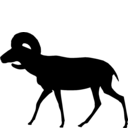
Silhouette: Sarah E. Haworth · PhyloPic
- KingdomAnimalia (Animals)
- PhylumChordata (Chordates)
- ClassMammalia (Mammals)
- OrderArtiodactyla (Even-toed Ungulates and Cetaceans)
- FamilyBovidae (Bovids)
- GenusOreamnos (Mountain Goats)
- SpeciesOreamnos americanus (Mountain Goat)
In 3 days ~80% in a week >90%
178 Verified sightings at Jasper National Park From 2019 to 2026
1,517 In all 8 parks
June Best month
☀️ Diurnal When it's spotted
About the Mountain Goat
The mountain goat (Oreamnos americanus), also known as the Rocky Mountain goat, is a cloven-footed mammal that is endemic to the remote and rugged mountainous areas of western North America. A subalpine to truly alpine species, it is a sure-footed climber commonly seen on sheer rock faces, near-vertical cliffs and icy passages. Mountain goats generally avoid venturing down into lower elevations—except during seasonal food shortages or during particularly bad weather—as the extreme elevation of their habitat is the primary defense against predators such as black and brown bears, pumas and wolves.
Despite its vernacular name and both genera being in the same subfamily (Caprinae), the mountain goat is not a member of Capra, the genus that includes all true goats (such as the wild goat (Capra aegagrus), from which the domestic goat is derived); rather, it is more closely allied with the other bovids known as "goat-antelopes", including the European chamois (Rupicapra), the gorals (Naemorhedus), the takins (Budorcas) and the serows (Capricornis), of Japan and eastern South Asia.
The mountain goat is an even-toed ungulate of the order Artiodactyla and the... Wikipedia →
Sounds
Recording0:13
United States · 2024
© jamiecatchfly · iNaturalist · CC BY-NC 4.0
Recent sightings of Mountain Goat in Jasper National Park
LIVEiNaturalistGlobal Distribution
Parks Where Found
| # | Park | Country | Daily sighting probability |
|---|---|---|---|
| 1 | Glacier National Park | 🇺🇸 United States | |
| 2 | Kenai Fjords National Park | 🇺🇸 United States | |
| 3 | Jasper National Park | 🇨🇦 Canada | |
| 4 | Yellowstone National Park | 🇺🇸 United States | |
| 5 | Banff National Park | 🇨🇦 Canada | |
| 6 | Great Bear Rainforest | 🇨🇦 Canada | |
| 7 | Rocky Mountain National Park | 🇺🇸 United States | |
| 8 | Olympic National Park | 🇺🇸 United States |
Zoos & Centres Where Found
Closest Relatives at Jasper National Park




Before you go
What are the chances of seeing a Mountain Goat in Jasper National Park?
Likely
About 50% of wildlife watchers report a Mountain Goat sighting in Jasper National Park on a given day, based on 178 verified sightings from GBIF citizen-science data from 2019 to 2026. It is the 9th most-seen of the 25 mammals we can rate there. Over three days the chance rises to about 80%, and over a week to over 90%, if each day is a fresh chance.
When is the best time to see a Mountain Goat in Jasper National Park?
June
In that month about 60% of wildlife watchers report a Mountain Goat in Jasper National Park on a given day, against under 5% in January to April, the lowest months. That is one of Jasper National Park's wettest months, with about 110 mm of rain against 55 mm in April.
What time of day is best to see a Mountain Goat?
Between 10 am and 1 pm
Across all the parks we cover, that three-hour window holds the most Mountain Goat sightings with a recorded time, and about 8 in 10 of them come between 6 am and 6 pm: it is a daytime animal.
Is Jasper National Park the best place to see a Mountain Goat?
3rd of 8
Of the 8 parks where we can rate Mountain Goat sightings, Jasper National Park ranks 3rd at about 50%. The best odds are in Glacier National Park (United States, about 80%) and Kenai Fjords National Park (United States, about 50%). All parks ranked.
Where does the Mountain Goat sighting chance come from?
GBIF citizen-science records
It is estimated from how often the Mountain Goat is recorded against all the mammals logged in Jasper National Park (178 verified sightings from 2019 to 2026), calibrated against known sighting rates. Figures are rounded to the nearest 10% because citizen-science data supports honest approximations, not decimals, and months with records from fewer than five people show "—". How it works.
