Slaty-headed Parakeet

Slaty-headed Parakeet

Psittacula himalayana

Silhouette: Farelli (photo), John E. McCormack, Michael G. Harvey, Brant C. Faircloth, Nicholas G. Crawford, Travis C. Glenn, Robb T. Brumfield & T. Michael Keesey · PhyloPic

Daily sighting probability ~10% · With luck
at Jim Corbett National Park

In 3 days ~30% in a week ~60%

349 Verified sightings at Jim Corbett National Park From 2019 to 2026
374 In all 3 parks
December Best month
☀️ Diurnal When it's spotted

About the Slaty-headed Parakeet

The slaty-headed parakeet (Psittacula himalayana) is the only psittacid species to exhibit altitudinal migration. The species' range extends from Pakistan, to Western Himalayas in India through Nepal and Bhutan and up to the Eastern Himalayas in the northeastern Indian state of Arunachal Pradesh. They descend to the valleys in winter, approximately during the last week of October.

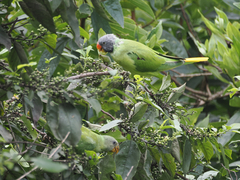
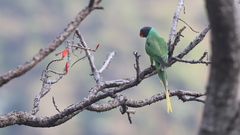
Adults of both sexes have green (tinted with blue) feathers on most of their body. It has a dark grey (slate colored) head with a light blue tint where head meets the neck. Males feature dark maroon patches on inner wing coverts. Females do not feature these maroon patches. Males have long central tail feathers which are shorter in female birds. The tail is green at base and becomes deep blue and widely tipped with bright yellow. The parakeet features a bright red-orange upper mandible with a pale yellow lower. It also has a pale yellow eye.

The slaty-headed parakeet has a wide range throughout the Himalayas and surrounding areas. This bird is found is western Bhutan, most of Nepal, and in the following the Indian states; Sikkim, Uttarakhand, Himachal Pradesh... Wikipedia →

Sounds

Song1:01

India · 2015

© Saqib Khaliq · XC655492 · CC BY-NC-SA 4.0

Call0:10

India · 2019

© Andrew Spencer · XC547741 · CC BY-NC-ND 4.0

Flight call0:17

India · 2019

© Sreekumar Chirukandoth · XC467443 · CC BY-NC-SA 4.0

Global Distribution

Parks Where Found

# Park Country Daily sighting probability
1 Jim Corbett National Park 🇮🇳 India
~10%
2 Langtang National Park 🇳🇵 Nepal
<5%
3 Chitwan National Park 🇳🇵 Nepal
<5%

Cities Where Found

# City Country Daily sighting probability
1 Dehradun 🇮🇳 India
~10%
2 Srinagar 🇮🇳 India
<5%
3 Kathmandu 🇳🇵 Nepal
<5%

Zoos & Centres Where Found

# Zoo / Centre Country
1 Loro Parque 🇪🇸 Spain In captivity

Before you go

What are the chances of seeing a Slaty-headed Parakeet in Jim Corbett National Park?

With luck

About 10% of wildlife watchers report a Slaty-headed Parakeet sighting in Jim Corbett National Park on a given day, based on 349 verified sightings from GBIF citizen-science data from 2019 to 2026. It is the 107th most-seen of the 368 birds we can rate there. Over three days the chance rises to about 30%, and over a week to about 60%, if each day is a fresh chance.

When is the best time to see a Slaty-headed Parakeet in Jim Corbett National Park?

December and January

In those months about 20% of wildlife watchers report a Slaty-headed Parakeet in Jim Corbett National Park on a given day, against under 5% in July and August, the lowest months. Those are among Jim Corbett National Park's driest months, with about 30 mm of rain a month against 360 mm in July.

What time of day is best to see a Slaty-headed Parakeet?

Between 8 and 11 am

Across all the parks we cover, that three-hour window holds the most Slaty-headed Parakeet sightings with a recorded time, and about 9 in 10 of them come between 6 am and 6 pm: it is a daytime animal.

Is Jim Corbett National Park the best place to see a Slaty-headed Parakeet?

Yes

Of the 3 parks where we can rate Slaty-headed Parakeet sightings, Jim Corbett National Park has the highest daily chance: about 10%. Next come Langtang National Park (Nepal, under 5%) and Chitwan National Park (Nepal, under 5%).

Which relatives of the Slaty-headed Parakeet live in Jim Corbett National Park?

Same genus: Psittacula

The closest relatives of the Slaty-headed Parakeet that you can see in Jim Corbett National Park (genus Psittacula, Old World Parakeets) are Plum-headed Parakeet (about 60%), Rose-ringed Parakeet (about 20%) and Red-breasted Parakeet (about 10%), with each one's daily chance of a sighting.

Where does the Slaty-headed Parakeet sighting chance come from?

GBIF citizen-science records

It is estimated from how often the Slaty-headed Parakeet is recorded against all the birds logged in Jim Corbett National Park (349 verified sightings from 2019 to 2026), calibrated against known sighting rates. Figures are rounded to the nearest 10% because citizen-science data supports honest approximations, not decimals, and months with records from fewer than five people show "—". How it works.

← Back to Jim Corbett National Park