


Completed



Tarai Gray Langur
Semnopithecus hector
Silhouette: Kai R. Caspar · PhyloPic
- KingdomAnimalia (Animals)
- PhylumChordata (Chordates)
- ClassMammalia (Mammals)
- OrderPrimates
- FamilyCercopithecidae (Old World Monkeys)
- GenusSemnopithecus (Grey and Nilgiri Langurs)
- SpeciesSemnopithecus hector (Tarai Gray Langur)
In 3 days ~60% in a week ~90%
25 Verified sightings at Jim Corbett National Park From 2019 to 2026
32 In all 2 parks
April Best month
🌅 Crepuscular When it's spotted
About the Tarai Gray Langur
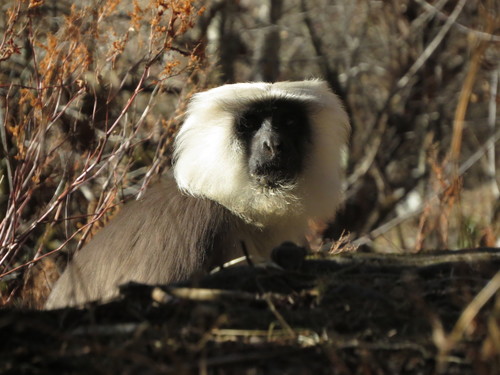
The Tarai gray langur (Semnopithecus hector) is an Old World monkey, and was formerly considered a subspecies of the northern plains gray langur. The species is listed as near threatened, as there are probably not many more than 10,000 mature individuals, and it is experiencing a continuing decline.
The Tarai gray langur is native to northern India, Bhutan, and Nepal, and inhabits the Himalayan foothills from Rajaji National Park to southwestern Bhutan. It also lives in the moist deciduous forest of the Siwalik Hills to oak forest ranging from altitudes of 150 to 1,600 m (490 to 5,250 ft).
It is a diurnal species which lives arboreally in the top canopy of sal tree forests in India and Nepal. The species' population is fragmented, with a 2003 report estimating that there were at most fifty separate subpopulations. The monkeys are leaf-eaters who live in groups with multiple males and females. Groups have been observed feeding in orchards and crop fields outside of Rajaji National Park.
The Tarai gray langur is near threatened, and the monkeys are threatened by human industrial activity (such as mining and logging) as well as human resettlement... Wikipedia →
Sounds
Call0:36
Nepal · 2023
© Marc Anderson · XC960758 · CC BY-NC-ND 4.0
Recent sightings of Tarai Gray Langur in Jim Corbett National Park
LIVEiNaturalistGlobal Distribution
Parks Where Found
| # | Park | Country | Daily sighting probability |
|---|---|---|---|
| 1 | Jim Corbett National Park | 🇮🇳 India | |
| 2 | Chitwan National Park | 🇳🇵 Nepal |
Closest Relatives at Jim Corbett National Park




Before you go
What are the chances of seeing a Tarai Gray Langur in Jim Corbett National Park?
Possible
About 20% of wildlife watchers report a Tarai Gray Langur sighting in Jim Corbett National Park on a given day, based on 25 verified sightings from GBIF citizen-science data from 2019 to 2026. It is the 10th most-seen of the 12 mammals we can rate there. Over three days the chance rises to about 60%, and over a week to about 90%, if each day is a fresh chance.
When is the best time to see a Tarai Gray Langur in Jim Corbett National Park?
April
In that month about 40% of wildlife watchers report a Tarai Gray Langur in Jim Corbett National Park on a given day, against under 5% in June to September, the lowest months. That is one of Jim Corbett National Park's driest months, with about 15 mm of rain against 360 mm in July.
What time of day is best to see a Tarai Gray Langur?
Between 7 and 10 am
Across all the parks we cover, that three-hour window holds the most Tarai Gray Langur sightings with a recorded time, and about 7 in 10 of them come between 6 am and 6 pm: it is most active around dawn and dusk.
Is Jim Corbett National Park the best place to see a Tarai Gray Langur?
Yes
Of the 2 parks where we can rate Tarai Gray Langur sightings, Jim Corbett National Park has the highest daily chance: about 20%. Next come Chitwan National Park (Nepal, about 20%).
Where does the Tarai Gray Langur sighting chance come from?
GBIF citizen-science records
It is estimated from how often the Tarai Gray Langur is recorded against all the mammals logged in Jim Corbett National Park (25 verified sightings from 2019 to 2026), calibrated against known sighting rates. Figures are rounded to the nearest 10% because citizen-science data supports honest approximations, not decimals, and months with records from fewer than five people show "—". How it works.
