White-backed Thrush

White-backed Thrush

Turdus kessleri

Silhouette: Sharon Wegner-Larsen · PhyloPic

LCLeast ConcernNTVUENCR Endemic
Daily sighting probability ~40% · Likely
at Jiuzhaigou National Park

In 3 days ~80% in a week >90%

61 Verified sightings at Jiuzhaigou National Park From 2019 to 2026
61 In 1 park
June Best month
🌅 Crepuscular When it's spotted

About the White-backed Thrush

The white-backed thrush or Kessler's thrush (Turdus kessleri) is a species of bird in the family Turdidae. It is primarily resident or a short-distance altitudinal migrant, found in central China in Gansu, Qinghai, Sichuan, eastern Tibet, and northwestern Yunnan, and also a scarce winter visitor in Bhutan, northeasternmost India (Arunachal Pradesh and Sikkim), and eastern Nepal. It breeds in alpine scrub on rocky sites at altitudes of 3600–4500 metres, and descends down to 2100 metres, rarely to 1500 metres, in winter.

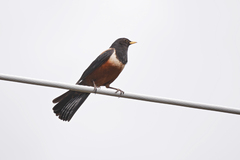
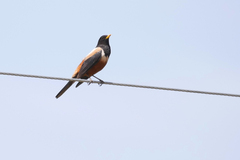
It is a large thrush, 28 cm long (same size as a mistle thrush). The male has a black head, wings, and tail, and a pink body, dark pink below and pale pink to nearly white on the mantle (thus superficially resembling a rosy starling in plumage pattern, though larger and longer-tailed than that). The female is similar but drabber, with a dark brown head and the pink tinged greyer. Juveniles are similar to adult females, but with pale streaks on the head. It is gregarious, forming flocks particularly in winter, but also on the breeding grounds, and often joins flocks of dusky thrush and red-throated thrush. It is omnivorous, feeding on insects, earthworms, and berries, with juniper cones ("berries") particularly important in winter. Wikipedia →

Sounds

Call0:34

China · 2024

© Peter Boesman · XC916668 · CC BY-NC-ND 4.0

Alarm call0:30

China · 2023

© Dave GUO · XC891370 · CC BY-NC-SA 4.0

Song0:46

China · 2015

© Mike Nelson · XC266261 · CC BY-NC-SA 4.0

Global Distribution

Parks Where Found

# Park Country Daily sighting probability
1 Jiuzhaigou National Park 🇨🇳 China
~40%

More parks will be added in future updates.

Before you go

What are the chances of seeing a White-backed Thrush in Jiuzhaigou National Park?

Likely

About 40% of wildlife watchers report a White-backed Thrush sighting in Jiuzhaigou National Park on a given day, based on 61 verified sightings from GBIF citizen-science data from 2019 to 2026. It is the 11th most-seen of the 131 birds we can rate there. Over three days the chance rises to about 80%, and over a week to over 90%, if each day is a fresh chance.

When is the best time to see a White-backed Thrush in Jiuzhaigou National Park?

June

In that month about 60% of wildlife watchers report a White-backed Thrush in Jiuzhaigou National Park on a given day, against about 20% in November, the lowest month. That is one of Jiuzhaigou National Park's wettest months, with about 160 mm of rain against 15 mm in December. January to March have too few records to rate.

What time of day is best to see a White-backed Thrush?

Between 2 and 5 am

Across all the parks we cover, that three-hour window holds the most White-backed Thrush sightings with a recorded time, and about half of them come between 6 am and 6 pm: it is most active around dawn and dusk.

Where else can you see a White-backed Thrush?

Only Jiuzhaigou National Park, in our data

Jiuzhaigou National Park is the only park on Wallace's Line with enough records to rate White-backed Thrush sightings: about 40% of wildlife watchers there report one on a given day.

Which relatives of the White-backed Thrush live in Jiuzhaigou National Park?

Same genus: Turdus

The closest relatives of the White-backed Thrush that you can see in Jiuzhaigou National Park (genus Turdus, Typical Thrushes) are Chestnut Thrush (about 60%) and Chinese Thrush (about 10%), with each one's daily chance of a sighting.

Where does the White-backed Thrush sighting chance come from?

GBIF citizen-science records

It is estimated from how often the White-backed Thrush is recorded against all the birds logged in Jiuzhaigou National Park (61 verified sightings from 2019 to 2026), calibrated against known sighting rates. Figures are rounded to the nearest 10% because citizen-science data supports honest approximations, not decimals, and months with records from fewer than five people show "—". How it works.

← Back to Jiuzhaigou National Park