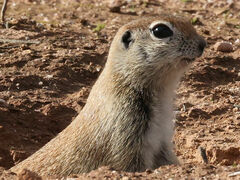

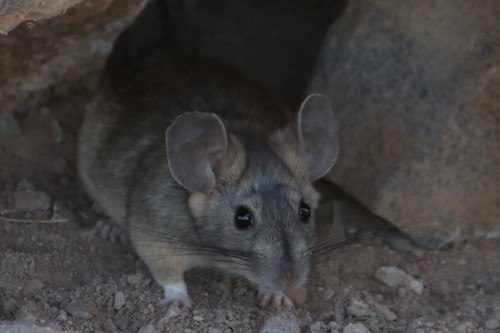
Round-tailed Ground Squirrel

Round-tailed Ground Squirrel

Xerospermophilus tereticaudus

Silhouette: Joseph Smit · PhyloPic

LCLeast ConcernNTVUENCR
Daily sighting probability ~10% · With luck
at Joshua Tree National Park

In 3 days ~20% in a week ~40%

13 Verified sightings at Joshua Tree National Park From 2019 to 2026
51 In all 2 parks
April Best month
☀️ Diurnal When it's spotted

About the Round-tailed Ground Squirrel

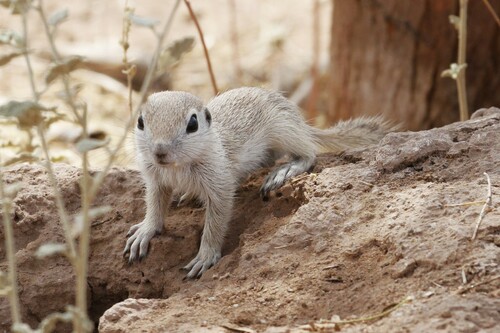
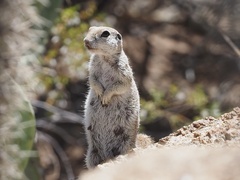
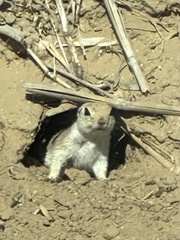
The round-tailed ground squirrel (Xerospermophilus tereticaudus), known as "Ardillón cola redonda" in Spanish, live in the desert of the Southwestern United States and Northwestern Mexico. They are called "ground squirrels" because they burrow in loose soil, often under mesquite trees and creosote bushes.

Most round-tailed ground squirrels are very small. Weight at birth is approximately 3.9 grams (0.14 oz). Adults weigh around 125 grams (4.4 oz). All have a long round tail and long, hairy hind feet. They have no fur markings, instead having a uniform sandy color, which matches the soil they burrow in. The underside of their body is usually a lighter shade. Round tailed squirrels average 204 to 278 millimetres (8.0 to 10.9 in) in length including the tail which is from 60 to 112 millimetres (2.4 to 4.4 in) long.

The gestation period is 28 days. An average of 5.4 pups are born in each litter. They reach sexual maturity at 325 days. There is little information on the longevity of these animals but one wild born specimen lived to approximately 8.9 years in captivity. They are prey animals for coyotes, badgers, hawks and snakes. Round-tailed ground... Wikipedia →

Sounds

Recording0:21

United States · 2025

© Daniel Donovan · iNaturalist · CC BY-NC 4.0

Recording0:12

United States · 2026

© nmoorhatch · iNaturalist · CC BY-NC 4.0

Global Distribution

Parks Where Found

# Park Country Daily sighting probability
1 Saguaro National Park 🇺🇸 United States
~10%
2 Joshua Tree National Park 🇺🇸 United States
~10%

Cities Where Found

# City Country Daily sighting probability
1 Phoenix 🇺🇸 United States
~30%
2 Las Vegas 🇺🇸 United States
~10%
3 Mesa 🇺🇸 United States
~10%

Zoos & Centres Where Found

# Zoo / Centre Country
1 Arizona-Sonora Desert Museum 🇺🇸 United States In captivity
2 Jardin zoologique de la ville de Lyon 🇫🇷 France In captivity
3 Grizzly & Wolf Discovery Center 🇺🇸 United States In captivity

Before you go

What are the chances of seeing a Round-tailed Ground Squirrel in Joshua Tree National Park?

With luck

About 10% of wildlife watchers report a Round-tailed Ground Squirrel sighting in Joshua Tree National Park on a given day, based on 13 verified sightings from GBIF citizen-science data from 2019 to 2026. It is the 13th most-seen of the 15 mammals we can rate there. Over three days the chance rises to about 20%, and over a week to about 40%, if each day is a fresh chance.

When is the best time to see a Round-tailed Ground Squirrel in Joshua Tree National Park?

March to June

In those months about 10% of wildlife watchers report a Round-tailed Ground Squirrel in Joshua Tree National Park on a given day, against under 5% in July to February, the lowest months.

What time of day is best to see a Round-tailed Ground Squirrel?

Between 10 am and 1 pm

Across all the parks we cover, that three-hour window holds the most Round-tailed Ground Squirrel sightings with a recorded time, and about 9 in 10 of them come between 6 am and 6 pm: it is a daytime animal.

Is Joshua Tree National Park the best place to see a Round-tailed Ground Squirrel?

Among the best

Of the 2 parks where we can rate Round-tailed Ground Squirrel sightings, Joshua Tree National Park ranks 2nd at about 10%, level with the leaders once rounded. The best odds are in Saguaro National Park (United States, about 10%).

Where does the Round-tailed Ground Squirrel sighting chance come from?

GBIF citizen-science records

It is estimated from how often the Round-tailed Ground Squirrel is recorded against all the mammals logged in Joshua Tree National Park (13 verified sightings from 2019 to 2026), calibrated against known sighting rates. Figures are rounded to the nearest 10% because citizen-science data supports honest approximations, not decimals, and months with records from fewer than five people show "—". How it works.

← Back to Joshua Tree National Park