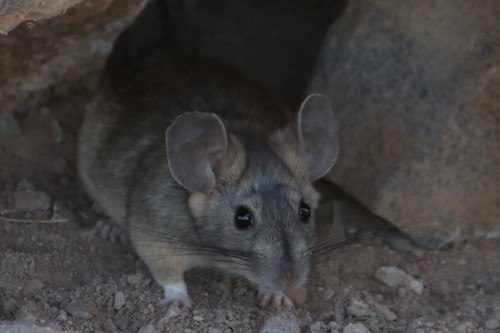


Desert Woodrat

Desert Woodrat

Neotoma lepida

Silhouette: T. Michael Keesey · PhyloPic

LCLeast ConcernNTVUENCR
Daily sighting probability ~10% · With luck
at Joshua Tree National Park

In 3 days ~30% in a week ~50%

20 Verified sightings at Joshua Tree National Park From 2019 to 2026
26 In all 2 parks
November Best month
☀️ Diurnal When it's spotted

About the Desert Woodrat

The desert woodrat (Neotoma lepida) is a species of pack rat native to desert regions of western North America. Desert woodrats are relatively small for pack rats, measuring 28 to 39 cm (11 to 15 in) in length, including a 12 to 20 cm (4.7 to 7.9 in) tail. They weigh from 122 to 350 g (4.3 to 12.3 oz), with males being larger than females. Their coloring varies between individuals, and can be anything from pale gray to cinnamon to near-black. Regardless of the color on the rest of the body, however, the animal's underparts and feet are always white, while the otherwise pale fur on the throat region is gray at its base. The tail is distinctly bicolored, and has more hair, and fewer visible scales, than the tails of brown rats. Desert woodrats have a narrow snout, long whiskers, and relatively long ears that are almost the length of the hind feet.

Desert woodrats range from southeastern Oregon and southwestern Idaho, south through Nevada and western Utah to California in the US, and Baja California and extreme northwestern Sonora in Mexico. They are generally found in sagebrush scrub areas, in chaparral, and in deserts and rocky slopes... Wikipedia →

Global Distribution

Parks Where Found

# Park Country Daily sighting probability
1 Death Valley National Park 🇺🇸 United States
~10%
2 Joshua Tree National Park 🇺🇸 United States
~10%

Before you go

What are the chances of seeing a Desert Woodrat in Joshua Tree National Park?

With luck

About 10% of wildlife watchers report a Desert Woodrat sighting in Joshua Tree National Park on a given day, based on 20 verified sightings from GBIF citizen-science data from 2019 to 2026. It is the 10th most-seen of the 15 mammals we can rate there. Over three days the chance rises to about 30%, and over a week to about 50%, if each day is a fresh chance.

When is the best time to see a Desert Woodrat in Joshua Tree National Park?

January, July and November

In those months about 20% of wildlife watchers report a Desert Woodrat in Joshua Tree National Park on a given day, against under 5% in September and December, the lowest months.

What time of day is best to see a Desert Woodrat?

Between 9 am and noon

Across all the parks we cover, that three-hour window holds the most Desert Woodrat sightings with a recorded time, and about 7 in 10 of them come between 6 am and 6 pm: it is a daytime animal.

Is Joshua Tree National Park the best place to see a Desert Woodrat?

Among the best

Of the 2 parks where we can rate Desert Woodrat sightings, Joshua Tree National Park ranks 2nd at about 10%, level with the leaders once rounded. The best odds are in Death Valley National Park (United States, about 10%).

Where does the Desert Woodrat sighting chance come from?

GBIF citizen-science records

It is estimated from how often the Desert Woodrat is recorded against all the mammals logged in Joshua Tree National Park (20 verified sightings from 2019 to 2026), calibrated against known sighting rates. Figures are rounded to the nearest 10% because citizen-science data supports honest approximations, not decimals, and months with records from fewer than five people show "—". How it works.

← Back to Joshua Tree National Park