Meves's Glossy-starling

Meves's Glossy-starling

Lamprotornis mevesii

Silhouette: Rafael Maia · PhyloPic

LCLeast ConcernNTVUENCR
Daily sighting probability ~10% · With luck
at Kafue National Park

In 3 days ~30% in a week ~50%

63 Verified sightings at Kafue National Park From 2019 to 2026
3,614 In all 10 parks
March Best month
☀️ Diurnal When it's spotted

About the Meves's Glossy-starling

Meves's starling (Lamprotornis mevesii), also Meves's glossy starling and Long-tailed starling, is a species of starling in the genus Lamprotornis. It is found in Angola, Botswana, Malawi, Mozambique, Namibia, South Africa, Zambia, and Zimbabwe.

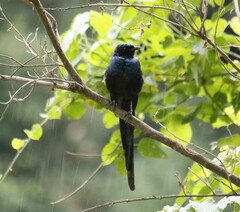
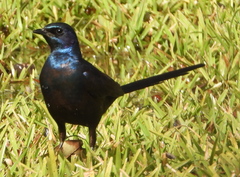
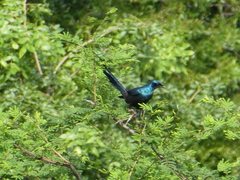
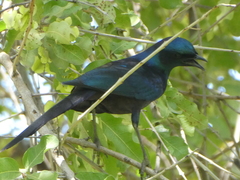
Its English and Latin names commemorate the German ornithologist Friedrich Wilhelm Meves. It is 30–36 cm long, with a very long tail; in dull light coloured black, but in bright light, with moderate to intensely strong iridescent gloss. It can be distinguished from the similar Burchell's starling by its longer tail with strongly graduated feathers (the central pair of tail feathers the longest, with subsequent pairs of feathers shorter to the outermost), and from other long-tailed species of Lamprotornis by its dark eyes.

Three subspecies are accepted: Lamprotornis mevesii benguelensis Shelley, 1906 — southwestern Angola (Angola Escarpment). Duller and browner, less glossy on the body and tail than the other subspecies. Lamprotornis mevesii violacior Clancey, 1973 — northern Namibia and south-central Angola. Dark, violet-purple glossed.

Lamprotornis mevesii mevesii (Wahlberg, 1856) — southeasternmost Angola, northeastern Namibia (Caprivi Strip), Botswana, east to southeastern Zambia, southern Malawi, and northeastern South Africa. Intensely green-and-blue glossed, with some bronze gloss on the flanks.

Some authorities have treated the three as separate species, but this is not widely followed. It is typically found in small flocks in mopane woodland, usually along major river basins, and often in areas which are flooded in the rainy season. The breeding season lasts from September to May, with peak nesting activity in February to March. Wikipedia →

Sounds

Call0:32

Botswana · 2023

© Marc Anderson · XC1080578 · CC BY-NC-ND 4.0

Call0:21

Zimbabwe · 2024

© Dries Van de Loock · XC963654 · CC BY-NC-ND 4.0

Call0:12

South Africa · 2024

© Ehren Eksteen · XC951963 · CC BY-NC-SA 4.0

Global Distribution

Parks Where Found

# Park Country Daily sighting probability
1 Liwonde National Park 🇲🇼 Malawi
~80%
2 Gonarezhou National Park 🇿🇼 Zimbabwe
~80%
3 South Luangwa National Park 🇿🇲 Zambia
~80%
4 Mana Pools National Park 🇿🇼 Zimbabwe
~70%
5 Lower Zambezi National Park 🇿🇲 Zambia
~70%
6 Moremi Game Reserve 🇧🇼 Botswana
~50%
7 Hwange National Park 🇿🇼 Zimbabwe
~30%
8 Chobe National Park 🇧🇼 Botswana
~10%
9 Kafue National Park 🇿🇲 Zambia
~10%
10 Kruger National Park 🇿🇦 South Africa
~10%

Zoos & Centres Where Found

# Zoo / Centre Country
1 Avifauna 🇪🇸 Spain In captivity

Before you go

What are the chances of seeing a Meves's Glossy-starling in Kafue National Park?

With luck

About 10% of wildlife watchers report a Meves's Glossy-starling sighting in Kafue National Park on a given day, based on 63 verified sightings from GBIF citizen-science data from 2019 to 2026. It is the 154th most-seen of the 338 birds we can rate there. Over three days the chance rises to about 30%, and over a week to about 50%, if each day is a fresh chance.

When is the best time to see a Meves's Glossy-starling in Kafue National Park?

March

In that month about 30% of wildlife watchers report a Meves's Glossy-starling in Kafue National Park on a given day, against under 5% in April and July, the lowest months. That is one of Kafue National Park's wettest months, with about 120 mm of rain against almost none in June.

What time of day is best to see a Meves's Glossy-starling?

Between 7 and 10 am

Across all the parks we cover, that three-hour window holds the most Meves's Glossy-starling sightings with a recorded time, and about 8 in 10 of them come between 6 am and 6 pm: it is a daytime animal.

Which relatives of the Meves's Glossy-starling live in Kafue National Park?

Same genus: Lamprotornis

The closest relatives of the Meves's Glossy-starling that you can see in Kafue National Park (genus Lamprotornis, Glossy Starlings and Allies) are Greater Blue-eared Starling (about 30%) and Lesser Blue-eared Glossy-starling (about 10%), with each one's daily chance of a sighting.

Where does the Meves's Glossy-starling sighting chance come from?

GBIF citizen-science records

It is estimated from how often the Meves's Glossy-starling is recorded against all the birds logged in Kafue National Park (63 verified sightings from 2019 to 2026), calibrated against known sighting rates. Figures are rounded to the nearest 10% because citizen-science data supports honest approximations, not decimals, and months with records from fewer than five people show "—". How it works.

← Back to Kafue National Park