Schalow's Turaco

Schalow's Turaco

Tauraco schalowi

Silhouette: Lisa M. "Pixxl" (photo), John E. McCormack, Michael G. Harvey, Brant C. Faircloth, Nicholas G. Crawford, Travis C. Glenn, Robb T. Brumfield & T. Michael Keesey · PhyloPic

LCLeast ConcernNTVUENCR
Daily sighting probability ~50% · Likely
at Kafue National Park

In 3 days ~80% in a week >90%

310 Verified sightings at Kafue National Park From 2019 to 2026
1,078 In all 6 parks
July Best month
☀️ Diurnal When it's spotted

About the Schalow's Turaco

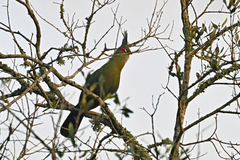
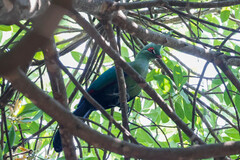
Schalow's turaco (Tauraco schalowi) is a frugivorous bird in the family Musophagidae. This bird's common name and Latin binomial commemorate the German banker and amateur ornithologist Herman Schalow. These birds are light for a turaco species; weighing just over half a pound (270g), with a length of 15 to 17 inches. Their colour is a coppery-jade green that fades to a dark iridescent blue the closer you get towards the tail. They have long white tripped crests with small red beaks and red skin around their dark eyes lined with white feathers. Mature birds have, on average, the longest crests of any turaco species. Their wings are short and round with red flight feathers meant for short flights.

It is distributed mainly in Zambia, central Angola, the southern DRC, and the uplands of southern Kenya, northern and western Tanzania and western Malawi. It occurs very locally in Botswana, Namibia and Zimbabwe, where it frequents riparian habitats of the Zambezi and Cuando Rivers. It occurs in the forested uplands and wooded inland plateaus of south central Africa. It is replaced in the eastern lowlands by Livingstone's turaco, which is comparable in appearance... Wikipedia →

Sounds

Song0:19

Namibia · 2024

© Tristan Spurway · XC1024580 · CC BY-NC-SA 4.0

Call0:31

Zambia · 2023

© Marc Anderson · XC1004441 · CC BY-NC-ND 4.0

Song0:28

Zambia · 2023

© Dries Van de Loock · XC858585 · CC BY-NC-ND 4.0

Global Distribution

Parks Where Found

# Park Country Daily sighting probability
1 Kafue National Park 🇿🇲 Zambia
~50%
2 Ngorongoro Conservation Area 🇹🇿 Tanzania
~10%
3 Masai Mara National Reserve 🇰🇪 Kenya
~10%
4 Chobe National Park 🇧🇼 Botswana
<5%
5 Serengeti National Park 🇹🇿 Tanzania
<5%
6 South Luangwa National Park 🇿🇲 Zambia
<5%

Cities Where Found

# City Country Daily sighting probability
1 Lilongwe 🇲🇼 Malawi
~20%
2 Lusaka 🇿🇲 Zambia
~10%

Zoos & Centres Where Found

# Zoo / Centre Country
1 Paphos Zoo 🇨🇾 Cyprus In captivity
2 Nifrel 🇯🇵 Japan In captivity
3 La Aurora Zoo 🇬🇹 Guatemala In captivity
4 The Little Zoo 🇳🇴 Norway In captivity

Before you go

What are the chances of seeing a Schalow's Turaco in Kafue National Park?

Likely

About 50% of wildlife watchers report a Schalow's Turaco sighting in Kafue National Park on a given day, based on 310 verified sightings from GBIF citizen-science data from 2019 to 2026. It is the 16th most-seen of the 338 birds we can rate there. Over three days the chance rises to about 80%, and over a week to over 90%, if each day is a fresh chance.

When is the best time to see a Schalow's Turaco in Kafue National Park?

July and November

In those months about 60% of wildlife watchers report a Schalow's Turaco in Kafue National Park on a given day, against about 30% in February and December, the lowest months.

What time of day is best to see a Schalow's Turaco?

Between 7 and 10 am

Across all the parks we cover, that three-hour window holds the most Schalow's Turaco sightings with a recorded time, and about 9 in 10 of them come between 6 am and 6 pm: it is a daytime animal.

Is Kafue National Park the best place to see a Schalow's Turaco?

Yes

Of the 6 parks where we can rate Schalow's Turaco sightings, Kafue National Park has the highest daily chance: about 50%. Next come Ngorongoro Conservation Area (Tanzania, about 10%) and Masai Mara National Reserve (Kenya, about 10%).

Where does the Schalow's Turaco sighting chance come from?

GBIF citizen-science records

It is estimated from how often the Schalow's Turaco is recorded against all the birds logged in Kafue National Park (310 verified sightings from 2019 to 2026), calibrated against known sighting rates. Figures are rounded to the nearest 10% because citizen-science data supports honest approximations, not decimals, and months with records from fewer than five people show "—". How it works.

← Back to Kafue National Park