Dahomey Forest Robin

Dahomey Forest Robin

Stiphrornis erythrothorax

Silhouette: Martin Bulla, based on François Desbordes' illustration · PhyloPic

LCLeast ConcernNTVUENCR
Daily sighting probability ~10% · With luck
at Kakum National Park

In 3 days ~20% in a week ~40%

43 Verified sightings at Kakum National Park From 2019 to 2026
55 In all 2 parks
September Best month
🌅 Crepuscular When it's spotted

About the Dahomey Forest Robin

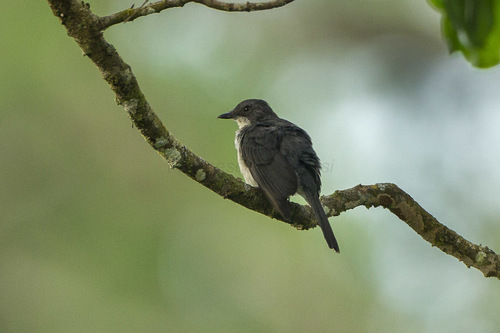
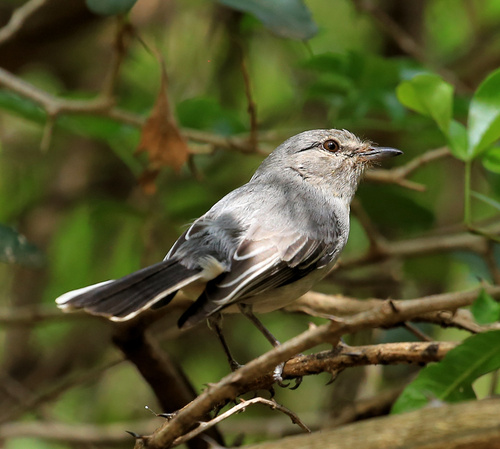
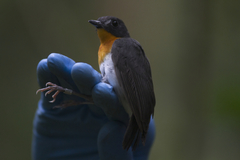
The orange-breasted forest robin (Stiphrornis erythrothorax) is a species of bird mainly found throughout the African tropical rainforest. It has a total length of around 12 cm (4+3⁄4 in), has dark upperparts, and a throat and chest that, depending on the subspecies, is yellow-orange or deep orange.

It has a total length of around 12 cm (4+3⁄4 in), has dark upperparts, and a throat and chest that, depending on the exact subspecies, is yellow-orange or deep orange. The orange-breasted forest robin was formally described in 1855 by the German ornithologist Gustav Hartlaub under the current binomial name Stiphrornis erythrothorax. The specimen had been collected by the Dutch zoologist and colonial administrator Hendrik Severinus Pel at Dabocrom, Ghana. The specific epithet combines the Ancient Greek ερυθρος/eruthros meaning "red" with θωραξ/thōrax meaning "breastplate".

The initial split into multiple species within this genus is based on a review from 1999 where it, based on the phylogenetic species concept, was argued that all then recognized taxa should be considered monotypic species. Of these, S. gabonensis and S. xanthogaster were formerly considered...

Wikipedia →

Sounds

Song0:22

Ivory Coast · 2025

© Bram Piot · XC997710 · CC BY-NC-SA 4.0

Song0:08

Tanzania · 2023

© isaac kilusu · XC803886 · CC BY-NC-SA 4.0

Song0:49

Uganda · 2022

© Peter Boesman · XC740006 · CC BY-NC-ND 4.0

Global Distribution

Parks Where Found

# Park Country Daily sighting probability
1 Taï National Park 🇨🇮 Ivory Coast
~20%
2 Kakum National Park 🇬🇭 Ghana
~10%

Before you go

What are the chances of seeing a Dahomey Forest Robin in Kakum National Park?

With luck

About 10% of wildlife watchers report a Dahomey Forest Robin sighting in Kakum National Park on a given day, based on 43 verified sightings from GBIF citizen-science data from 2019 to 2026. It is the 164th most-seen of the 250 birds we can rate there. Over three days the chance rises to about 20%, and over a week to about 40%, if each day is a fresh chance.

When is the best time to see a Dahomey Forest Robin in Kakum National Park?

September

In that month about 20% of wildlife watchers report a Dahomey Forest Robin in Kakum National Park on a given day, against under 5% in November to January, the lowest months. That is one of Kakum National Park's wettest months, with about 210 mm of rain against 35 mm in January.

What time of day is best to see a Dahomey Forest Robin?

Between 6 and 9 am

Across all the parks we cover, that three-hour window holds the most Dahomey Forest Robin sightings with a recorded time, and about 7 in 10 of them come between 6 am and 6 pm: it is most active around dawn and dusk.

Is Kakum National Park the best place to see a Dahomey Forest Robin?

2nd of 2

Of the 2 parks where we can rate Dahomey Forest Robin sightings, Kakum National Park ranks 2nd at about 10%. The best odds are in Taï National Park (Ivory Coast, about 20%).

Which relatives of the Dahomey Forest Robin live in Kakum National Park?

Same family: Muscicapidae

The closest relatives of the Dahomey Forest Robin that you can see in Kakum National Park (family Muscicapidae, Old World Flycatchers, Robins, and Chats) are Little Gray Flycatcher (about 20%), Dusky-blue Flycatcher (about 10%) and Grey-throated Flycatcher (about 10%), with each one's daily chance of a sighting.

Where does the Dahomey Forest Robin sighting chance come from?

GBIF citizen-science records

It is estimated from how often the Dahomey Forest Robin is recorded against all the birds logged in Kakum National Park (43 verified sightings from 2019 to 2026), calibrated against known sighting rates. Figures are rounded to the nearest 10% because citizen-science data supports honest approximations, not decimals, and months with records from fewer than five people show "—". How it works.

← Back to Kakum National Park