Pied Falconet

Pied Falconet

Microhierax melanoleucos

Silhouette: Sheatherius · PhyloPic

LCLeast ConcernNTVUENCR
Daily sighting probability <5% · Rare
at Kaziranga National Park

In 3 days <5% in a week ~10%

26 Verified sightings at Kaziranga National Park From 2019 to 2026
291 In all 4 parks
January Best month
🌅 Crepuscular When it's spotted

About the Pied Falconet

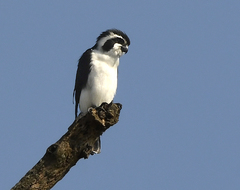
The pied falconet, (Microhierax melanoleucos) is a species of bird of prey in the family Falconidae. It is found in Bangladesh, Bhutan, China, Hong Kong, India, Laos, and Vietnam. Its natural habitat is temperate forests.

These raptors belong to the genus Microhierax, which includes the smallest bird of prey species in the world. The pied falconet, also known as the white-legged falconet, nests in old woodpecker cavities. The species is listed as least concern because of its large home range and stable population size.

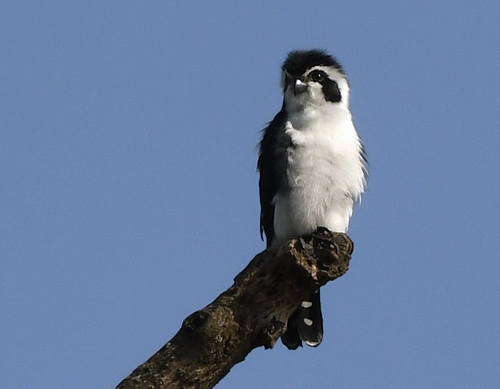
The pied falconet is a small black and white raptor, measuring between 7 and 7 ½ inches and weighing between 55 and 75 grams (2.6 oz). However, it is still larger than the other members of the genus Microhierax. Its face is white with a prominent black patch covering the eyes reaching to the ear coverts. The upper parts, including the crown, are completely black. The primaries are black with white wing bars. Its long tail has black upper parts and is black with white bars from below. The pied falconet displays no sexual dimorphism, and the juveniles strongly resemble adult males.

The five species belonging to the genus Microhierax are the smallest members... Wikipedia →
Sounds

Flight call0:10

China · 2023

© Bo Shunqi 薄顺奇 · XC815445 · CC BY-NC-SA 4.0

Begging call0:34

China · 2023

© Dave GUO · XC892235 · CC BY-NC-SA 4.0

Call0:08

Vietnam · 2011

© Herman van Oosten · XC74954 · CC BY-NC-ND 2.5

Global Distribution

Parks Where Found

# Park Country Daily sighting probability
1 Cuc Phuong National Park 🇻🇳 Vietnam
~20%
2 Namdapha National Park 🇮🇳 India
~10%
3 Kaziranga National Park 🇮🇳 India
<5%
4 Royal Manas National Park 🇧🇹 Bhutan
<5%

Before you go

What are the chances of seeing a Pied Falconet in Kaziranga National Park?

Rare

Under 5% of wildlife watchers report a Pied Falconet sighting in Kaziranga National Park on a given day, based on 26 verified sightings from GBIF citizen-science data from 2019 to 2026. It is the 251st most-seen of the 323 birds we can rate there. Over three days the chance rises to under 5%, and over a week to about 10%, if each day is a fresh chance.

When is the best time to see a Pied Falconet in Kaziranga National Park?

Any time of year

In every month with enough records, under 5% of wildlife watchers report a Pied Falconet in Kaziranga National Park on a given day, so our monthly data shows no clear season. June and July have too few records to rate.

What time of day is best to see a Pied Falconet?

Between midnight and 3 am

Across all the parks we cover, that three-hour window holds the most Pied Falconet sightings with a recorded time, and about 6 in 10 of them come between 6 pm and 6 am: it is most active around dawn and dusk.

Is Kaziranga National Park the best place to see a Pied Falconet?

3rd of 4

Of the 4 parks where we can rate Pied Falconet sightings, Kaziranga National Park ranks 3rd at under 5%. The best odds are in Cuc Phuong National Park (Vietnam, about 20%) and Namdapha National Park (India, about 10%).

Which relatives of the Pied Falconet live in Kaziranga National Park?

Same family: Falconidae

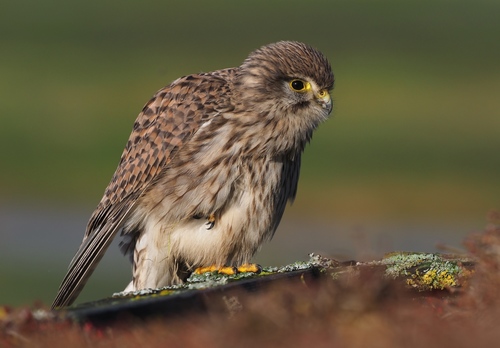
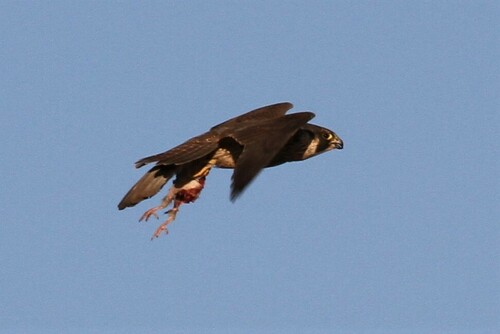
The closest relatives of the Pied Falconet that you can see in Kaziranga National Park (family Falconidae, Falcons and Caracaras) are Common Kestrel (about 20%) and Peregrine Falcon (about 10%), with each one's daily chance of a sighting.

Where does the Pied Falconet sighting chance come from?

GBIF citizen-science records

It is estimated from how often the Pied Falconet is recorded against all the birds logged in Kaziranga National Park (26 verified sightings from 2019 to 2026), calibrated against known sighting rates. Figures are rounded to the nearest 10% because citizen-science data supports honest approximations, not decimals, and months with records from fewer than five people show "—". How it works.

← Back to Kaziranga National Park