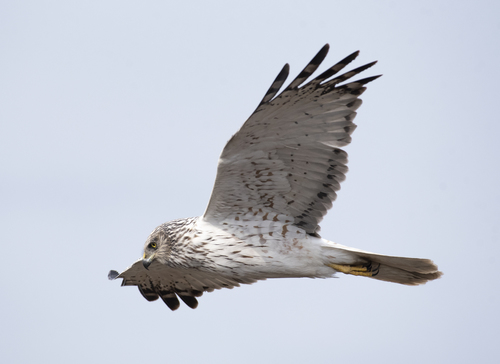
Pied Harrier

Pied Harrier

Circus melanoleucos

Silhouette: Shyamal · PhyloPic

LCLeast ConcernNTVUENCR
Daily sighting probability <5% · Rare
at Kaziranga National Park

In 3 days ~10% in a week ~20%

72 Verified sightings at Kaziranga National Park From 2019 to 2026
285 In all 3 parks
February Best month
☀️ Diurnal When it's spotted

About the Pied Harrier

The pied harrier (Circus melanoleucos) is a bird of prey in the family Accipitridae, named for the male's distinctive white and black colouration. It is a migratory bird endemic to Asia, ranging roughly from southern Siberia to the Philippines. They are primarily solitary although will sometimes form loose groups. They mostly live in open country and eat small mammals.

The pied harrier is a medium-sized raptor. They measure 41-49cm (16 – 19 in) from the end of the tail to tip of the beak. Adult males weigh 265–325g, while adult females weigh 390–455g. They perch on reeds, posts, or on the ground, rarely on trees. Their wings reach far down their tail but not past the tip.

The male is black on the head, neck, back, breast, and primary flight feathers, and white on the forewing, rump, and the rest of its underparts. It has striking yellow eyes. The female is similar looking to that of Montagu's harrier. It is generally dark brown above and pale brown to white below with dark streaking, and a small white rump. Unlike the male, it generally has brown eyes.

The juvenile pied harrier resembles a juvenile Montagu's harrier. It Is darker above than an adult female, with rich... Wikipedia →

Sounds

Flight call0:16

Russian Federation · 2017

© Alex Thomas · XC379706 · CC BY-NC-SA 4.0

Global Distribution

Parks Where Found

# Park Country Daily sighting probability
1 Manas National Park 🇮🇳 India
~10%
2 Kaziranga National Park 🇮🇳 India
<5%
3 Royal Manas National Park 🇧🇹 Bhutan
<5%

Cities Where Found

# City Country Daily sighting probability
1 Kolkata 🇮🇳 India
<5%
2 Beijing 🇨🇳 China
<5%
3 Bangkok 🇹🇭 Thailand
<5%
4 Colombo [Sri Jayawardenepura Kotte] 🇱🇰 Sri Lanka
<5%
5 Guangzhou 🇨🇳 China
<5%
6 Singapore 🇸🇬 Singapore
<5%
7 Taipei 🇹🇼 Taiwan
<5%

Before you go

What are the chances of seeing a Pied Harrier in Kaziranga National Park?

Rare

Under 5% of wildlife watchers report a Pied Harrier sighting in Kaziranga National Park on a given day, based on 72 verified sightings from GBIF citizen-science data from 2019 to 2026. It is the 197th most-seen of the 323 birds we can rate there. Over three days the chance rises to about 10%, and over a week to about 20%, if each day is a fresh chance.

When is the best time to see a Pied Harrier in Kaziranga National Park?

January and February

In those months about 10% of wildlife watchers report a Pied Harrier in Kaziranga National Park on a given day, against under 5% in March–May and August–December, the lowest months. Those are among Kaziranga National Park's driest months, with about 30 mm of rain a month against 520 mm in June. June and July have too few records to rate.

What time of day is best to see a Pied Harrier?

Between 3 and 6 pm

Across all the parks we cover, that three-hour window holds the most Pied Harrier sightings with a recorded time, and about 9 in 10 of them come between 6 am and 6 pm: it is a daytime animal.

Is Kaziranga National Park the best place to see a Pied Harrier?

2nd of 3

Of the 3 parks where we can rate Pied Harrier sightings, Kaziranga National Park ranks 2nd at under 5%. The best odds are in Manas National Park (India, about 10%).

Where does the Pied Harrier sighting chance come from?

GBIF citizen-science records

It is estimated from how often the Pied Harrier is recorded against all the birds logged in Kaziranga National Park (72 verified sightings from 2019 to 2026), calibrated against known sighting rates. Figures are rounded to the nearest 10% because citizen-science data supports honest approximations, not decimals, and months with records from fewer than five people show "—". How it works.

← Back to Kaziranga National Park