White-tailed Lapwing

White-tailed Lapwing

Vanellus leucurus

Silhouette: Rebecca Groom · PhyloPic

LCLeast ConcernNTVUENCR
Daily sighting probability ~30% · Possible
at Keoladeo National Park

In 3 days ~70% in a week ~90%

800 Verified sightings at Keoladeo National Park From 2019 to 2026
800 In 1 park
February Best month
☀️ Diurnal When it's spotted

About the White-tailed Lapwing

The white-tailed lapwing or white-tailed plover (Vanellus leucurus) is a wader in the lapwing genus. The genus name Vanellus is Medieval Latin for a lapwing and derives from vannus, which refers to a winnowing fan. The specific leucurus is from Ancient Greek leukouros, "white-tailed".

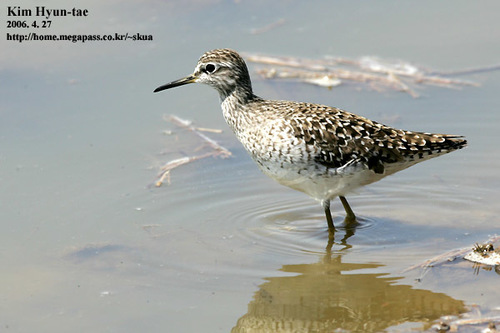
This medium-sized lapwing is long-legged and fairly long-billed. It is the only lapwing likely to be seen in other than very shallow water, where it picks insects and other small prey mainly from the surface. Adults are slim erect birds with a brown back and foreneck, paler face and grey breast. Its long yellow legs, pure white tail and distinctive brown, white and black wings make this species unmistakable. Young birds have a scaly back, and may show some brown in the tail.

The breeding season call is a peewit, similar to northern lapwing. It breeds semi-colonially on inland marshes in Iraq, Kuwait, Iran and southern Russia. Four eggs are laid in a ground nest. The Iraqi and Iranian breeders are mainly residents, but Russian birds migrate south in winter to the Indian subcontinent, the Middle East and north east Africa. It is a very rare vagrant in western Europe, the first example in Britain being found at Packington, Warwickshire on 12 July 1975.

In some parts of its distribution range the species faces threats related to habitat destruction and unintentional poaching. The white-tailed lapwing is one of the species to which the Agreement on the Conservation of African-Eurasian Migratory Waterbirds (AEWA) applies. Wikipedia →

Sounds

Call0:07

Kuwait · 2025

© AUDEVARD Aurélien · XC1071544 · CC BY-NC-SA 4.0

Alarm call1:14

United Arab Emirates · 2022

© Oscar Campbell · XC783130 · CC BY-NC-ND 4.0

Flight call0:24

Uzbekistan · 2014

© Albert Lastukhin · XC184908 · CC BY-NC-SA 4.0

Global Distribution

Parks Where Found

# Park Country Daily sighting probability
1 Keoladeo National Park 🇮🇳 India
~30%

More parks will be added in future updates.

Cities Where Found

# City Country Daily sighting probability
1 Dubai 🇦🇪 United Arab Emirates
<5%
2 New Delhi 🇮🇳 India
<5%

Before you go

What are the chances of seeing a White-tailed Lapwing in Keoladeo National Park?

Possible

About 30% of wildlife watchers report a White-tailed Lapwing sighting in Keoladeo National Park on a given day, based on 800 verified sightings from GBIF citizen-science data from 2019 to 2026. It is the 80th most-seen of the 278 birds we can rate there. Over three days the chance rises to about 70%, and over a week to about 90%, if each day is a fresh chance.

When is the best time to see a White-tailed Lapwing in Keoladeo National Park?

February

In that month about 60% of wildlife watchers report a White-tailed Lapwing in Keoladeo National Park on a given day, against about 10% in April to November, the lowest months. That is one of Keoladeo National Park's driest months, with about 10 mm of rain against 240 mm in July.

What time of day is best to see a White-tailed Lapwing?

Between 6 and 9 am

Across all the parks we cover, that three-hour window holds the most White-tailed Lapwing sightings with a recorded time, and about 7 in 10 of them come between 6 am and 6 pm: it is a daytime animal.

Where else can you see a White-tailed Lapwing?

Only Keoladeo National Park, in our data

Keoladeo National Park is the only park on Wallace's Line with enough records to rate White-tailed Lapwing sightings: about 30% of wildlife watchers there report one on a given day.

Which relatives of the White-tailed Lapwing live in Keoladeo National Park?

Same genus: Vanellus

The closest relatives of the White-tailed Lapwing that you can see in Keoladeo National Park (genus Vanellus, Lapwings) are Red-wattled Lapwing (about 80%), Grey-headed Lapwing (about 10%) and Yellow-wattled Lapwing (about 10%), with each one's daily chance of a sighting.

Where does the White-tailed Lapwing sighting chance come from?

GBIF citizen-science records

It is estimated from how often the White-tailed Lapwing is recorded against all the birds logged in Keoladeo National Park (800 verified sightings from 2019 to 2026), calibrated against known sighting rates. Figures are rounded to the nearest 10% because citizen-science data supports honest approximations, not decimals, and months with records from fewer than five people show "—". How it works.

← Back to Keoladeo National Park