
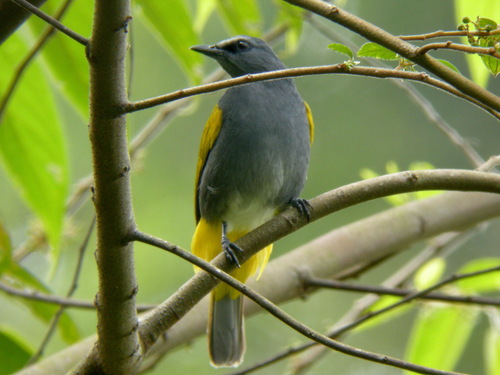
Orange-spotted Bulbul

Orange-spotted Bulbul

Pycnonotus bimaculatus

Silhouette: Andy Wilson · PhyloPic

LCNTNear ThreatenedVUENCR
Daily sighting probability ~30% · Possible
at Kerinci Seblat National Park

In 3 days ~60% in a week ~90%

6 Verified sightings at Kerinci Seblat National Park From 2019 to 2026
15 In all 2 parks
June Best month
🌅 Crepuscular When it's spotted

About the Orange-spotted Bulbul

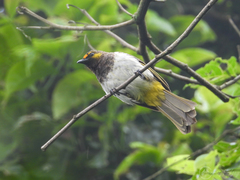
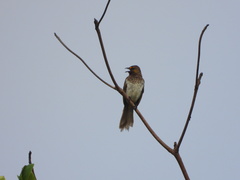
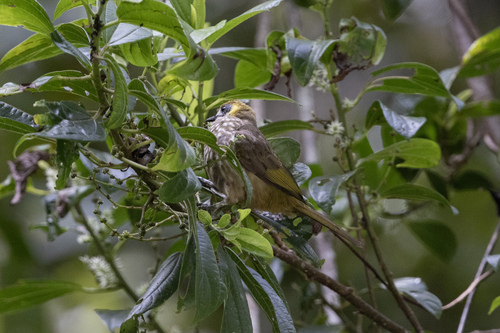
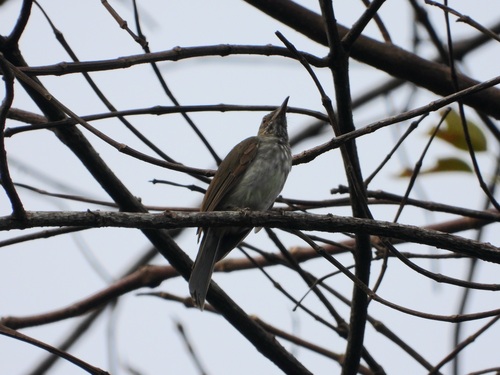
The orange-spotted bulbul (Pycnonotus bimaculatus) is a species of songbird in the bulbul family of passerine birds. It is endemic to Java, Bali and Sumatra. It favors forest edges and open meadows in montane forests. The orange-spotted bulbul was originally described in the genus Turdus by Thomas Horsfield in 1821. Until 2016, the Aceh bulbul (Pycnonotus snouckaerti) was considered as a subspecies of the orange-spotted bulbul until split by the IOC. Most other authorities have not yet recognized this split.

It is a dark-colored and active bulbul with a rounded tail. It is a noisy bird, giving out a variety of harsh and loud calls and songs. It is a frugivore. It breeds throughout the year. Nesting occurs year-round, peaking in May. Nests are robust and cup-shaped. Wikipedia →

Sounds

Recording0:25

Indonesia · 2022

© Meynard Dinesh · iNaturalist · CC BY-NC 4.0

Recording0:11

Indonesia · 2025

© Liam Pentangelo · iNaturalist · CC BY-NC 4.0

Global Distribution

Parks Where Found

# Park Country Daily sighting probability
1 Kerinci Seblat National Park 🇮🇩 Indonesia
~30%
2 Gunung Leuser National Park 🇮🇩 Indonesia
~20%

Zoos & Centres Where Found

# Zoo / Centre Country
1 Aviary 🇭🇰 Hong Kong SAR China In captivity

Before you go

What are the chances of seeing an Orange-spotted Bulbul in Kerinci Seblat National Park?

Possible

About 30% of wildlife watchers report an Orange-spotted Bulbul sighting in Kerinci Seblat National Park on a given day, based on 6 verified sightings from GBIF citizen-science data from 2019 to 2026. It is the 38th most-seen of the 203 birds we can rate there. Over three days the chance rises to about 60%, and over a week to about 90%, if each day is a fresh chance.

When is the best time to see an Orange-spotted Bulbul in Kerinci Seblat National Park?

February, June and September

In those months about 50% of wildlife watchers report an Orange-spotted Bulbul in Kerinci Seblat National Park on a given day, against under 5% in July–August and December–January, the lowest months.

What time of day is best to see an Orange-spotted Bulbul?

Between 3 and 6 am

Across all the parks we cover, that three-hour window holds the most Orange-spotted Bulbul sightings with a recorded time, and about 6 in 10 of them come between 6 pm and 6 am: it is most active around dawn and dusk.

Is Kerinci Seblat National Park the best place to see an Orange-spotted Bulbul?

Yes

Of the 2 parks where we can rate Orange-spotted Bulbul sightings, Kerinci Seblat National Park has the highest daily chance: about 30%. Next come Gunung Leuser National Park (Indonesia, about 20%).

Which relatives of the Orange-spotted Bulbul live in Kerinci Seblat National Park?

Same genus: Pycnonotus

The closest relatives of the Orange-spotted Bulbul that you can see in Kerinci Seblat National Park (genus Pycnonotus, Typical Bulbuls) are Spot-necked Bulbul (about 30%), Sooty-headed Bulbul (about 20%) and Yellow-vented Bulbul (about 20%), with each one's daily chance of a sighting.

Where does the Orange-spotted Bulbul sighting chance come from?

GBIF citizen-science records

It is estimated from how often the Orange-spotted Bulbul is recorded against all the birds logged in Kerinci Seblat National Park (6 verified sightings from 2019 to 2026), calibrated against known sighting rates. Figures are rounded to the nearest 10% because citizen-science data supports honest approximations, not decimals, and months with records from fewer than five people show "—". How it works.

← Back to Kerinci Seblat National Park