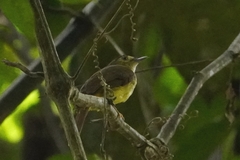
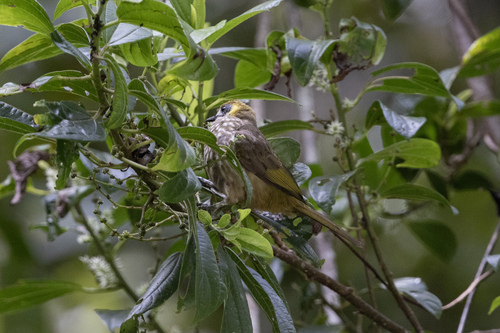
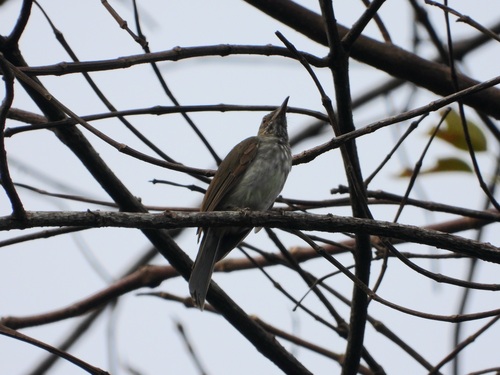
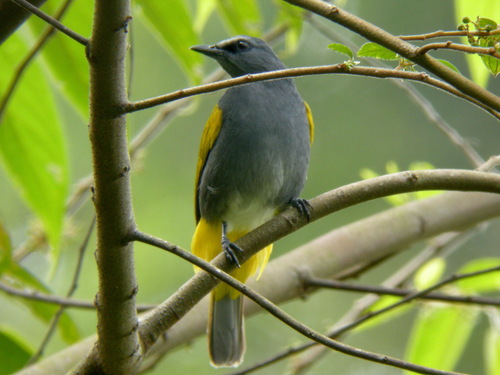
Hairy-backed Bulbul

Hairy-backed Bulbul

Tricholestes criniger

Silhouette: PhyloPic

LCLeast ConcernNTVUENCR
Daily sighting probability ~10% · With luck
at Kerinci Seblat National Park

In 3 days ~20% in a week ~40%

43 Verified sightings at Kerinci Seblat National Park From 2019 to 2026
1,880 In all 10 parks
August Best month
🌅 Crepuscular When it's spotted

About the Hairy-backed Bulbul

The hairy-backed bulbul (Tricholestes criniger) is a songbird species in the bulbul family, Pycnonotidae. It is the sole species contained within the monotypic genus Tricholestes. It is found on the Malay Peninsula, Sumatra, and Borneo. Its natural habitat is subtropical or tropical moist lowland forests.

The hairy-backed bulbul was originally described in the genus Brachypodius (a synonym for Pycnonotus). Alternatively, some authorities have classified the hairy-backed bulbul in the genera Trichophorus (a synonym for Criniger) and Hypsipetes.

Found on western Sumatra Found on Borneo The hairy-backed bulbul is a small (16–17 cm long, weigh 12–21 g), relatively quiet bulbul with a slightly rounded tail and strong rictal bristles. It is olive above and yellowish below... Wikipedia →

Sounds

Song0:18

Malaysia · 2023

© Joshua Chong · XC808398 · CC BY-NC-SA 4.0

Call1:04

Thailand · 2023

© Ding Li Yong · XC804213 · CC BY-NC-ND 4.0

Alarm call0:22

Thailand · 2016

© Greg Irving · XC345996 · CC BY-NC-SA 4.0

Global Distribution

Parks Where Found

# Park Country Daily sighting probability
1 Khao Luang National Park 🇹🇭 Thailand
~40%
2 Danum Valley Conservation Area 🇲🇾 Malaysia
~40%
3 Taman Negara National Park 🇲🇾 Malaysia
~30%
4 Way Kambas National Park 🇮🇩 Indonesia
~20%
5 Khao Sok National Park 🇹🇭 Thailand
~20%
6 Sepilok 🇲🇾 Malaysia
~10%
7 Gunung Leuser National Park 🇮🇩 Indonesia
~10%
8 Kerinci Seblat National Park 🇮🇩 Indonesia
~10%
9 Kinabalu Park 🇲🇾 Malaysia
<5%
10 Kinabatangan Wildlife Sanctuary 🇲🇾 Malaysia
<5%

Before you go

What are the chances of seeing a Hairy-backed Bulbul in Kerinci Seblat National Park?

With luck

About 10% of wildlife watchers report a Hairy-backed Bulbul sighting in Kerinci Seblat National Park on a given day, based on 43 verified sightings from GBIF citizen-science data from 2019 to 2026. It is the 99th most-seen of the 203 birds we can rate there. Over three days the chance rises to about 20%, and over a week to about 40%, if each day is a fresh chance.

When is the best time to see a Hairy-backed Bulbul in Kerinci Seblat National Park?

July and August

In those months about 10% of wildlife watchers report a Hairy-backed Bulbul in Kerinci Seblat National Park on a given day, against under 5% in February–June and September–December, the lowest months. January has too few records to rate.

What time of day is best to see a Hairy-backed Bulbul?

Between 2 and 5 am

Across all the parks we cover, that three-hour window holds the most Hairy-backed Bulbul sightings with a recorded time, and about 6 in 10 of them come between 6 pm and 6 am: it is most active around dawn and dusk.

Which relatives of the Hairy-backed Bulbul live in Kerinci Seblat National Park?

Same family: Pycnonotidae

The closest relatives of the Hairy-backed Bulbul that you can see in Kerinci Seblat National Park (family Pycnonotidae, Bulbuls) are Spot-necked Bulbul (about 30%), Orange-spotted Bulbul (about 30%) and Sooty-headed Bulbul (about 20%), with each one's daily chance of a sighting.

Where does the Hairy-backed Bulbul sighting chance come from?

GBIF citizen-science records

It is estimated from how often the Hairy-backed Bulbul is recorded against all the birds logged in Kerinci Seblat National Park (43 verified sightings from 2019 to 2026), calibrated against known sighting rates. Figures are rounded to the nearest 10% because citizen-science data supports honest approximations, not decimals, and months with records from fewer than five people show "—". How it works.

← Back to Kerinci Seblat National Park