Rufous-vented Warbler

Rufous-vented Warbler

Sylvia subcaerulea

Silhouette: Martin Bulla, based on John Cox's illustration · PhyloPic

Daily sighting probability ~20% · Possible
at Kgalagadi Transfrontier Park

In 3 days ~50% in a week ~80%

24 Verified sightings at Kgalagadi Transfrontier Park From 2019 to 2026
24 In 1 park
May Best month
☀️ Diurnal When it's spotted

About the Rufous-vented Warbler

The chestnut-vented warbler, chestnut-vented tit-babbler or rufous-vented warbler (Curruca subcoerulea) is an Old World warbler of the family Sylviidae. The chestnut-vented warbler breeds in southern Africa in Angola, Botswana, Zimbabwe, Zambia, Namibia, South Africa, Lesotho, Mozambique and Eswatini. This is a common species found in a range of habitats including fynbos, scrub, thickets and dry riverbeds.

The first formal description of the chestnut-vented warbler was by the French naturalist Louis Pierre Vieillot in 1817. He introduced the binomial name Sylvia subcœrulea using the œ ligature. The specific epithet would normally be spelled subcaerulea or subcærulea and comes from the Latin sub meaning somewhat or beneath and caeruleus for blue. In modern Latin subcaeruleus is used to indicate pale blue. Most authorities use the standard spelling subcaerulea but some use the original spelling subcoerulea.

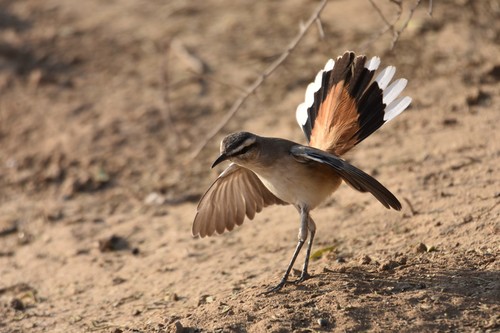
The chestnut-vented warbler is 14–15 cm long and weighs around 16 g. Its upperparts are grey-brown, and the tail is black with a broad white band at its tip. This warbler has a white eye ring. The throat is grey with heavy dark streaking, the breast... Wikipedia →

Sounds

Recording0:34

Namibia · 2025

© Douwe de Boer · Observation.org, Nature data from around the World · CC BY-NC-ND 4.0

Global Distribution

Parks Where Found

# Park Country Daily sighting probability
1 Kgalagadi Transfrontier Park 🇿🇦 South Africa
~20%

More parks will be added in future updates.

Before you go

What are the chances of seeing a Rufous-vented Warbler in Kgalagadi Transfrontier Park?

Possible

About 20% of wildlife watchers report a Rufous-vented Warbler sighting in Kgalagadi Transfrontier Park on a given day, based on 24 verified sightings from GBIF citizen-science data from 2019 to 2026. It is the 44th most-seen of the 122 birds we can rate there. Over three days the chance rises to about 50%, and over a week to about 80%, if each day is a fresh chance.

When is the best time to see a Rufous-vented Warbler in Kgalagadi Transfrontier Park?

May

In that month about 40% of wildlife watchers report a Rufous-vented Warbler in Kgalagadi Transfrontier Park on a given day, against under 5% in June, August and November–February, the lowest months. That is one of Kgalagadi Transfrontier Park's driest months, with almost no rain against 40 mm in January.

What time of day is best to see a Rufous-vented Warbler?

Between 7 and 10 am

Across all the parks we cover, that three-hour window holds the most Rufous-vented Warbler sightings with a recorded time, and about 9 in 10 of them come between 6 am and 6 pm: it is a daytime animal.

Where else can you see a Rufous-vented Warbler?

Only Kgalagadi Transfrontier Park, in our data

Kgalagadi Transfrontier Park is the only park on Wallace's Line with enough records to rate Rufous-vented Warbler sightings: about 20% of wildlife watchers there report one on a given day.

Where does the Rufous-vented Warbler sighting chance come from?

GBIF citizen-science records

It is estimated from how often the Rufous-vented Warbler is recorded against all the birds logged in Kgalagadi Transfrontier Park (24 verified sightings from 2019 to 2026), calibrated against known sighting rates. Figures are rounded to the nearest 10% because citizen-science data supports honest approximations, not decimals, and months with records from fewer than five people show "—". How it works.

← Back to Kgalagadi Transfrontier Park