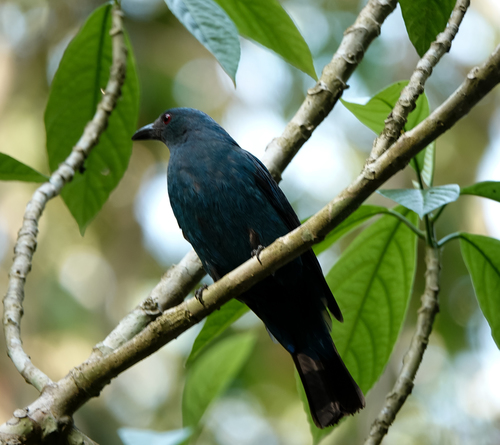
Lesser Cuckooshrike

Lesser Cuckooshrike

Coracina fimbriata

Silhouette: PhyloPic

Daily sighting probability ~20% · Possible
at Khao Luang National Park

In 3 days ~50% in a week ~80%

139 Verified sightings at Khao Luang National Park From 2019 to 2026
675 In all 7 parks
May Best month
☀️ Diurnal When it's spotted

About the Lesser Cuckooshrike

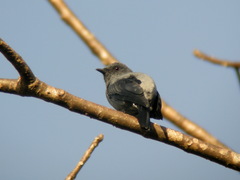
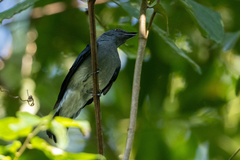
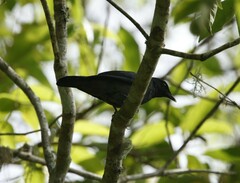
The lesser cuckooshrike (Lalage fimbriata) is a species of bird in the family Campephagidae. It is found in Brunei, Indonesia, Malaysia, Myanmar, Singapore, and Thailand. It is small, short-tailed, shrike-like bird, 20 cm in length. The male is dark grey, paler below with contrasting dark, blackish flight feathers, and a blackish head. The tail is also black with light tips, ranging from white to greyish. The female is paler with pale barring on underside. Immature birds are browner with grey and white barring or spotting on the pale breast. The iris is brown, and the bill and feet are black.

It is resident across the Malay Peninsula and the Greater Sundas, where it is an occasional bird of lowland and hill forest (up to 1000 m on Sumatra, and 1500 m on Java). The lesser cuckooshrike prefers primary forest but also visits surrounding cultivated areas and plantations and gardens. It generally keeps to treetops, where it can be seen singly or in pairs and often in mixed flocks. In winter small flocks form. Its diet consists of insects.

Jean Delacour, 'The Lesser Graybirds (Coracina) of Asia and Malaysia', American Museum Novitates, 3 April 1951 Wikipedia →

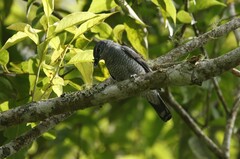
Sounds

Recording0:04

Malaysia · 2025

© David Torres · iNaturalist · CC BY-NC 4.0

Global Distribution

Parks Where Found

# Park Country Daily sighting probability
1 Way Kambas National Park 🇮🇩 Indonesia
~20%
2 Khao Luang National Park 🇹🇭 Thailand
~20%
3 Danum Valley Conservation Area 🇲🇾 Malaysia
~10%
4 Bako National Park 🇲🇾 Malaysia
~10%
5 Sepilok 🇲🇾 Malaysia
~10%
6 Khao Sok National Park 🇹🇭 Thailand
<5%
7 Taman Negara National Park 🇲🇾 Malaysia
<5%

Cities Where Found

# City Country Daily sighting probability
1 Kuala Lumpur 🇲🇾 Malaysia
<5%

Before you go

What are the chances of seeing a Lesser Cuckooshrike in Khao Luang National Park?

Possible

About 20% of wildlife watchers report a Lesser Cuckooshrike sighting in Khao Luang National Park on a given day, based on 139 verified sightings from GBIF citizen-science data from 2019 to 2026. It is the 76th most-seen of the 215 birds we can rate there. Over three days the chance rises to about 50%, and over a week to about 80%, if each day is a fresh chance.

When is the best time to see a Lesser Cuckooshrike in Khao Luang National Park?

May

In that month about 40% of wildlife watchers report a Lesser Cuckooshrike in Khao Luang National Park on a given day, against about 10% in June–July and September, the lowest months.

What time of day is best to see a Lesser Cuckooshrike?

Between 9 am and noon

Across all the parks we cover, that three-hour window holds the most Lesser Cuckooshrike sightings with a recorded time, and about 9 in 10 of them come between 6 am and 6 pm: it is a daytime animal.

Is Khao Luang National Park the best place to see a Lesser Cuckooshrike?

Among the best

Of the 7 parks where we can rate Lesser Cuckooshrike sightings, Khao Luang National Park ranks 2nd at about 20%, level with the leaders once rounded. The best odds are in Way Kambas National Park (Indonesia, about 20%).

Which relatives of the Lesser Cuckooshrike live in Khao Luang National Park?

Same family: Campephagidae

The closest relatives of the Lesser Cuckooshrike that you can see in Khao Luang National Park (family Campephagidae, Cuckooshrikes) are Brown-rumped Minivet (about 10%), Scarlet Minivet (about 10%) and Fiery Minivet (about 10%), with each one's daily chance of a sighting.

Where does the Lesser Cuckooshrike sighting chance come from?

GBIF citizen-science records

It is estimated from how often the Lesser Cuckooshrike is recorded against all the birds logged in Khao Luang National Park (139 verified sightings from 2019 to 2026), calibrated against known sighting rates. Figures are rounded to the nearest 10% because citizen-science data supports honest approximations, not decimals, and months with records from fewer than five people show "—". How it works.

← Back to Khao Luang National Park