Sakhalin Leaf-Warbler

Sakhalin Leaf-Warbler

Phylloscopus borealoides

Silhouette: Jiekun He · PhyloPic

LCLeast ConcernNTVUENCR
Daily sighting probability ~10% · With luck
at Khao Luang National Park

In 3 days ~20% in a week ~40%

35 Verified sightings at Khao Luang National Park From 2019 to 2026
193 In all 6 parks
December Best month

About the Sakhalin Leaf-Warbler

The Sakhalin leaf warbler (Phylloscopus borealoides) is a species of Old World warbler in the family Phylloscopidae. It is found in Sakhalin, the Kuril Islands and Japan; it winters to the Amami and Okinawa islands and Indochina.

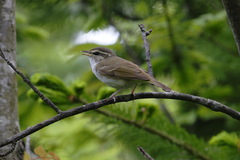
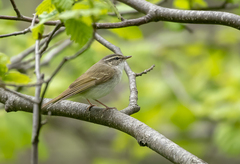
Its natural habitat is temperate forests. It has a long white supercilium and broad, dark brown eye-stripes. Its crown, upper parts, and bill are also dark brown. It has greenish-brown cheeks and its ear-coverts are mottled. Its bill has a pink base that extends to the lower mandible. Its legs are pale pinkish-brown.

It is easily confused with the pale-legged leaf warbler. One possible distinguishing feature is that its upperparts are slightly more greenish. It is more easily distinguished by its lower-pitched vocalizations, but some overlap does exist in the species' pitch ranges.

It nests in shrubs. Wikipedia →

Sounds

Song0:42

Japan · 2026

© Ding Li Yong · XC1148018 · CC BY-NC-ND 4.0

Call0:15

Singapore · 2026

© Kim Chuah Lim · XC1075519 · CC BY-NC-SA 4.0

Call0:31

Laos · 2022

© Bram Piot · XC700069 · CC BY-NC-SA 4.0

Global Distribution

Parks Where Found

# Park Country Daily sighting probability
1 Nikko National Park 🇯🇵 Japan
~10%
2 Khao Luang National Park 🇹🇭 Thailand
~10%
3 Khao Sok National Park 🇹🇭 Thailand
<5%
4 Kaeng Krachan National Park 🇹🇭 Thailand
<5%
5 Doi Inthanon National Park 🇹🇭 Thailand
<5%
6 Khao Yai National Park 🇹🇭 Thailand
<5%

Cities Where Found

# City Country Daily sighting probability
1 Sendai 🇯🇵 Japan
<5%
2 Bangkok 🇹🇭 Thailand
<5%
3 Nagoya 🇯🇵 Japan
<5%
4 Osaka 🇯🇵 Japan
<5%
5 Hangzhou 🇨🇳 China
<5%
6 Hong Kong 🇨🇳 China
<5%
7 Guangzhou 🇨🇳 China
<5%
8 Singapore 🇸🇬 Singapore
<5%
9 Tokyo 🇯🇵 Japan
<5%

Before you go

What are the chances of seeing a Sakhalin Leaf-Warbler in Khao Luang National Park?

With luck

About 10% of wildlife watchers report a Sakhalin Leaf-Warbler sighting in Khao Luang National Park on a given day, based on 35 verified sightings from GBIF citizen-science data from 2019 to 2026. It is the 139th most-seen of the 215 birds we can rate there. Over three days the chance rises to about 20%, and over a week to about 40%, if each day is a fresh chance.

When is the best time to see a Sakhalin Leaf-Warbler in Khao Luang National Park?

December

In that month about 20% of wildlife watchers report a Sakhalin Leaf-Warbler in Khao Luang National Park on a given day, against under 5% in April to November, the lowest months. That is one of Khao Luang National Park's wettest months, with about 310 mm of rain against 65 mm in March.

Is Khao Luang National Park the best place to see a Sakhalin Leaf-Warbler?

Among the best

Of the 6 parks where we can rate Sakhalin Leaf-Warbler sightings, Khao Luang National Park ranks 2nd at about 10%, level with the leaders once rounded. The best odds are in Nikko National Park (Japan, about 10%).

Which relatives of the Sakhalin Leaf-Warbler live in Khao Luang National Park?

Same genus: Phylloscopus

The closest relatives of the Sakhalin Leaf-Warbler that you can see in Khao Luang National Park (genus Phylloscopus, Leaf Warblers) are Arctic Warbler (about 10%), Eastern Crowned-Warbler (about 10%) and Yellow-browed Warbler (about 10%), with each one's daily chance of a sighting.

Where does the Sakhalin Leaf-Warbler sighting chance come from?

GBIF citizen-science records

It is estimated from how often the Sakhalin Leaf-Warbler is recorded against all the birds logged in Khao Luang National Park (35 verified sightings from 2019 to 2026), calibrated against known sighting rates. Figures are rounded to the nearest 10% because citizen-science data supports honest approximations, not decimals, and months with records from fewer than five people show "—". How it works.

← Back to Khao Luang National Park