Tiger Shrike

Tiger Shrike

Lanius tigrinus

Silhouette: Andy Wilson · PhyloPic

LCLeast ConcernNTVUENCR
Daily sighting probability <5% · Rare
at Khao Sok National Park

In 3 days <5% in a week ~10%

11 Verified sightings at Khao Sok National Park From 2019 to 2026
121 In all 7 parks
April Best month
☀️ Diurnal When it's spotted

About the Tiger Shrike

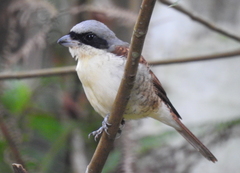
The tiger shrike or thick-billed shrike (Lanius tigrinus) is a small passerine bird which belongs to the genus Lanius in the shrike family, Laniidae. It is found in wooded habitats across eastern Asia. It is a shy, often solitary bird which is less conspicuous than most other shrikes. Like other shrikes it is predatory, feeding on small animals. Its nest is built in a tree and three to six eggs are laid.

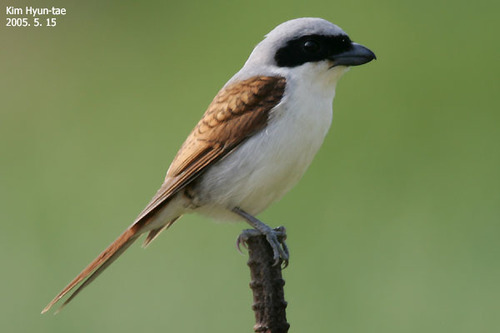
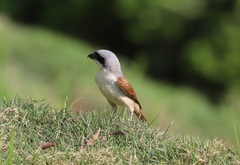
It derives its name from the tiger-like pattern of its upperparts which are reddish-brown with dark bars. Adult males have white underparts and a grey head with a black mask. Females and young birds are duller and browner and young birds lack the grey and black on the head.

The tiger shrike was first described in 1822 by the Belgian naturalist Pierre Auguste Joseph Drapiez in the Dictionnaire classique d'histoire naturelle. He placed it in the genus Lanius, a group of about 26 species living in open areas across Eurasia, Africa and North America. The name of the genus means "butcher" in Latin, referring to the birds' habit of impaling and storing prey. Within the genus, analysis of calls suggests that the tiger shrike is most closely related to the brown shrike (L. cristatus... Wikipedia →
Sounds

Call0:15

China · 2014

© Bo Shunqi 薄顺奇 · XC843312 · CC BY-NC-SA 4.0

Subsong1:19

Laos · 2022

© Bram Piot · XC721417 · CC BY-NC-SA 4.0

Song0:14

South Korea · 2020

© Wonseok Jang · XC661929 · CC BY-NC-SA 4.0

Global Distribution

Parks Where Found

# Park Country Daily sighting probability
1 Way Kambas National Park 🇮🇩 Indonesia
~10%
2 Gunung Leuser National Park 🇮🇩 Indonesia
~10%
3 Khao Sok National Park 🇹🇭 Thailand
<5%
4 Khao Luang National Park 🇹🇭 Thailand
<5%
5 Taman Negara National Park 🇲🇾 Malaysia
<5%
6 Cat Tien National Park 🇻🇳 Vietnam
<5%
7 Kaeng Krachan National Park 🇹🇭 Thailand
<5%

Cities Where Found

# City Country Daily sighting probability
1 Kuala Lumpur 🇲🇾 Malaysia
~10%
2 Wuhan 🇨🇳 China
<5%
3 Chengdu 🇨🇳 China
<5%
4 Singapore 🇸🇬 Singapore
<5%
5 Hangzhou 🇨🇳 China
<5%
6 Suzhou 🇨🇳 China
<5%
7 Nanjing 🇨🇳 China
<5%
8 Guangzhou 🇨🇳 China
<5%
9 Bangkok 🇹🇭 Thailand
<5%
10 Seoul 🇰🇷 South Korea
<5%

Before you go

What are the chances of seeing a Tiger Shrike in Khao Sok National Park?

Rare

Under 5% of wildlife watchers report a Tiger Shrike sighting in Khao Sok National Park on a given day, based on 11 verified sightings from GBIF citizen-science data from 2019 to 2026. It is the 188th most-seen of the 213 birds we can rate there. Over three days the chance rises to under 5%, and over a week to about 10%, if each day is a fresh chance.

When is the best time to see a Tiger Shrike in Khao Sok National Park?

April

In that month about 10% of wildlife watchers report a Tiger Shrike in Khao Sok National Park on a given day, against under 5% in May to March, the lowest months.

What time of day is best to see a Tiger Shrike?

Between 7 and 10 am

Across all the parks we cover, that three-hour window holds the most Tiger Shrike sightings with a recorded time, and about 9 in 10 of them come between 6 am and 6 pm: it is a daytime animal.

Is Khao Sok National Park the best place to see a Tiger Shrike?

3rd of 7

Of the 7 parks where we can rate Tiger Shrike sightings, Khao Sok National Park ranks 3rd at under 5%. The best odds are in Way Kambas National Park (Indonesia, about 10%) and Gunung Leuser National Park (Indonesia, about 10%).

Where does the Tiger Shrike sighting chance come from?

GBIF citizen-science records

It is estimated from how often the Tiger Shrike is recorded against all the birds logged in Khao Sok National Park (11 verified sightings from 2019 to 2026), calibrated against known sighting rates. Figures are rounded to the nearest 10% because citizen-science data supports honest approximations, not decimals, and months with records from fewer than five people show "—". How it works.

← Back to Khao Sok National Park