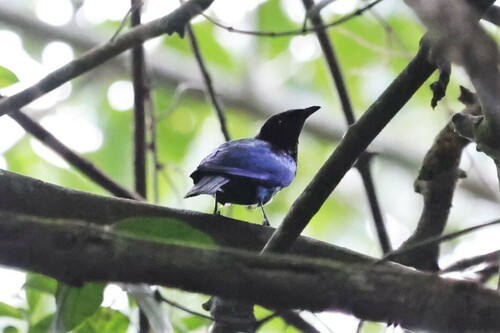
Dusky Tit

Dusky Tit

Parus funereus

Silhouette: Ferran Sayol · PhyloPic

LCLeast ConcernNTVUENCR
Daily sighting probability ~10% · With luck
at Kibale National Park

In 3 days ~30% in a week ~50%

173 Verified sightings at Kibale National Park From 2019 to 2026
733 In all 4 parks
February Best month
☀️ Diurnal When it's spotted

About the Dusky Tit

The dusky tit (Melaniparus funereus) is a species of bird in the tit family Paridae. It is native to the African tropical rainforest. The dusky tit was formerly one of the many species placed in the genus Parus. It was moved to the resurrected genus Melaniparus based on a molecular phylogenetic analysis published in 2013.

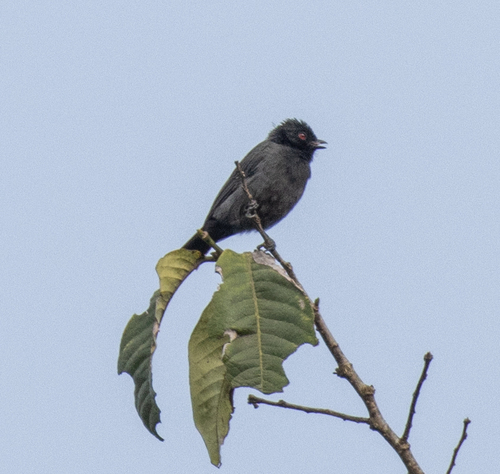
This bird has an unknown population size in the middle of Africa. The dusky tit is known for being almost entirely black with brownish or gray tones, depending on its sex. It is a relatively minor bird to a medium-sized bird; it may range from 13 to 15 cm depending on the sex. It is characterized by red eyes and a chirp that sounds like "dree di-di-di".

The males are mostly black, and the only distinct color resides in the eyes. The eyes will almost always be primarily red, but can vary from red to orange-red. Another key feature is its bill, which is smaller and thus easier to identify. In general, the male is the dominant sex. Therefore, its length will vary more towards the 14-15 cm mark.

The female has similar characteristics as the male; however, the upper body parts are more blackish-gray. Their tail is fringed gray and brown; however,... Wikipedia →
Global Distribution

Parks Where Found

# Park Country Daily sighting probability
1 Bwindi Impenetrable National Park 🇺🇬 Uganda
~20%
2 Odzala-Kokoua National Park 🇨🇬 Republic of the Congo
~20%
3 Nyungwe National Park 🇷🇼 Rwanda
~10%
4 Kibale National Park 🇺🇬 Uganda
~10%

Before you go

What are the chances of seeing a Dusky Tit in Kibale National Park?

With luck

About 10% of wildlife watchers report a Dusky Tit sighting in Kibale National Park on a given day, based on 173 verified sightings from GBIF citizen-science data from 2019 to 2026. It is the 130th most-seen of the 366 birds we can rate there. Over three days the chance rises to about 30%, and over a week to about 50%, if each day is a fresh chance.

When is the best time to see a Dusky Tit in Kibale National Park?

February

In that month about 20% of wildlife watchers report a Dusky Tit in Kibale National Park on a given day, against under 5% in April and November, the lowest months. That is one of Kibale National Park's driest months, with about 20 mm of rain against 140 mm in November.

What time of day is best to see a Dusky Tit?

Between 9 am and noon

Across all the parks we cover, that three-hour window holds the most Dusky Tit sightings with a recorded time, and nearly all of them come between 6 am and 6 pm: it is a daytime animal.

Which relatives of the Dusky Tit live in Kibale National Park?

Same order: Passeriformes

The closest relatives of the Dusky Tit that you can see in Kibale National Park (order Passeriformes, Perching Birds) are Common Bulbul (about 60%), Little Greenbul (about 50%) and Gray-headed Negrofinch (about 50%), with each one's daily chance of a sighting.

Where does the Dusky Tit sighting chance come from?

GBIF citizen-science records

It is estimated from how often the Dusky Tit is recorded against all the birds logged in Kibale National Park (173 verified sightings from 2019 to 2026), calibrated against known sighting rates. Figures are rounded to the nearest 10% because citizen-science data supports honest approximations, not decimals, and months with records from fewer than five people show "—". How it works.

← Back to Kibale National Park