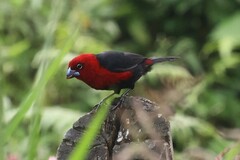
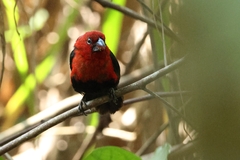
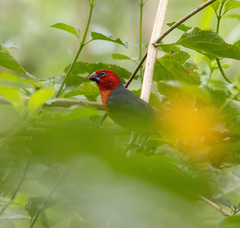
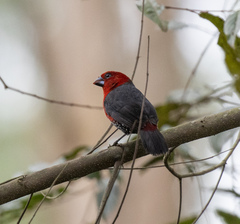
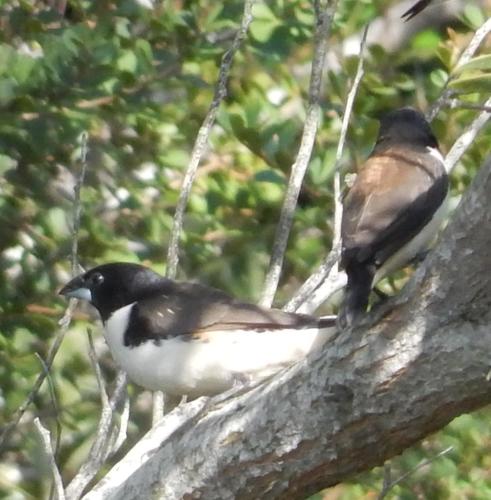
Red-headed Bluebill

Red-headed Bluebill

Spermophaga ruficapilla

Silhouette: Sheatherius · PhyloPic

LCLeast ConcernNTVUENCR
Daily sighting probability ~20% · Possible
at Kibale National Park

In 3 days ~40% in a week ~70%

275 Verified sightings at Kibale National Park From 2019 to 2026
447 In all 5 parks
August Best month
☀️ Diurnal When it's spotted

About the Red-headed Bluebill

The red-headed bluebill (Spermophaga ruficapilla) is a common species of estrildid finch found in Sub-Saharan Africa. It is found in Angola, Burundi, Central African Republic, The Democratic Republic of the Congo, Kenya, Rwanda, South Sudan, Tanzania and Uganda.

This species has a large range, with an estimated global extent of occurrence of 560,000 km2. The global population size has not been quantified, but it is believed to be large as the species is described as "frequent" in at least parts of its range (Fry and Keith 2004). Global population trends have not been quantified, but the species is not believed to approach the thresholds for the population decline criterion of the IUCN Red List (i.e. declining more than 30% in ten years or three generations). For these reasons, the species is evaluated as being of least concern.[1]

BirdLife International species factsheet Wikipedia →

Sounds

Call0:29

Uganda · 2022

© Peter Boesman · XC740001 · CC BY-NC-ND 4.0

Call0:15

Uganda · 2013

© Josh Engel · XC137899 · CC BY-NC-SA 3.0

Global Distribution

Parks Where Found

# Park Country Daily sighting probability
1 Semuliki National Park 🇺🇬 Uganda
~20%
2 Kibale National Park 🇺🇬 Uganda
~20%
3 Bwindi Impenetrable National Park 🇺🇬 Uganda
<5%
4 Virunga National Park 🇨🇩 Democratic Republic of the Congo
<5%
5 Queen Elizabeth National Park 🇺🇬 Uganda
<5%

Cities Where Found

# City Country Daily sighting probability
1 Kampala 🇺🇬 Uganda
<5%

Before you go

What are the chances of seeing a Red-headed Bluebill in Kibale National Park?

Possible

About 20% of wildlife watchers report a Red-headed Bluebill sighting in Kibale National Park on a given day, based on 275 verified sightings from GBIF citizen-science data from 2019 to 2026. It is the 93rd most-seen of the 366 birds we can rate there. Over three days the chance rises to about 40%, and over a week to about 70%, if each day is a fresh chance.

When is the best time to see a Red-headed Bluebill in Kibale National Park?

August

In that month about 30% of wildlife watchers report a Red-headed Bluebill in Kibale National Park on a given day, against about 10% in January–February, June–July, September and November, the lowest months.

What time of day is best to see a Red-headed Bluebill?

Between 7 and 10 am

Across all the parks we cover, that three-hour window holds the most Red-headed Bluebill sightings with a recorded time, and about 8 in 10 of them come between 6 am and 6 pm: it is a daytime animal.

Is Kibale National Park the best place to see a Red-headed Bluebill?

Among the best

Of the 5 parks where we can rate Red-headed Bluebill sightings, Kibale National Park ranks 2nd at about 20%, level with the leaders once rounded. The best odds are in Semuliki National Park (Uganda, about 20%).

Which relatives of the Red-headed Bluebill live in Kibale National Park?

Same family: Estrildidae

The closest relatives of the Red-headed Bluebill that you can see in Kibale National Park (family Estrildidae, Waxbills and Allies) are Gray-headed Negrofinch (about 50%), Bronze Mannikin (about 40%) and White-breasted Negrofinch (about 40%), with each one's daily chance of a sighting.

Where does the Red-headed Bluebill sighting chance come from?

GBIF citizen-science records

It is estimated from how often the Red-headed Bluebill is recorded against all the birds logged in Kibale National Park (275 verified sightings from 2019 to 2026), calibrated against known sighting rates. Figures are rounded to the nearest 10% because citizen-science data supports honest approximations, not decimals, and months with records from fewer than five people show "—". How it works.

← Back to Kibale National Park