Black-billed Barbet

Black-billed Barbet

Lybius guifsobalito

Silhouette: PhyloPic

LCLeast ConcernNTVUENCR
Daily sighting probability ~10% · With luck
at Kidepo Valley National Park

In 3 days ~20% in a week ~40%

26 Verified sightings at Kidepo Valley National Park From 2019 to 2026
463 In all 3 parks
September Best month
☀️ Diurnal When it's spotted

About the Black-billed Barbet

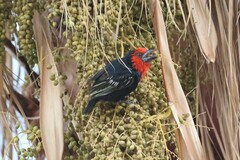
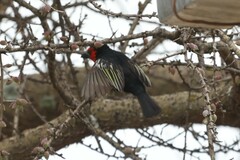
The black-billed barbet (Lybius guifsobalito) is a species of bird in the Lybiidae family. This species has an extremely large range in the Afrotropical realm. It is present in Cameroon, northeastern Democratic Republic of the Congo, Eritrea, from eastern Sudan to western Ethiopia, western Kenya, northern Tanzania, and Uganda.

These birds occur at altitudes between 900 and 2,200 meters above sea level, in open forests, forest edges, woodland vegetation, savannah, scrubs, gardens and cultivated areas with fruit-bearing trees. Lybius guifsobalito can reach a wingspan of 7.9–9.4 cm (3.1–3.7 in) in males. The tail length is between 4.5 and 5.4 centimeters. The beak reaches a length between 1.9 and 2.2 centimeters. Females have similar body measurements, without noticeable sexual dimorphism.

Males and femalesof these medium-sized barbets are glossy blue-black, the wings and the belly are a little more brown. They also have a bright red or red-orange face, throat and upper chest. The upperwing are narrowly lined with yellow to white. The beak is rather strong and black, the featherless skin of the face is gray, the eyes are reddish brown... Wikipedia →

Sounds

Duet0:15

Ethiopia · 2015

© Peter Boesman · XC300440 · CC BY-NC-ND 4.0

Call0:19

Ethiopia · 2014

© Andrew Spencer · XC216063 · CC BY-NC-SA 4.0

Global Distribution

Parks Where Found

# Park Country Daily sighting probability
1 Murchison Falls National Park 🇺🇬 Uganda
~30%
2 Awash National Park 🇪🇹 Ethiopia
~20%
3 Kidepo Valley National Park 🇺🇬 Uganda
~10%

Before you go

What are the chances of seeing a Black-billed Barbet in Kidepo Valley National Park?

With luck

About 10% of wildlife watchers report a Black-billed Barbet sighting in Kidepo Valley National Park on a given day, based on 26 verified sightings from GBIF citizen-science data from 2019 to 2026. It is the 181st most-seen of the 332 birds we can rate there. Over three days the chance rises to about 20%, and over a week to about 40%, if each day is a fresh chance.

When is the best time to see a Black-billed Barbet in Kidepo Valley National Park?

September

In that month about 20% of wildlife watchers report a Black-billed Barbet in Kidepo Valley National Park on a given day, against under 5% in March, July–August, October and December, the lowest months. April and May have too few records to rate.

What time of day is best to see a Black-billed Barbet?

Between 7 and 10 am

Across all the parks we cover, that three-hour window holds the most Black-billed Barbet sightings with a recorded time, and about 9 in 10 of them come between 6 am and 6 pm: it is a daytime animal.

Is Kidepo Valley National Park the best place to see a Black-billed Barbet?

3rd of 3

Of the 3 parks where we can rate Black-billed Barbet sightings, Kidepo Valley National Park ranks 3rd at about 10%. The best odds are in Murchison Falls National Park (Uganda, about 30%) and Awash National Park (Ethiopia, about 20%).

Which relatives of the Black-billed Barbet live in Kidepo Valley National Park?

Same genus: Lybius

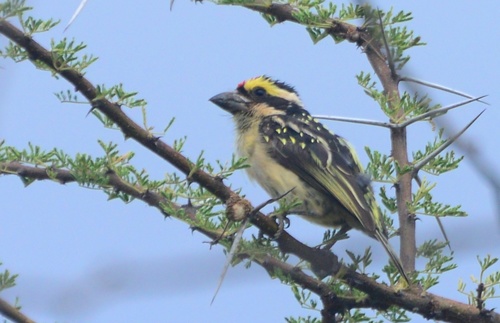
The closest relatives of the Black-billed Barbet that you can see in Kidepo Valley National Park (genus Lybius, Typical African Barbets) are White-headed Barbet (about 20%) and Black-Breasted Barbet (about 20%), with each one's daily chance of a sighting.

Where does the Black-billed Barbet sighting chance come from?

GBIF citizen-science records

It is estimated from how often the Black-billed Barbet is recorded against all the birds logged in Kidepo Valley National Park (26 verified sightings from 2019 to 2026), calibrated against known sighting rates. Figures are rounded to the nearest 10% because citizen-science data supports honest approximations, not decimals, and months with records from fewer than five people show "—". How it works.

← Back to Kidepo Valley National Park