
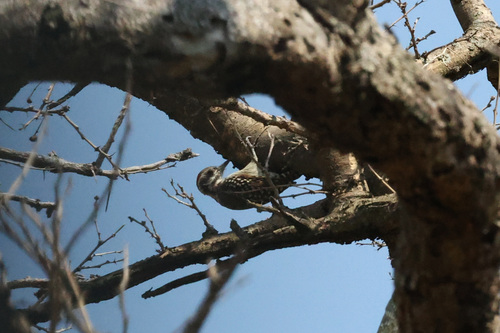
African Grey Woodpecker

African Grey Woodpecker

Dendropicos goertae

Silhouette: Pepe Reigada · PhyloPic

LCLeast ConcernNTVUENCR
Daily sighting probability <5% · Rare
at Kidepo Valley National Park

In 3 days ~10% in a week ~20%

10 Verified sightings at Kidepo Valley National Park From 2019 to 2026
759 In all 9 parks
September Best month
☀️ Diurnal When it's spotted

About the African Grey Woodpecker

The African grey woodpecker (Dendropicos goertae) is a species of bird in the woodpecker family Picidae. Is a widespread and frequently common resident breeder in much of Sub-Saharan and equatorial Africa. It is a species associated with forest and bush which nests in a tree hole, often in an oil palm, laying two to four eggs. It is a common bird with a very wide range, and the International Union for Conservation of Nature has rated its conservation status as being of "least concern".

The African grey woodpecker was described by the German zoologist Philipp Ludwig Statius Müller in 1776 from a specimen collected in Senegal. He coined the binomial name Picus goertae. The specific epithet is from the French polymath Comte de Buffon who noted that "Goërtan" was the name used for the species in Senegal. The species was also illustrated in a set of plates that accompanied Brisson's work. The African grey woodpecker is now placed in the genus Dendropicos that was introduced by the French ornithologist Alfred Malherbe in 1849.

Five subspecies are recognised: Wikipedia →

Sounds

Call0:05

Guinea-Bissau · 2020

© Joost van Bruggen · XC694629 · CC BY-NC-ND 4.0

Song0:10

Senegal · 2024

© Frank Lambert · XC1041360 · CC BY-NC-ND 4.0

Recording1:28

Nigeria · 2020

© Sun Madakan · XC598602 · CC BY-NC-SA 4.0

Global Distribution

Parks Where Found

# Park Country Daily sighting probability
1 Niokolo-Koba National Park 🇸🇳 Senegal
~30%
2 Murchison Falls National Park 🇺🇬 Uganda
~20%
3 Queen Elizabeth National Park 🇺🇬 Uganda
~10%
4 Kibale National Park 🇺🇬 Uganda
~10%
5 Lake Mburo National Park 🇺🇬 Uganda
~10%
6 Kidepo Valley National Park 🇺🇬 Uganda
<5%
7 Serengeti National Park 🇹🇿 Tanzania
<5%
8 Bwindi Impenetrable National Park 🇺🇬 Uganda
<5%
9 Ngorongoro Conservation Area 🇹🇿 Tanzania
<5%

Cities Where Found

# City Country Daily sighting probability
1 Serrekunda 🇬🇲 Gambia
~40%
2 Ouagadougou 🇧🇫 Burkina Faso
~30%
3 Maiduguri 🇳🇬 Nigeria
~20%
4 Accra 🇬🇭 Ghana
~20%
5 Abuja 🇳🇬 Nigeria
~10%
6 Kampala 🇺🇬 Uganda
~10%
7 Freetown 🇸🇱 Sierra Leone
~10%
8 Brazzaville 🇨🇬 Republic of the Congo
~10%
9 Dakar 🇸🇳 Senegal
<5%
10 Kigali 🇷🇼 Rwanda
<5%

Before you go

What are the chances of seeing an African Grey Woodpecker in Kidepo Valley National Park?

Rare

Under 5% of wildlife watchers report an African Grey Woodpecker sighting in Kidepo Valley National Park on a given day, based on 10 verified sightings from GBIF citizen-science data from 2019 to 2026. It is the 256th most-seen of the 332 birds we can rate there. Over three days the chance rises to about 10%, and over a week to about 20%, if each day is a fresh chance.

When is the best time to see an African Grey Woodpecker in Kidepo Valley National Park?

September and October

In those months about 10% of wildlife watchers report an African Grey Woodpecker in Kidepo Valley National Park on a given day, against under 5% in June–August and November–March, the lowest months. April and May have too few records to rate.

What time of day is best to see an African Grey Woodpecker?

Between 10 am and 1 pm

Across all the parks we cover, that three-hour window holds the most African Grey Woodpecker sightings with a recorded time, and about 9 in 10 of them come between 6 am and 6 pm: it is a daytime animal.

Where does the African Grey Woodpecker sighting chance come from?

GBIF citizen-science records

It is estimated from how often the African Grey Woodpecker is recorded against all the birds logged in Kidepo Valley National Park (10 verified sightings from 2019 to 2026), calibrated against known sighting rates. Figures are rounded to the nearest 10% because citizen-science data supports honest approximations, not decimals, and months with records from fewer than five people show "—". How it works.

← Back to Kidepo Valley National Park