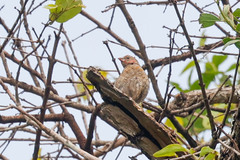
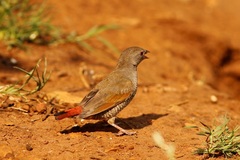
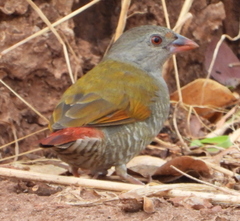
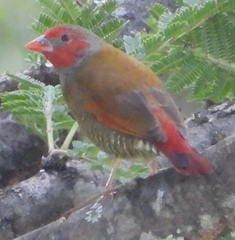

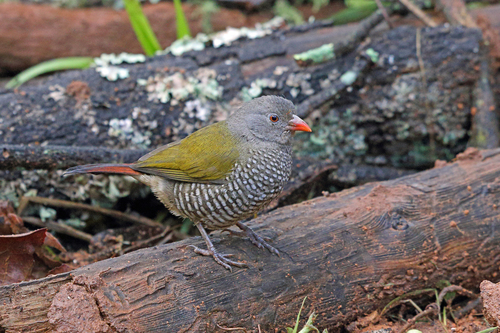
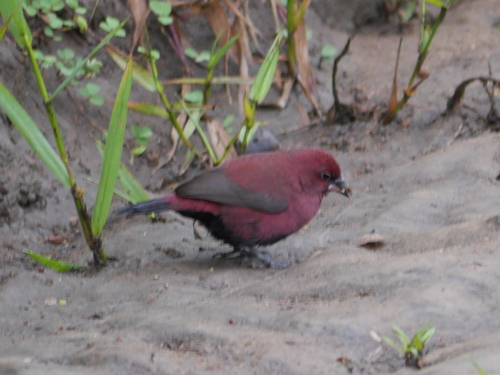
Orange-winged Pytilia

Orange-winged Pytilia

Pytilia afra

Silhouette: Sheatherius · PhyloPic

LCLeast ConcernNTVUENCR
Daily sighting probability <5% · Rare
at Kidepo Valley National Park

In 3 days ~10% in a week ~20%

9 Verified sightings at Kidepo Valley National Park From 2019 to 2026
69 In all 6 parks
September Best month
☀️ Diurnal When it's spotted

About the Orange-winged Pytilia

The orange-winged pytilia (Pytilia afra), also known as the golden-backed pytilia, is a species of estrildid finch found in Africa. It has a wide range and the International Union for Conservation of Nature has assessed it as being of least concern.

The orange-winged pytilia was formally described in 1789 by the German naturalist Johann Friedrich Gmelin in his revised and expanded edition of Carl Linnaeus's Systema Naturae. He placed it with the finches in the genus Fringilla and coined the binomial name Fringilla afra. Gmelin gave the locality as Angola. The specific epithet is from Latin afer meaning "Africa". Gmelin based his account on the "red-faced finch" that had been described and illustrated in 1776 by the English naturalist Peter Brown. The orange-winged pytilia is now one of five pytilias placed in the genus Pytilia that was introduced in 1837 by the English naturalist William Swainson. The species is monotypic: no subspecies are recognised.

The orange-winged pytilia is 11 cm (4.3 in) long and weighs 14–15 g (0.49–0.53 oz). The male's forehead, face and chin are red, and its crown and nape are grey. Its back is green, with an olive tinge.... Wikipedia →

Sounds

Call0:06

Tanzania · 2014

© Thibaut Chansac · XC200765 · CC BY-NC-SA 4.0

Global Distribution

Parks Where Found

# Park Country Daily sighting probability
1 Meru National Park 🇰🇪 Kenya
~10%
2 Mikumi National Park 🇹🇿 Tanzania
~10%
3 Kidepo Valley National Park 🇺🇬 Uganda
<5%
4 Kafue National Park 🇿🇲 Zambia
<5%
5 Hwange National Park 🇿🇼 Zimbabwe
<5%
6 South Luangwa National Park 🇿🇲 Zambia
<5%

Zoos & Centres Where Found

# Zoo / Centre Country
1 Berlin Zoological Garden 🇩🇪 Germany In captivity
2 Aquarium Berlin 🇩🇪 Germany In captivity

Before you go

What are the chances of seeing an Orange-winged Pytilia in Kidepo Valley National Park?

Rare

Under 5% of wildlife watchers report an Orange-winged Pytilia sighting in Kidepo Valley National Park on a given day, based on 9 verified sightings from GBIF citizen-science data from 2019 to 2026. It is the 269th most-seen of the 332 birds we can rate there. Over three days the chance rises to about 10%, and over a week to about 20%, if each day is a fresh chance.

When is the best time to see an Orange-winged Pytilia in Kidepo Valley National Park?

September

In that month about 10% of wildlife watchers report an Orange-winged Pytilia in Kidepo Valley National Park on a given day, against under 5% in June–August and October–March, the lowest months. April and May have too few records to rate.

What time of day is best to see an Orange-winged Pytilia?

Between 8 and 11 am

Across all the parks we cover, that three-hour window holds the most Orange-winged Pytilia sightings with a recorded time, and about 9 in 10 of them come between 6 am and 6 pm: it is a daytime animal.

Is Kidepo Valley National Park the best place to see an Orange-winged Pytilia?

3rd of 6

Of the 6 parks where we can rate Orange-winged Pytilia sightings, Kidepo Valley National Park ranks 3rd at under 5%. The best odds are in Meru National Park (Kenya, about 10%) and Mikumi National Park (Tanzania, about 10%).

Which relatives of the Orange-winged Pytilia live in Kidepo Valley National Park?

Same genus: Pytilia

The closest relatives of the Orange-winged Pytilia that you can see in Kidepo Valley National Park (genus Pytilia, Pytilias) are Red-winged Pytilia (about 10%) and Green-winged Pytilia (about 10%), with each one's daily chance of a sighting.

Where does the Orange-winged Pytilia sighting chance come from?

GBIF citizen-science records

It is estimated from how often the Orange-winged Pytilia is recorded against all the birds logged in Kidepo Valley National Park (9 verified sightings from 2019 to 2026), calibrated against known sighting rates. Figures are rounded to the nearest 10% because citizen-science data supports honest approximations, not decimals, and months with records from fewer than five people show "—". How it works.

← Back to Kidepo Valley National Park