Black-sided Flowerpecker

Black-sided Flowerpecker

Dicaeum monticolum

Silhouette: Rachael Joakim · PhyloPic

LCLeast ConcernNTVUENCR
Daily sighting probability ~50% · Likely
at Kinabalu Park

In 3 days ~90% in a week >90%

1,668 Verified sightings at Kinabalu Park From 2019 to 2026
1,668 In 1 park
July Best month
🌅 Crepuscular When it's spotted

About the Black-sided Flowerpecker

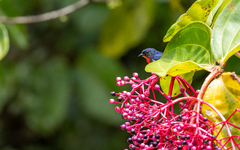
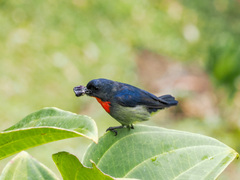
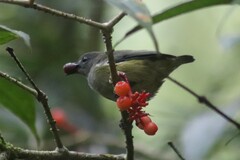
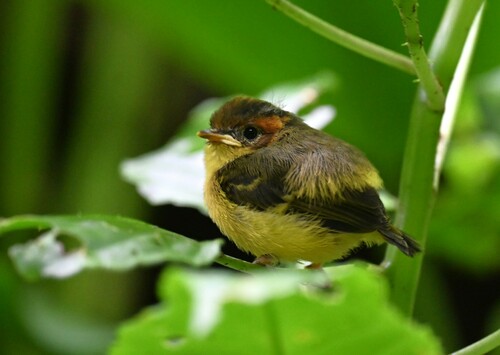
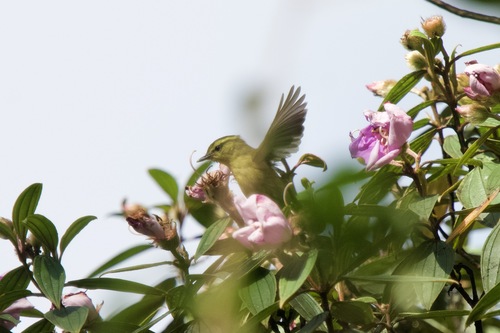
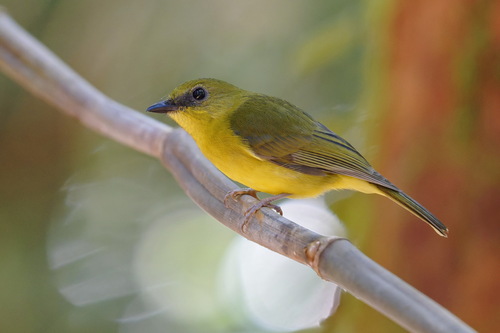
The black-sided flowerpecker (Dicaeum monticolum), also known as the Bornean flowerpecker, is a species of bird in the family Dicaeidae. It is endemic to the island of Borneo, where it is found in the mountains, primarily above 1,000 m (3,300 ft) in elevation. The species is sexually dimorphic. The male has glossy blue-black upperparts, with a scarlet throat and breast, a dark grey upper belly, olive flanks, a white lower belly, and a buffy vent and undertail coverts. The female is olive-green above and greyish below, with buffy flanks and a whitish throat. It inhabits a range of forest habitats, including primary and secondary montane forest, kerangas forest, and scrub, and is also occasionally found in gardens. It feeds primarily on small fruits—particularly mistletoe berries—as well as seeds, nectar, and various invertebrates. It builds a nest of moss, camouflaged on the outside with lichens and lined with the pith of tree ferns. The International Union for Conservation of Nature rates it as a species of least concern. Though its numbers have not been quantified, the black-sided flowerpecker is said to be common throughout much of its range, and any declines are not thought to be precipitous. However, destruction of forest for palm plantations may impact it. Wikipedia →

Sounds

Call0:39

Indonesia · 2026

© Kim Chuah Lim · XC1175511 · CC BY-NC-SA 4.0

Song1:28

Malaysia · 2014

© Mike Nelson · XC205403 · CC BY-NC-SA 4.0

Call0:08

Malaysia · 2025

© Nick Talbot · XC1035503 · CC BY-NC-SA 4.0

Global Distribution

Parks Where Found

# Park Country Daily sighting probability
1 Kinabalu Park 🇲🇾 Malaysia
~50%

More parks will be added in future updates.

Before you go

What are the chances of seeing a Black-sided Flowerpecker in Kinabalu Park?

Likely

About 50% of wildlife watchers report a Black-sided Flowerpecker sighting in Kinabalu Park on a given day, based on 1,668 verified sightings from GBIF citizen-science data from 2019 to 2026. It is the 13th most-seen of the 247 birds we can rate there. Over three days the chance rises to about 90%, and over a week to over 90%, if each day is a fresh chance.

When is the best time to see a Black-sided Flowerpecker in Kinabalu Park?

March and July–August

In those months about 60% of wildlife watchers report a Black-sided Flowerpecker in Kinabalu Park on a given day, against about 40% in January and November, the lowest months.

What time of day is best to see a Black-sided Flowerpecker?

Between 2 and 5 am

Across all the parks we cover, that three-hour window holds the most Black-sided Flowerpecker sightings with a recorded time, and about 6 in 10 of them come between 6 pm and 6 am: it is most active around dawn and dusk.

Where else can you see a Black-sided Flowerpecker?

Only Kinabalu Park, in our data

Kinabalu Park is the only park on Wallace's Line with enough records to rate Black-sided Flowerpecker sightings: about 50% of wildlife watchers there report one on a given day.

Where does the Black-sided Flowerpecker sighting chance come from?

GBIF citizen-science records

It is estimated from how often the Black-sided Flowerpecker is recorded against all the birds logged in Kinabalu Park (1,668 verified sightings from 2019 to 2026), calibrated against known sighting rates. Figures are rounded to the nearest 10% because citizen-science data supports honest approximations, not decimals, and months with records from fewer than five people show "—". How it works.

← Back to Kinabalu Park