Chestnut-hooded Laughingthrush

Chestnut-hooded Laughingthrush

Garrulax treacheri

LCLeast ConcernNTVUENCR
Daily sighting probability ~80% · Very likely
at Kinabalu Park

In 3 days >90%

2,826 Verified sightings at Kinabalu Park From 2019 to 2026
2,826 In 1 park
July Best month
☀️ Diurnal When it's spotted

About the Chestnut-hooded Laughingthrush

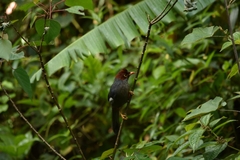
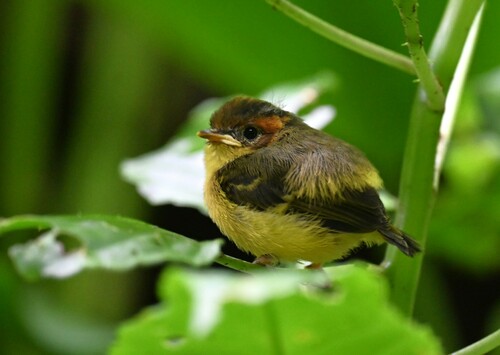
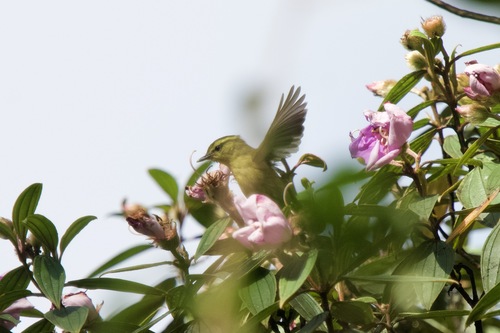
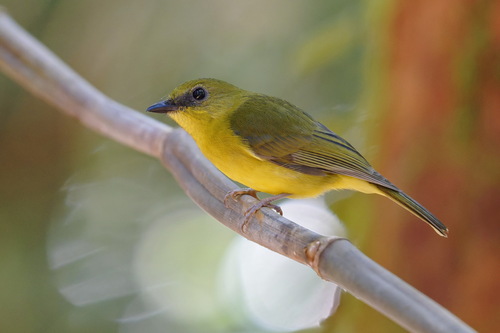
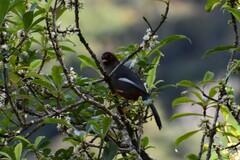
The chestnut-hooded laughingthrush (Pterorhinus treacheri) is a species of bird in the laughingthrush family Leiothrichidae endemic to Borneo. Described by the British ornithologist Richard Bowdler Sharpe as a distinct species in 1879, it was subsequently considered a subspecies of the chestnut-capped laughingthrush until 2007, when it was again raised to species status by the ornithologists Nigel Collar and Craig Robson. It is 22–24 cm (8.7–9.4 in) long, with a chestnut brown head and chin, with grey feathering on the top of the head. The upperparts and the side of the neck are slaty-grey, with a long white wing patch. The throat, breast, and upper belly are dull yellowish-brown, with purer grey flanks and a reddish-brown vent, lower belly, and thighs. It has a yellow half eye-ring behind and below the eye, while the tail has a blackish tip. Both sexes look similar, while juveniles are duller than adults.

The species inhabits montane and hill forest, forest edge, disturbed vegetation, and cultivated areas in mountains in the north-central and southeastern parts of Borneo. It is mainly found at elevations of 600–2,800 m (2,000–9,200 ft), but can be found down to 200 m (660 ft) and as high as 3,350 m (10,990 ft). It is omnivorous, feeding on arthropods, fruit, and flowers. Breeding occurs from February to April and in October, with the species building cup nests and laying clutches of two bright blue to greenish-blue eggs. It is classified as being of least concern by the International Union for Conservation of Nature due to its very large range, fairly large population, and a lack of significant population decline, but its numbers are thought to be decreasing and it is threatened by habitat destruction and habitat fragmentation. Wikipedia →

Sounds

Call1:01

Malaysia · 2026

© Ding Li Yong · XC1102855 · CC BY-NC-ND 4.0

Uncertain0:05

Malaysia · 2025

© Nick Talbot · XC1038528 · CC BY-NC-SA 4.0

Song1:16

Malaysia · 2016

© Daniel Hinckley · XC561634 · CC BY-NC-SA 4.0

Global Distribution

Parks Where Found

# Park Country Daily sighting probability
1 Kinabalu Park 🇲🇾 Malaysia
~80%

More parks will be added in future updates.

Before you go

What are the chances of seeing a Chestnut-hooded Laughingthrush in Kinabalu Park?

Very likely

About 80% of wildlife watchers report a Chestnut-hooded Laughingthrush sighting in Kinabalu Park on a given day, based on 2,826 verified sightings from GBIF citizen-science data from 2019 to 2026. It is the most-seen of the 247 birds we can rate there. Over three days the chance rises to over 90%, if each day is a fresh chance.

When is the best time to see a Chestnut-hooded Laughingthrush in Kinabalu Park?

July

In that month about 90% of wildlife watchers report a Chestnut-hooded Laughingthrush in Kinabalu Park on a given day, against about 70% in April–June, September and December–January, the lowest months.

What time of day is best to see a Chestnut-hooded Laughingthrush?

Between 6 and 9 am

Across all the parks we cover, that three-hour window holds the most Chestnut-hooded Laughingthrush sightings with a recorded time, and about 9 in 10 of them come between 6 am and 6 pm: it is a daytime animal.

Where else can you see a Chestnut-hooded Laughingthrush?

Only Kinabalu Park, in our data

Kinabalu Park is the only park on Wallace's Line with enough records to rate Chestnut-hooded Laughingthrush sightings: about 80% of wildlife watchers there report one on a given day.

Where does the Chestnut-hooded Laughingthrush sighting chance come from?

GBIF citizen-science records

It is estimated from how often the Chestnut-hooded Laughingthrush is recorded against all the birds logged in Kinabalu Park (2,826 verified sightings from 2019 to 2026), calibrated against known sighting rates. Figures are rounded to the nearest 10% because citizen-science data supports honest approximations, not decimals, and months with records from fewer than five people show "—". How it works.

← Back to Kinabalu Park