Bornean Stubtail

Bornean Stubtail

Urosphena whiteheadi

Silhouette: Sheatherius · PhyloPic

LCLeast ConcernNTVUENCR
Daily sighting probability ~40% · Likely
at Kinabalu Park

In 3 days ~70% in a week >90%

963 Verified sightings at Kinabalu Park From 2019 to 2026
963 In 1 park
September Best month
🌙 Nocturnal When it's spotted

About the Bornean Stubtail

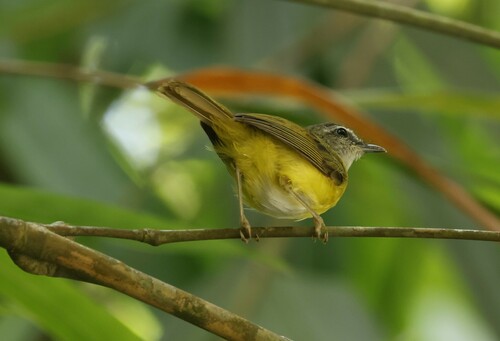
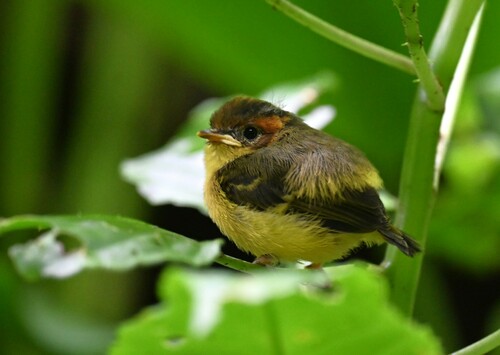
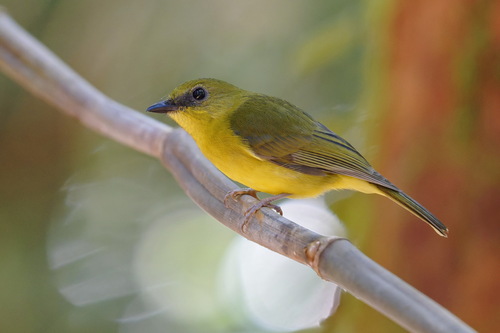
The Bornean stubtail (Urosphena whiteheadi) is a species of bird in the cettiid warbler family Cettiidae. It is endemic to the island of Borneo, where it inhabits forest floors and undergrowth in montane forests at elevations of 750–3,150 m (2,460–10,330 ft). It is a small, short-tailed warbler, measuring 9.5–10 cm (3.7–3.9 in) in length and having an average mass of 10.4 g (0.37 oz). The tops of the head and the upperparts are brown, with whitish underparts that turn grey at the sides of the breast and the flanks. The supercilium (stripe above the eye) is long and buffish-brown, with an equally long dark grey eyestripe (stripe through the eye) and a thin yellow eye-ring. Both sexes are similar.

The species feeds on invertebrates, especially green aphids, foraging in a mouse-like manner on the ground and in undergrowth. Nests are made out of reddish plant fibres, with incubation taking 24 days on average. It is classified as being of least concern by the International Union for Conservation of Nature due to its sufficiently large range and stable population.

The Bornean stubtail was described as Orthnocichla whiteheadi by the British ornithologist Richard... Wikipedia →

Sounds

Call0:36

Malaysia · 2022

© Lim Ying Hien · XC841667 · CC BY-NC-ND 4.0

Song0:45

Malaysia · 2023

© Daan Drukker · XC828017 · CC BY-NC-SA 4.0

Song0:16

Malaysia · 2018

© Hans Matheve · XC520275 · CC BY-NC-ND 4.0

Global Distribution

Parks Where Found

# Park Country Daily sighting probability
1 Kinabalu Park 🇲🇾 Malaysia
~40%

More parks will be added in future updates.

Before you go

What are the chances of seeing a Bornean Stubtail in Kinabalu Park?

Likely

About 40% of wildlife watchers report a Bornean Stubtail sighting in Kinabalu Park on a given day, based on 963 verified sightings from GBIF citizen-science data from 2019 to 2026. It is the 30th most-seen of the 247 birds we can rate there. Over three days the chance rises to about 70%, and over a week to over 90%, if each day is a fresh chance.

When is the best time to see a Bornean Stubtail in Kinabalu Park?

February–March and May–October

In those months about 40% of wildlife watchers report a Bornean Stubtail in Kinabalu Park on a given day, against about 30% in April and November–January, the lowest months.

What time of day is best to see a Bornean Stubtail?

Between midnight and 3 am

Across all the parks we cover, that three-hour window holds the most Bornean Stubtail sightings with a recorded time, and about 7 in 10 of them come between 6 pm and 6 am: it is mostly seen at night.

Where else can you see a Bornean Stubtail?

Only Kinabalu Park, in our data

Kinabalu Park is the only park on Wallace's Line with enough records to rate Bornean Stubtail sightings: about 40% of wildlife watchers there report one on a given day.

Which relatives of the Bornean Stubtail live in Kinabalu Park?

Same family: Cettiidae

The closest relatives of the Bornean Stubtail that you can see in Kinabalu Park (family Cettiidae, Bush Warblers and Allies) are Mountain Tailorbird (about 50%), Aberrant Bush-Warbler (about 40%) and Yellow-bellied Warbler (about 10%), with each one's daily chance of a sighting.

Where does the Bornean Stubtail sighting chance come from?

GBIF citizen-science records

It is estimated from how often the Bornean Stubtail is recorded against all the birds logged in Kinabalu Park (963 verified sightings from 2019 to 2026), calibrated against known sighting rates. Figures are rounded to the nearest 10% because citizen-science data supports honest approximations, not decimals, and months with records from fewer than five people show "—". How it works.

← Back to Kinabalu Park