Fruit-hunter

Fruit-hunter

Chlamydochaera jefferyi

Silhouette: Francesco "Architetto" Rollandin · PhyloPic

LCLeast ConcernNTVUENCR
Daily sighting probability ~10% · With luck
at Kinabalu Park

In 3 days ~40% in a week ~70%

381 Verified sightings at Kinabalu Park From 2019 to 2026
381 In 1 park
September Best month
☀️ Diurnal When it's spotted

About the Fruit-hunter

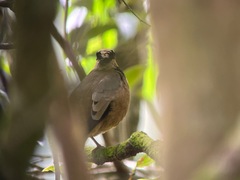
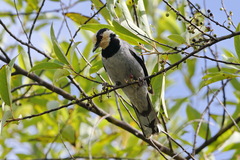
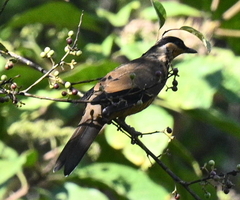
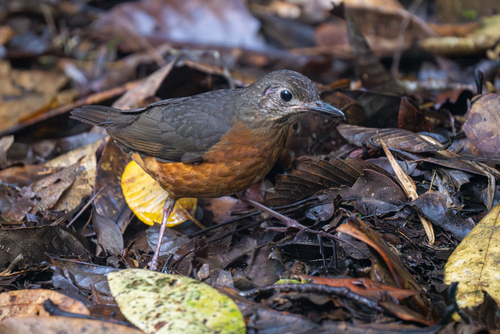
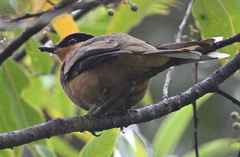
The fruithunter or fruit-hunter (Chlamydochaera jefferyi), also known as the black-breasted fruit-hunter, is an enigmatic species of bird currently placed with the typical thrushes in the family Turdidae. It is native to the Borneo montane rain forests.

It is highly distinct from other thrushes, instead being convergent to Corvoidea such as trillers (Lalage) or true orioles (Oriolus). Thus it is placed in a monotypic genus Chlamydochaera. It was formerly called the black-breasted triller and placed within the family Campephagidae. Its breeding biology has only been recently detailed. The female fruithunter broods and incubates the two eggs that are laid, and the male assists in feeding the nestlings.

The fruithunter is not considered a threatened species by the IUCN. This species was first described in 1887 by Richard Bowdler Sharpe based on specimens of a male and female collected on Mount Kinabalu. Wikipedia →

Sounds

Call?0:20

Malaysia · 2008

© Hans Matheve · XC520313 · CC BY-NC-ND 4.0

Call0:25

Malaysia · 2019

© Brendan Sloan · XC490218 · CC BY-NC-ND 4.0

Song0:29

Malaysia · 2009

© Mike Nelson · XC38752 · CC BY-NC-SA 3.0

Global Distribution

Parks Where Found

# Park Country Daily sighting probability
1 Kinabalu Park 🇲🇾 Malaysia
~10%

More parks will be added in future updates.

Before you go

What are the chances of seeing a Fruit-hunter in Kinabalu Park?

With luck

About 10% of wildlife watchers report a Fruit-hunter sighting in Kinabalu Park on a given day, based on 381 verified sightings from GBIF citizen-science data from 2019 to 2026. It is the 56th most-seen of the 247 birds we can rate there. Over three days the chance rises to about 40%, and over a week to about 70%, if each day is a fresh chance.

When is the best time to see a Fruit-hunter in Kinabalu Park?

August to October

In those months about 20% of wildlife watchers report a Fruit-hunter in Kinabalu Park on a given day, against about 10% in November to July, the lowest months.

What time of day is best to see a Fruit-hunter?

Between 7 and 10 am

Across all the parks we cover, that three-hour window holds the most Fruit-hunter sightings with a recorded time, and about 9 in 10 of them come between 6 am and 6 pm: it is a daytime animal.

Where else can you see a Fruit-hunter?

Only Kinabalu Park, in our data

Kinabalu Park is the only park on Wallace's Line with enough records to rate Fruit-hunter sightings: about 10% of wildlife watchers there report one on a given day.

Where does the Fruit-hunter sighting chance come from?

GBIF citizen-science records

It is estimated from how often the Fruit-hunter is recorded against all the birds logged in Kinabalu Park (381 verified sightings from 2019 to 2026), calibrated against known sighting rates. Figures are rounded to the nearest 10% because citizen-science data supports honest approximations, not decimals, and months with records from fewer than five people show "—". How it works.

← Back to Kinabalu Park