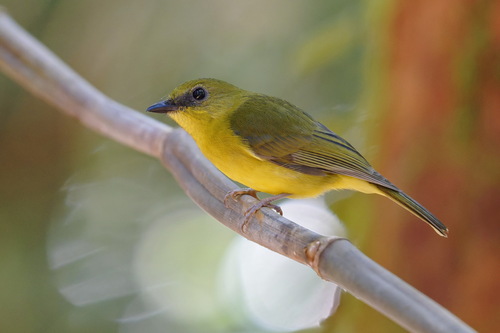
Mountain Blackeye

Mountain Blackeye

Chlorocharis emiliae

Silhouette: Ferran Sayol · PhyloPic

Daily sighting probability ~30% · Possible
at Kinabalu Park

In 3 days ~60% in a week ~90%

788 Verified sightings at Kinabalu Park From 2019 to 2026
788 In 1 park
July Best month
🌅 Crepuscular When it's spotted

About the Mountain Blackeye

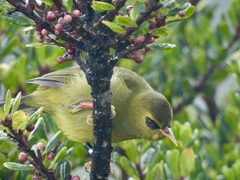
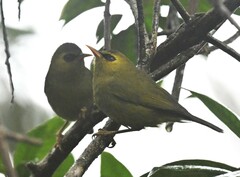
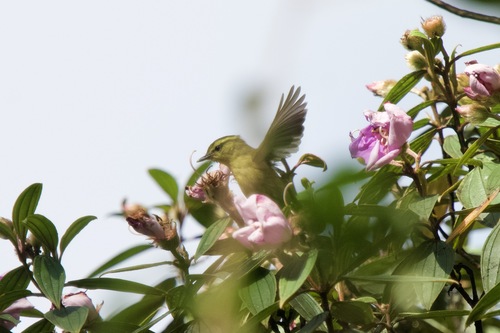
The mountain blackeye (Zosterops emiliae), sometimes referred to as the olive blackeye or simply black-eye, is a species of passerine bird in the family Zosteropidae. It is endemic to the highest mountains on the island of Borneo. It is known from both Malaysian states on the island, and four of the five Indonesian provinces, but has never been recorded in Brunei. Typically found at elevations above 1,800 m (5,900 ft), the mountain blackeye sometimes moves to lower altitudes during periods of drought. There are four subspecies, which show clinal variations in size and coloring. Birds in the north are largest, darkest, and proportionately longer-tailed, while those further south are smaller, paler, and proportionately shorter-tailed. Adults are dark olive-green with a sharply-pointed, bright yellow-orange bill and a small dark mask connecting black lores with a black eye-ring. The subspecies show varying amounts of yellow in their plumage, particularly on the face and underparts. Young birds resemble their parents, but have less brightly colored bills.

It feeds on insects, nectar, pollen, and small fruits, and is a major pollinator of several species of Rhododendron. It is also a minor partner in a symbiotic relationship with the pitcher-plant Nepenthes lowii. Little is known about its breeding ecology. Its nest is a shallow cup made of rootlets and lined with bits of moss. The female lays a single egg, and the nestling takes 14–15 days to fledge after hatching. The International Union for Conservation of Nature lists it as a species of least concern. Although its population has not been quantified, it is very common across much of its range. Wikipedia →

Global Distribution

Parks Where Found

# Park Country Daily sighting probability
1 Kinabalu Park 🇲🇾 Malaysia
~30%

More parks will be added in future updates.

Before you go

What are the chances of seeing a Mountain Blackeye in Kinabalu Park?

Possible

About 30% of wildlife watchers report a Mountain Blackeye sighting in Kinabalu Park on a given day, based on 788 verified sightings from GBIF citizen-science data from 2019 to 2026. It is the 37th most-seen of the 247 birds we can rate there. Over three days the chance rises to about 60%, and over a week to about 90%, if each day is a fresh chance.

When is the best time to see a Mountain Blackeye in Kinabalu Park?

July

In that month about 50% of wildlife watchers report a Mountain Blackeye in Kinabalu Park on a given day, against about 10% in April–May and November–February, the lowest months.

What time of day is best to see a Mountain Blackeye?

Between 1 and 4 am

Across all the parks we cover, that three-hour window holds the most Mountain Blackeye sightings with a recorded time, and about 7 in 10 of them come between 6 pm and 6 am: it is most active around dawn and dusk.

Where else can you see a Mountain Blackeye?

Only Kinabalu Park, in our data

Kinabalu Park is the only park on Wallace's Line with enough records to rate Mountain Blackeye sightings: about 30% of wildlife watchers there report one on a given day.

Which relatives of the Mountain Blackeye live in Kinabalu Park?

Same family: Zosteropidae

The closest relatives of the Mountain Blackeye that you can see in Kinabalu Park (family Zosteropidae, White-eyes, Yuhinas, and Allies) are Black-capped White-eye (about 60%), Chestnut-crested Yuhina (about 60%) and Pygmy Ibon (about 10%), with each one's daily chance of a sighting.

Where does the Mountain Blackeye sighting chance come from?

GBIF citizen-science records

It is estimated from how often the Mountain Blackeye is recorded against all the birds logged in Kinabalu Park (788 verified sightings from 2019 to 2026), calibrated against known sighting rates. Figures are rounded to the nearest 10% because citizen-science data supports honest approximations, not decimals, and months with records from fewer than five people show "—". How it works.

← Back to Kinabalu Park