
Sunda Cuckoo

Sunda Cuckoo

Cuculus lepidus

Silhouette: Nicolas Huet le Jeune and Jean-Gabriel Prêtre (vectorized by T. Michael Keesey) · PhyloPic

LCLeast ConcernNTVUENCR
Daily sighting probability ~20% · Possible
at Kinabalu Park

In 3 days ~40% in a week ~70%

455 Verified sightings at Kinabalu Park From 2019 to 2026
495 In all 2 parks
May Best month
☀️ Diurnal When it's spotted

About the Sunda Cuckoo

The Sunda cuckoo or Sunda lesser cuckoo (Cuculus lepidus) is a South-east Asian bird belonging to the genus Cuculus in the cuckoo family, Cuculidae. It was formerly classified with the Himalayan cuckoo (C. saturatus) and Oriental cuckoo (C. optatus) in a single species, C. saturatus, but is now often regarded as a separate species based on differences in voice, size and plumage.

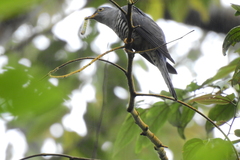
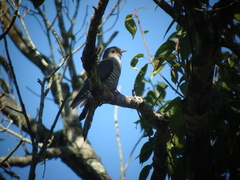
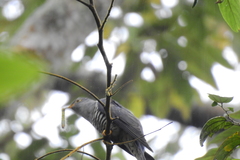
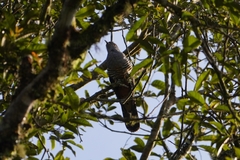
It is 29–30 cm long. The upperparts, throat and upper breast are dark grey. The rest of the underparts are buff with black bars. The tail is blackish with white spots. The female also occurs in a rufous form which has reddish-brown upperparts, paler underparts and black barring both above and below. The Himalayan cuckoo and Oriental cuckoo are similar to the Sunda cuckoo but paler with less buff-coloured underparts and narrower black bars.

The song of the Sunda cuckoo usually consists of a short first note followed by two or three longer and lower "hoop" notes. The whole song is higher-pitched than that of the Himalayan cuckoo which gives three or four "hoop" notes.

It was first described as a species in 1845 by the German naturalist Salomon Müller. In 1940 it was included in... Wikipedia →

Sounds

Call0:29

Malaysia · 2025

© Lim Ying Hien · XC1004719 · CC BY-NC-ND 4.0

Song0:33

Malaysia · 2024

© Wai Loon Wong · XC900274 · CC BY-NC-SA 4.0

Call0:30

Malaysia · 2018

© Jason Bugay Reyes · XC446518 · CC BY-NC-SA 4.0

Global Distribution

Parks Where Found

# Park Country Daily sighting probability
1 Kinabalu Park 🇲🇾 Malaysia
~20%
2 Kerinci Seblat National Park 🇮🇩 Indonesia
~10%

Before you go

What are the chances of seeing a Sunda Cuckoo in Kinabalu Park?

Possible

About 20% of wildlife watchers report a Sunda Cuckoo sighting in Kinabalu Park on a given day, based on 455 verified sightings from GBIF citizen-science data from 2019 to 2026. It is the 51st most-seen of the 247 birds we can rate there. Over three days the chance rises to about 40%, and over a week to about 70%, if each day is a fresh chance.

When is the best time to see a Sunda Cuckoo in Kinabalu Park?

May

In that month about 40% of wildlife watchers report a Sunda Cuckoo in Kinabalu Park on a given day, against under 5% in August to October, the lowest months.

What time of day is best to see a Sunda Cuckoo?

Between 8 and 11 am

Across all the parks we cover, that three-hour window holds the most Sunda Cuckoo sightings with a recorded time, and about 7 in 10 of them come between 6 am and 6 pm: it is a daytime animal.

Is Kinabalu Park the best place to see a Sunda Cuckoo?

Yes

Of the 2 parks where we can rate Sunda Cuckoo sightings, Kinabalu Park has the highest daily chance: about 20%. Next come Kerinci Seblat National Park (Indonesia, about 10%).

Where does the Sunda Cuckoo sighting chance come from?

GBIF citizen-science records

It is estimated from how often the Sunda Cuckoo is recorded against all the birds logged in Kinabalu Park (455 verified sightings from 2019 to 2026), calibrated against known sighting rates. Figures are rounded to the nearest 10% because citizen-science data supports honest approximations, not decimals, and months with records from fewer than five people show "—". How it works.

← Back to Kinabalu Park