Whitehead's Spiderhunter

Whitehead's Spiderhunter

Arachnothera juliae

Silhouette: Sheatherius · PhyloPic

LCLeast ConcernNTVUENCR
Daily sighting probability ~20% · Possible
at Kinabalu Park

In 3 days ~40% in a week ~70%

426 Verified sightings at Kinabalu Park From 2019 to 2026
426 In 1 park
March Best month
🌅 Crepuscular When it's spotted

About the Whitehead's Spiderhunter

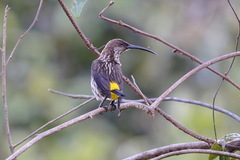
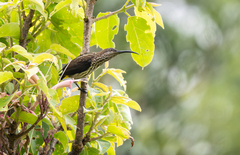
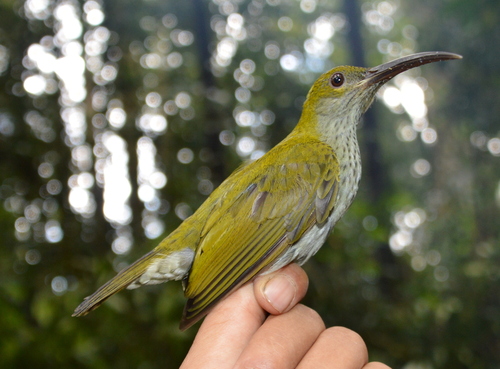
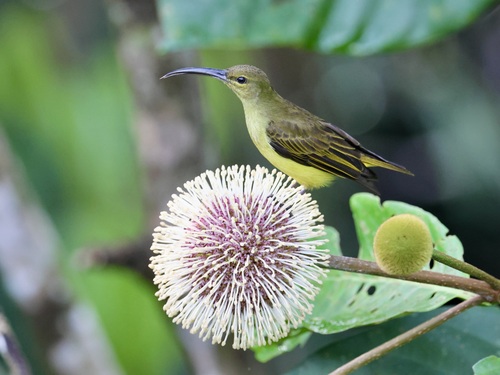
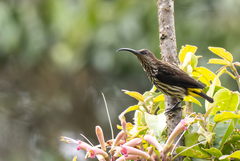
Whitehead's spiderhunter (Arachnothera juliae) is a species of spiderhunter in the sunbird and spiderhunter family Nectariniidae. It is endemic to Borneo, where it is found in the mountain ranges in the north-central part of the island. It inhabits hill dipterocarp forest, primary and secondary montane forest, and forest edge at elevations of 930–3,000 m (3,050–9,840 ft). A large and distinctive spiderhunter, the species is mostly brown with profuse whitish streaking all over the body and bright yellow vents and uppertail coverts. Both sexes are similar in appearance, but males are larger, with a length of 16.5–18 cm (6.5–7.1 in) compared to a length of 15.5–16.5 cm (6.1–6.5 in) for females. The juvenile plumage is unknown.

The species feeds on small arthropods, berries, and nectar, foraging alone, in pairs, or in small flocks of up to five birds. It breeds from March to at least August, making bark-lined nests in hollows it excavates in naturally occurring clumps of moss, vegetation, and roots. This nest is unique within its genus and is shared only with the closely related yellow-eared and naked-faced spiderhunters. Clutches consist of two chicks, which are fed berries and arthropods. It is listed as being of least concern by the International Union for Conservation of Nature, but is experiencing a population decline caused by habitat destruction. Wikipedia →

Sounds

Song0:18

Malaysia

© Craig Robson · XC19423 · CC BY-NC-ND 2.5

Call0:05

Malaysia · 2025

© Nick Talbot · XC1018220 · CC BY-NC-SA 4.0

Call1:08

Malaysia · 2015

© Mike Nelson · XC244092 · CC BY-NC-SA 4.0

Global Distribution

Parks Where Found

# Park Country Daily sighting probability
1 Kinabalu Park 🇲🇾 Malaysia
~20%

More parks will be added in future updates.

Before you go

What are the chances of seeing a Whitehead's Spiderhunter in Kinabalu Park?

Possible

About 20% of wildlife watchers report a Whitehead's Spiderhunter sighting in Kinabalu Park on a given day, based on 426 verified sightings from GBIF citizen-science data from 2019 to 2026. It is the 52nd most-seen of the 247 birds we can rate there. Over three days the chance rises to about 40%, and over a week to about 70%, if each day is a fresh chance.

When is the best time to see a Whitehead's Spiderhunter in Kinabalu Park?

March

In that month about 40% of wildlife watchers report a Whitehead's Spiderhunter in Kinabalu Park on a given day, against about 10% in May–June and August–February, the lowest months.

What time of day is best to see a Whitehead's Spiderhunter?

Between midnight and 3 am

Across all the parks we cover, that three-hour window holds the most Whitehead's Spiderhunter sightings with a recorded time, and about 6 in 10 of them come between 6 pm and 6 am: it is most active around dawn and dusk.

Where else can you see a Whitehead's Spiderhunter?

Only Kinabalu Park, in our data

Kinabalu Park is the only park on Wallace's Line with enough records to rate Whitehead's Spiderhunter sightings: about 20% of wildlife watchers there report one on a given day.

Which relatives of the Whitehead's Spiderhunter live in Kinabalu Park?

Same genus: Arachnothera

The closest relatives of the Whitehead's Spiderhunter that you can see in Kinabalu Park (genus Arachnothera, Typical Spiderhunters) are Little Spiderhunter (about 10%) and Bornean Spiderhunter (about 10%), with each one's daily chance of a sighting.

Where does the Whitehead's Spiderhunter sighting chance come from?

GBIF citizen-science records

It is estimated from how often the Whitehead's Spiderhunter is recorded against all the birds logged in Kinabalu Park (426 verified sightings from 2019 to 2026), calibrated against known sighting rates. Figures are rounded to the nearest 10% because citizen-science data supports honest approximations, not decimals, and months with records from fewer than five people show "—". How it works.

← Back to Kinabalu Park